

Lesson 1245: The Impact of Motivational Instability on Long-Term Goals

Duration:70 minutes
Topic Introduction:This section explains how unstable motivation can affect long-term goals. Short-term emotional fluctuations can cause you to rush ahead one moment and stop completely the next. By using tiered goals and flexible milestones, long-term direction is less likely to be swallowed up by short-term states. Allow yourself time to learn. Understanding one thing today is enough. Don't rush to change everything. Put safety first. Gentle observation is more helpful than blame.
○ Course Topic Audio
Lesson 1245: The Impact of Motivational Instability on Long-Term Goals
Click to view the read-aloud text
Now, gently turn your attention back to yourself. Today we'll learn about "The Impact of Motivational Instability on Long-Term Goals." We'll understand the impact of motivational instability on long-term goals, learn about tiered goals and flexible milestones, and prevent our direction from being swallowed up by short-term fluctuations. If you find your emotions sometimes slightly rising and sometimes slowly falling, don't immediately interpret it as a lack of willpower, unstable personality, or insufficient effort. The difficulty of cyclothymic mood disorder is often not a sudden loss of control, but rather a long-term, subtle, and recurring fluctuation: for a period of time you are more thoughtful, more social, and more likely to commit; for another period of time you become tired, procrastinate, withdraw, or even doubt yourself. If these changes occur repeatedly, they deserve to be gently observed and recorded. Try looking back at the past week or month: Is your sleep regular? Have your wake-up and bedtimes shifted significantly? Has your workload fluctuated? Have you over-planned, made impromptu decisions, socialized excessively, or suddenly withdrawn, avoided, or found it difficult to start? These clues are not meant to criticize you, but rather signals to help you take care of yourself earlier. In this exercise, you can start by choosing a small anchor point: a fixed wake-up time, a regular mealtime, reducing one impromptu commitment, minimizing phone use before bed, or recording your emotions for the day in ten minutes. If emotional fluctuations affect your sleep, work, relationships, or lead to dangerous behavior or self-harming thoughts, please contact professional support immediately. You don't need to change everything today; simply being willing to recognize a pattern, protect a rhythm, and perform a small, gentle action is already a step towards stability. Allow yourself time; stability doesn't happen overnight. You can treat this exercise as a gentle self-observation, not an exam. If you feel tired after hearing this, please drink some water and feel the ground beneath your feet. Every act of recording and seeking help paves a small step towards your future self. Allow yourself time; stability doesn't happen overnight. You can treat this exercise as a gentle self-observation, not an exam. If you feel tired after hearing this, please drink some water and feel the ground beneath your feet.

AI Healing Q&A
The AI-powered healing Q&A section helps you clarify your questions about "the impact of unstable motivation on long-term goals." During the interaction, you can describe recent changes in your mood, sleep, energy, behavior, and your most feared consequences. The AI will gently organize your clues to help you find a small, actionable step; however, it cannot replace doctors, psychologists, or crisis intervention. If there is a risk of self-harm, please contact offline professional resources immediately. After your Q&A session, please jot down one observation and a small care action you can perform today. Take it slow.

○ Music therapy guidance
The guided music therapy section can help you maintain a gentle connection when your motivation fluctuates. Please choose a stable, non-overly emotional piece of music as a transition before returning to your long-term goals. Don't demand immediate motivation while listening; simply feel the small things you can still do today. The music can remind you that consistency doesn't equal daily intensity. After listening, write down a small step to make your goals more gentle and accessible.

○Eastern and Western Healing Teas
○ Western Healing Tea: Rose Tea. Introduction: Rose tea is believed to have mood-soothing, stress-relieving, and calming effects. Its petals are rich in antioxidants, which help alleviate low mood caused by depression or anxiety, and improve mental health. Instructions: Steep 1 teaspoon of rose petals in hot water for 5-10 minutes. Honey can be added before drinking. Drinking 1-2 cups daily can help relieve stress and improve mood.
○ Healing Recipes
○ Japanese Dietary Therapy: Tofu Skin and Lettuce Soup (Light and Heartwarming)
Recommended dishes:Bean curd and lettuce soup (light and comforting) Recommended reasons:Tofu skin and lettuce soup is a light, gentle, and easy-to-make Japanese therapeutic dish, suitable for stabilizing mild mood swings in cyclical mood disorder programs. It doesn't emphasize strong flavors or intense stimulation, but rather uses refreshing, low-calorie ingredients to help the body gradually return to a manageable rhythm during highs and lows. When addressing the topic of "the impact of unstable motivation on long-term goals," this dietary approach reminds you that emotions can be observed, and the body deserves gentle care. Recipe (1–2 servings): practice: When preparing a clear soup with tofu skin and lettuce, first place the ingredients separately on a plate and observe their color, shape, and aroma. This process can help you gradually shift your focus from emotional fluctuations, overthinking, or feeling down and sluggish back to what you are doing. Don't strive for perfection while cooking; just slow down and breathe more deeply. Before taking your first bite, remind yourself: I am gently supporting my body's rhythm for the day with a simple meal. If you're in a good mood today, slow down your movements and reduce the number of steps; if you're in a bad mood, simplify your cooking to the easiest version possible. Food is not a task, but a gentle support for your mind and body. Video Title:Tofu Skin and Lettuce Soup: A Refreshing and Calming Japanese Dietary Recipe hint:Please understand diet within the overall care plan: regular sleep, stable schedule, professional support, mood journaling, and necessary treatment remain important foundations for the long-term management of cyclothymia.Click to view healing recipes
◉ Japanese Dietary Therapy: Tofu Skin and Lettuce Soup (Light and Heartwarming)
I. Recommended Dietary Therapy and Reasons
2. Recipe and Method
3. Small rituals for body and mind
4. Dietary Therapy Experience Record
V. Instructional Videos (approximately 3–5 minutes)
6. Precautions

○Mandala Healing
The Mandala Healing section helps you maintain a gentle connection when your motivation fluctuates. Observe the recurring patterns in the mandala; a sense of stability doesn't need to be intense, but can be built up gradually. While observing, don't demand immediate motivation; simply ask yourself what small step you can take towards your goal today. If you feel anxious or discouraged, bring your gaze back to the center. After finishing, write down a small, achievable action.
● AI Dynamic Geometric Vision Focus and Emotion Regulation Engine ●
AI Dynamic Geometric Vision Focus and Emotion Regulation Engine · v7.0.0
Before we begin, I'd like to know how you feel right now.
There is no standard answer; just choose the one that best reflects how you feel right now.
The experience is over. Tell us how you feel now.
There is still no standard answer; just choose the one that best reflects how you feel right now.
#FF5252
After the fluorescent line crawling is completed and stopped, first select a color, then click on the closed area in the graphic to fill in the color.
AI Digital Mandala Static Focus EngineAZ Image Coloring · 60 Colors
AI Digital Mandala Interactive Focus Engine
A–Z Free Selection · Layered Lines · 60 Color Fills

○ Calligraphy and engraving therapy practice
The calligraphy and engraving therapy practice section helps you maintain a gentle connection when your motivation fluctuates. The practice phrase is consistently "slowly organize," without specifying any particular goal; simply feel how each stroke slowly continues. Stability doesn't have to be intense; it can be very light. If you don't have much motivation today, just write a little. After finishing writing, remind yourself: continuity isn't about forcing yourself, but about gently returning time and time again.

○ Art Therapy Guidance
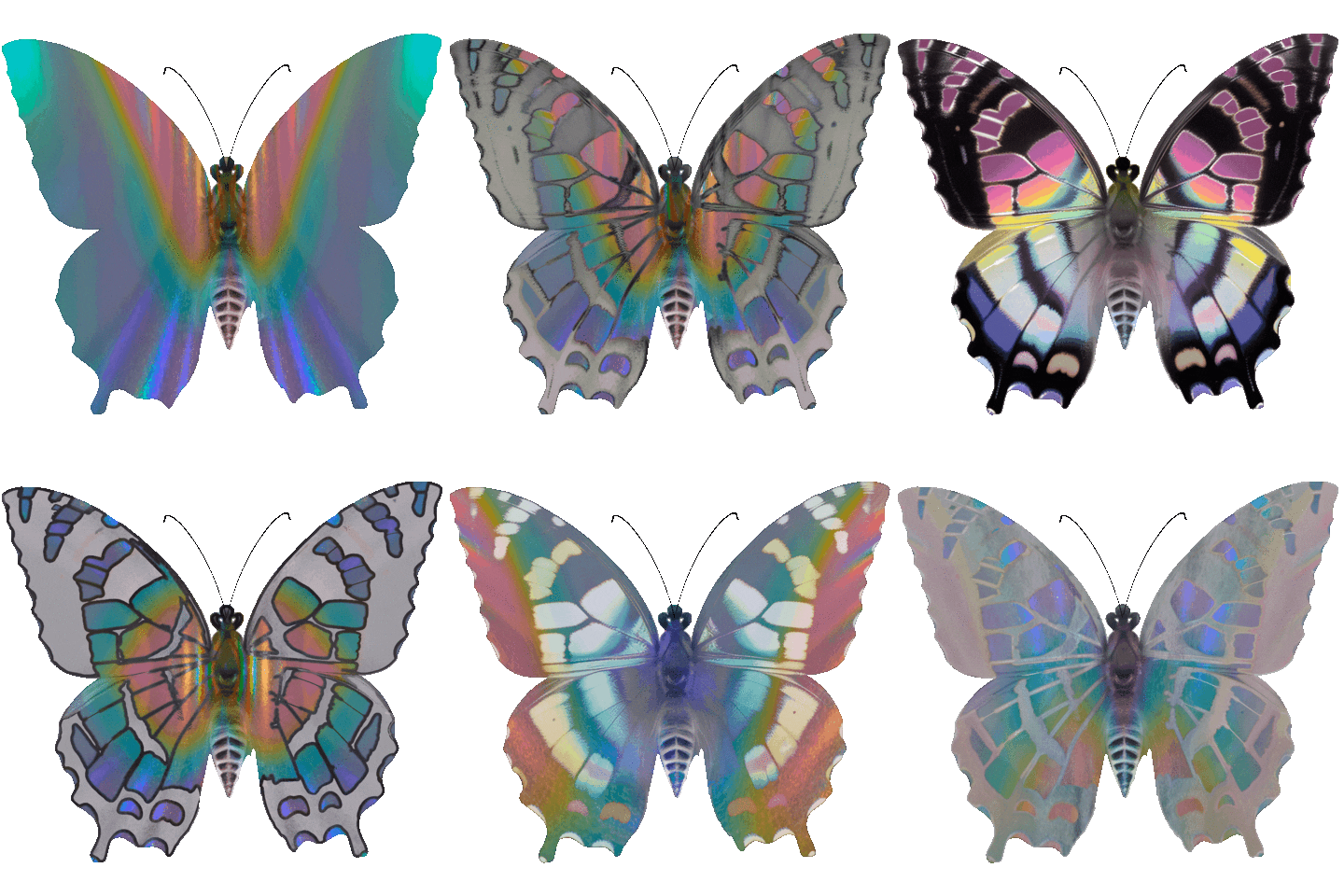
The art therapy guidance section helps you draw out your fluctuating motivations. You can use broken lines, varying shades of color, or different perspectives to represent these changes, and then find a small point that you can still approach today. Don't try to be powerful while drawing; just make the goal soft and accessible. If discouragement arises, lighten the colors. After you're finished, look back and see which part represents a small step forward.
Please log in before submitting your drawings and feelings.

○ Diary Healing Suggestions
Journaling therapy suggestion: Please write down the most impactful point from today's lesson. Perhaps it's realizing that long-term goals cannot rely solely on a single burst of strong motivation, but rather require gentle, stable, and repeatable small steps. Also, write down one small action you're willing to try, such as taking only the smallest step towards your goal today. Don't negate your direction just because of low motivation while journaling. Finally, write: I can gradually approach my desired destination without a sprint.
Please log in to use.
May you gradually return to a more stable, clear-headed, and gentler version of yourself through today's practice.