

Lesson 1009: Inner Dialogue and Positive Self-Suggestion
Duration:75 minutes
Topic Introduction (Overview):
Following acute stress or traumatic events, people's inner dialogue often subtly shifts: from their usual rational, gentle, and logical language to rapid, negative, blaming, and catastrophic self-monologues. For example, phrases like "It's all my fault," "I can't take it anymore," "I should be stronger," and "I'm doomed"—these are not facts, but rather survival language amplified by stress. Like a recurring shadow in the mind, they weaken your ability to face reality. The core of this course is to help you rebuild a stable, healthy, and supportive inner language system, allowing you to maintain a psychological anchor during turbulent times.
Positive self-suggestion is not about "forcing optimism" or ignoring pain, but rather a psychological technique that allows you to continue breathing and remaining steadfast amidst emotional storms. It's more like a mandala observation exercise: not redrawing your emotions, but quietly observing the patterns, rhythms, and repetitions of your inner language, gradually transforming chaotic self-criticism into stable, slow, and supportive self-responses. When you can see your inner dialogue, you can begin to change it. When you can change it, you can regain your strength.
▲ AI Interaction: Recognizing Your "Inner Voice"“
Please write down the inner monologue that has appeared most frequently in the past 48 hours, such as: "I'm afraid something bad will happen again," "I'm not good enough," "I can't hold on."
Then write: Whose voice does this sentence sound like most? A past experience? Or some great fear?
Finally, try writing a gentler but more truthful version of this sentence, such as: "I'm under a lot of pressure right now, but I'm trying to protect myself."“
Click the button to practice "Internal Language Rewriting" with AI.
○ Inner Language · Music Guidance
Choose a piece of instrumental music with a soothing rhythm and warm strings, and slow down the pace of your inner language.
Ask yourself three questions while listening to music:
① What's the loudest thought in my head right now?
② Does it stem from fear, stress, or unhealed memories?
③ Can I replace it with a more realistic version that better supports me?
Let music be a "buffer zone," slowing down self-criticism and allowing awareness to emerge.
🍵 Herbal Healing Teas: A "Temperature Regulator" for Your Inner Language“
Recommended tea recipe:Rose + Chamomile + Lemon Balm
This combination of three can alleviate chest tightness, reduce sympathetic nerve excitation during self-criticism, and make it easier for you to "talk to yourself properly."
Drinking tip: Smell the aroma for three seconds before drinking to allow the fragrance to become the first step in your psychological comfort.
○ German Whole Grain Therapy: A Dietary Structure that Helps Stabilize Inner Language
When internal dialogue is rapid, negative, or chaotic, the body is often in a state of energy discontinuity, leading to "brain energy deficiency," which in turn reinforces negative self-talk. German whole grain therapy emphasizes maintaining a stable energy supply to the brain with whole grains, low-GI cereals, and is particularly suitable for people who frequently engage in self-criticism and experience sudden mood swings.
We recommend incorporating a whole-grain calming porridge into your breakfast or lunch: rye porridge, oatmeal porridge, buckwheat porridge, or mixed grain porridge. The warm, slow, and grounding energy will help slow down your inner dialogue.
Healing Recipes
/home2/lzxwhemy/public_html/arttao_org/wp-content/uploads/cookbook/kao-hong-shu-pei-hei-dou.html(Please confirm that the file has been uploaded: kao-hong-shu-pei-hei-dou.html)
🎨 Dream Mandala Healing · Mi Xiangwen 1009 · The Center of Sound
In your dream, you stand in a huge circular hall, surrounded by different sounds: some people are weeping softly, some are shouting angrily, and some are gently comforting you, but you can't tell where these sounds are coming from. You close your eyes and slowly focus your attention on the ground beneath your feet.
You discover that the sounds are like layers of mandala lines, gradually converging inward from the outer ring of noise. You follow the trajectory of the sounds to the center, where there is only a faint but steady voice: "You are still here, you are still trying." The mandala is not about drawing something, but about observing—observing that faintest but most authentic supportive voice within your heart.

○ Running script - Writing positive suggestive sentences
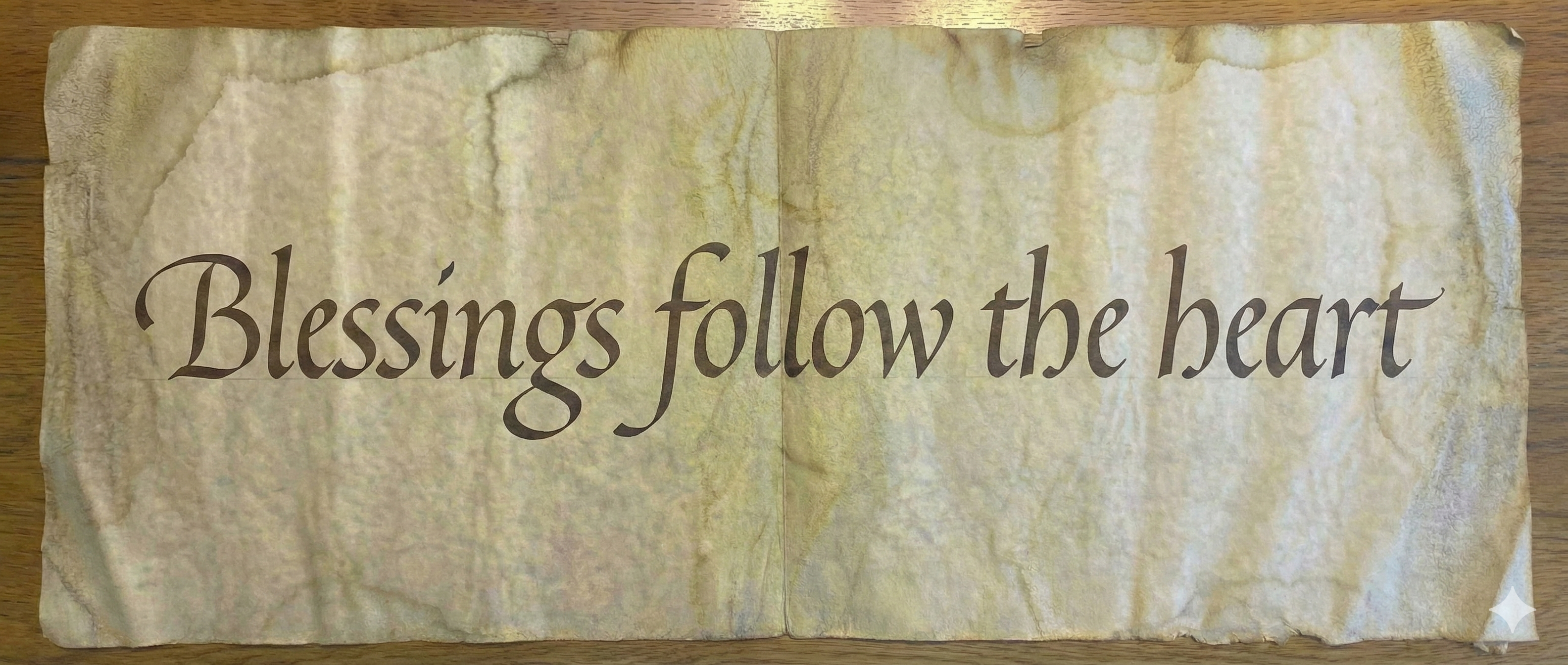
The continuous strokes of running script are suitable for practicing a stable and gentle inner rhythm of language.
- Sentence writing:I deserve to be treated kindly, and I deserve to treat myself kindly as well.
- English equivalent:I deserve kindness, especially from myself.
- hint:When writing the character "善" (goodness), one should deliberately slow down, allowing the arc of the hand to give the heart a buffer.
Lesson 1009: Inner Dialogue & Guided Drawing
Objective: To make "inner language" a visible image.
Steps: Draw a concentric circle mandala on a piece of paper. Write down your recent negative self-talk in the outermost circle; write down the "true facts" in the middle circle; and write down a gentle phrase you hope to say to yourself in the future in the innermost circle. Finally, observe which circle is the most jarring and which is the most calming, making the act of observing itself the starting point for change.
Please log in before submitting your drawings and feelings.
○ 1009. Inner Dialogue and Positive Suggestions: Journaling Guidance Suggestions
① Write down the three most frequent self-talk phrases that popped into your head today, and label them as "fear/stress/habit".
② Write a more realistic and gentler alternative sentence for each sentence.
③ Write down "What did my body feel when I heard these gentle words?"“
④ What is the one thing you most want someone to say to you today? You can say it yourself.
⑤ Conclusion: Your inner language is the first environment you create for yourself each day.
Please log in to use.
When you are willing to talk to yourself properly, you build the most solid bridge for recovery.
 EN
EN  ZH
ZH  ES
ES  FR
FR  JA
JA