

Lesson 101: The Difference Between Specific Fears and Generalized Anxiety
Duration:70 minutes
Topic Introduction:
Specific fears and generalized anxiety are often confused, but their triggers, ways of experiencing them, and physical reactions are quite different.
Specific phobia is "an acute fear that suddenly increases when encountering a certain object or situation";
Generalized anxiety is like a "24/7 background noise of worry," without a specific object and with persistent high tension.
This lesson will help you clearly identify and more accurately understand your own experience and training direction.
How to distinguish between the two? Their core mechanisms are quite different.
- Different trigger points:Specific fears = specific objects (heights, dogs, elevators, needles); generalized anxiety = "worry that is everywhere".
- Different bodily reactions:Specific fears are an acute peak; generalized anxiety is a long-term, energy-consuming tension.
- Different approaches:Specific fears are classified by exposure level; generalized anxiety is classified by cognitive regulation and life stability.
Lesson 101: The Difference Between Specific Fears and Generalized Anxiety, Click to listen to the reading and view the content.
Many people, experiencing prolonged tension and anxiety, confuse specific phobias with generalized anxiety, feeling as if they are afraid of everything yet unable to pinpoint the true source. Understanding the difference between the two helps you more accurately recognize your own state and avoid wasting your energy using incorrect methods. Specific phobias are directed at a specific object or situation, such as an animal, a high place, an enclosed space, injection, or a specific social scene. When you encounter these cues, the fear is quickly triggered, while your emotions remain relatively stable when you are away from them. The fear exhibits a clear on/off characteristic, and the physical reaction is highly focused. Generalized anxiety, on the other hand, is not attached to a single object but is a persistent state of worry. You may feel tense even without a clear threat, constantly rehearsing future risks in your mind, and your body remains in a state of constant alert, making it difficult to truly relax. From a psychological perspective, specific phobias stem more from conditioned reflexes and learned memory, while generalized anxiety is closely related to tolerance for uncertainty and long-term cognitive patterns. The coping strategies for the two also differ. Specific phobias are better suited to graded exposure, allowing the body to relearn safety, while generalized anxiety requires attention to thought habits, emotional regulation, and daily rhythms simultaneously. Treating generalized anxiety as a single fear can feel overwhelming, while repeatedly analyzing a specific fear as part of a broader anxiety cycle might prolong the distress. The significance of this distinction isn't about labeling, but about focusing your energy in the right direction. You may experience both states simultaneously, but they are not the same and don't need to be treated the same way. When you begin to identify which type of anxiety is at play, the fear transforms from vague and oppressive into an understandable experience. Understanding itself is part of the adjustment process; it allows you to stop fighting against yourself and instead take more strategic care of your mind and body.
▲ AI Interaction: Which type of anxiety do you feel most?
Tell the AI: Are you only afraid when you encounter something, or are you tense every day?
AI will help you initially identify your anxiety type, giving you a clearer direction for your training.
You don't need to perfectly fit a certain type; hybrid types are very common.
Music can help your body discern whether it's an emergency or a time to slow down.
Let gentle melodies serve as a mental and physical cue to help you distinguish between different anxiety experiences.
○ Eastern Healing Tea - Longjing
Recommended drinks:Longjing green tea
Recommended reasons:It has a refreshing and invigorating effect, which helps keep the mind clear when identifying the type of anxiety.
practice:Brew with 80℃ hot water, gently inhale the aroma before drinking, and let your mind be brightened.
○ Stable Dietary Therapy: Sesame, Red Date, and Millet Porridge (ID101)
In a state of prolonged anxiety and fear, the body needs nourishment that is both soothing and gentle. The mild warmth of sesame helps calm the nervous system, while red dates provide a gentle sweetness and support. Millet aids digestion and overall rhythm. This calming porridge is suitable for consumption when learning to differentiate between types of anxiety or feeling internally confused, helping the body gradually return to clarity and peace. It symbolizes building a stable foundation for oneself after understanding differences.
Gentle nourishment
Clearly distinguish
Open Recipe
◉ Stable Dietary Therapy: Sesame, Red Date, and Millet Porridge (ID 101)
Sesame, red date, and millet porridge combines the soft, smooth texture of millet, the natural sweetness of red dates, and the subtle nutty aroma of black sesame seeds, creating a comforting and nourishing bowl of porridge. Millet porridge itself is warming and easily absorbed; red dates release their sweetness during cooking, making the porridge smoother; and black sesame seeds, added at the end, bring a gentle aroma and delicate texture to the entire bowl, offering a soothing experience that calms both body and mind with every bite. It's suitable as breakfast, a relaxing afternoon snack, or a light meal during recovery.
Warm and gentle Natural sweet aroma Lightly replenish energy
I. Recommended Dietary Therapy and Reasons
Recommended dishes:Sesame, red date, and millet porridge (ID 101)
Recommended reasons: Millet porridge is easy to digest and gently replenishes energy; red dates release a subtle sweetness, adding layers of flavor and providing a feeling of being cared for; the aroma of black sesame enhances satisfaction, making this porridge both light and substantial. The overall flavor is refreshing, non-greasy, and easy on the stomach, making it especially suitable for when you're feeling emotional, have a weak appetite, or want to slow down the pace of your day.
2. Recipe and Method
Recipe (1–2 servings):
- Xiaomi 40–50 g
- 3-4 red dates (remove the pits and slice them to release their flavor more easily)
- 500–600 ml of clean water
- 1–2 teaspoons of black sesame seeds (lightly toasted for better aroma)
- Add a little rock sugar or honey (optional, to enhance the sweetness).
- A pinch of salt (optional, for flavoring).
practice:
- Gently rinse the millet and soak it for 10 minutes; wash the red dates, remove the pits, and slice them for later use.
- Add water, millet, and red dates to a pot, bring to a boil over high heat, then reduce to low heat and simmer for 25–30 minutes.
- Stir occasionally to make the porridge smooth and even, and to prevent it from sticking to the bottom.
- If you prefer a thicker consistency, you can extend the cooking time; if you prefer a thinner consistency, you can add water to adjust.
- After turning off the heat, add black sesame seeds (you can lightly toast them beforehand to enhance the aroma) and gently mix well.
- You can add a little rock sugar or honey to sweeten it according to your preference; you can also add a pinch of salt to make the flavor more rounded.
- After serving in a bowl, sprinkle with a little extra sesame seeds for garnish, and it's ready to enjoy.
3. Small rituals for body and mind
While washing millet and processing red dates, I deliberately slowed down my movements and focused my attention on the tactile sensation of my hands, allowing my brain to switch out of a tense mode.
When cooking porridge, observe the gently rolling bubbles on the surface of the water and let yourself slowly relax along with your breathing.
Before taking the first bite, tell yourself, "I deserve this tenderness." Let this bowl of porridge be a quiet reminder.
4. Dietary Therapy Experience Record
- Record your emotional state while drinking (fatigue, depression, tension, need for comfort, etc.).
- Pay attention to the speed and extent of the warmth spreading in the stomach and chest.
- Observe whether there is any improvement in sleep, stress, and energy levels after drinking it for several consecutive days.
V. Instructional Videos (approximately 3–5 minutes)
◉ Video Title:Sesame, red date, and millet porridge – a bowl of gentle, sweet aroma for everyday comfort.
6. Precautions
- Red dates are quite sweet, so if you need to control sugar intake, you can reduce the amount used or omit any additional sweeteners.
- Black sesame seeds should be roasted and used immediately for the best aroma; it is not recommended to add too much at once to avoid making it too fragrant.
- Those with weak stomachs can cook the millet into a thinner, softer consistency by extending the cooking time.
hint:This recipe is for daily dietary reference only and does not replace medical advice. If you have any special health conditions, please consult a professional first.
○ Chinese Calligraphy - Running Script - Lesson 101 Writing Practice
The topic of this lesson:Specific fears vs. generalized anxiety: a distinction between specific points and generalized concerns
In-depth analysis:
Specific phobia is like a stone on the road, with a clear target (fear of dogs, fear of heights); while generalized anxiety disorder (GAD) is like a thick fog, pervasive and boundless, an excessive worry about every detail of life.
In the writing of running script, we emphasize“"Practical writing"”(The main body of the character) and“"False strokes"”(The connecting lines between characters).
Anxiety sufferers often exaggerate their imagined worries more than their actual events.
Practicing cursive script means learning to distinguish which stroke is the core that must be rewritten (specific problem) and which stroke is just a transition (background anxiety). Don't write dotted lines as solid lines.
Writing Instructions:
The beauty of running script lies in the interplay of emptiness and fullness.
When writing, the main strokes (horizontal and vertical) should be written full and powerful (representing the specific problems we need to deal with); while the connecting strokes should be written as thin as hair, light and graceful (representing those pervasive anxious thoughts).
If you find yourself writing thick, dark lines, it means you're expending too much energy on trivial worries. Try lifting your wrist to make those lines "lighter."
Written words:
Fortune follows your heart
Motivational words:
See clearly what the clouds are (illusory worries) and what the mountains are (real existence). When the wind comes, the clouds disperse, and the mountains and rivers are revealed.
Writing Tips:
When writing the character "云" (cloud), the upper part, the "雨" (rain) radical, should be written with ample coverage (symbolizing widespread anxiety), but the lower part, "云", should have a lively and agile turn, with the last dot gently flicked out, symbolizing the dispersal of pent-up anxiety like clouds and mist.
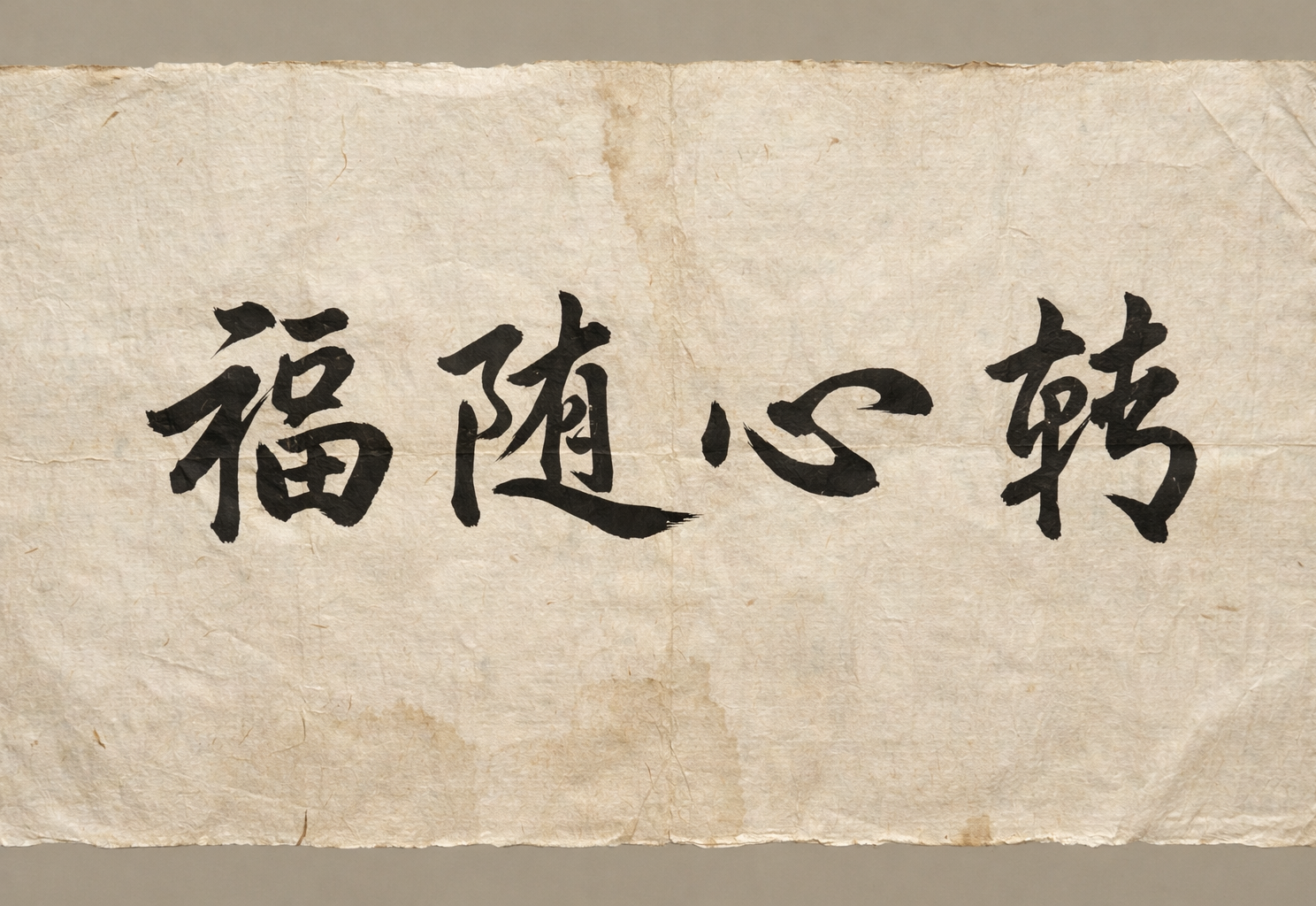
Image Healing: Mandala Stability Guidance 101
Look at this mandala. Its background is a light-colored, blurred grid (representing background noise of generalized anxiety), while the foreground features several clear, bright geometric shapes (representing specific objects of fear). Practice this visual separation: see that the specific shapes are finite and bounded, and they don't encroach on the entire background. The background exists, but it is blurred and receding. This visual exercise of "clear foreground, blurred background" helps the brain clarify the boundaries of anxiety.
Traditional mandalas typically feature a harmonious and intricately varied circular structure, symbolizing the wholeness of the universe and the cycle of life. By viewing mandala images, individuals can perceive inner peace and strength, achieving psychological balance.
◉ Gaze at the mandala twice, while taking deep breaths.

Lesson 101: Identifying My Anxiety Type (Guided Drawing)
① Action guidance:Draw a specific object (such as a shape or symbol) on the left side of the drawing paper to symbolize the concentration of a particular fear.
② Action guidance:The right side is drawn with diffused, flowing blocks of color or lines, representing a pervasive sense of anxiety, contrasting with the left side.
Please log in before submitting your drawings and feelings.
○ 101. Anxiety Type Identification · Journal-Guided Suggestions
① Which type of anxiety am I experiencing today? Concentrated or diffuse?
② Am I mistaking generalized anxiety for a specific fear? Or vice versa?
③ Which method helps me stabilize myself the most? (Breathing/Exposure/Recording/Pause)
④ Use 0–10 to describe today’s “identifiability”.
Please log in to use.
Clarity is the gentlest starting point for healing. Distinguishing between different types of anxiety is also a way of understanding oneself again.
 EN
EN  ZH
ZH  ES
ES  FR
FR  JA
JA