

Lesson 105: Safety Anchor Point Practice
Duration:70 minutes
Topic Introduction:
“"Safety anchors" refer to internal or external signals that can quickly pull you back to a stable state when anxiety rises.
It can be a sentence, an image, a touch, an action, or even a stable posture.
This lesson will teach you how to establish your own "emotional anchor point" to let your body know: I am not in danger, I can come back.
Why are safety anchors effective?
- Anchor points can break the cycle of fear:Interrupt the "disaster imagination" and turn to the real present.
- Anchor points have a direct effect on the body:Use touch, vision, or language to re-stabilize the nervous system.
- Anchor points can be repeatedly practiced into automatic responses:The more frequently you use it, the faster it will take effect.
Lesson 105: Safety Anchor Point Practice, Click to listen to the reading, View the content
The core of safety anchoring practice is not to make fear disappear, but to provide the body with a stable reference point to return to the present moment when fear arises. Many people feel swept away by their emotions, their thoughts spiraling out of control, and their bodies floating when anxious or fearful. This state is essentially the nervous system losing its anchor point. Safety anchors are the tools used to re-establish this anchoring. From a psychological and physiological perspective, when the brain cannot confirm safety, it continuously expands its range of alertness. The role of the anchor is to convey a clear message to the system: "I am safe here and now." Safety anchors can be bodily sensations or external cues, such as the weight of your feet on the ground, the rise and fall of your breath in your chest, the tactile sensation of an object in your hand, or a sound that makes you feel stable. The first step in the practice is to choose an anchor point in advance, rather than waiting until the fear is strongest, so that the body can quickly recall it when needed. The second step is to practice repeatedly in a low-intensity emotional state to establish a connection between the anchor point and the stable sensation—a conditioned learning process. The third step is to consciously bring your attention back to the anchor point when fear arises, rather than getting entangled in the content of the fear. It needs to be understood that anchors do not immediately make emotions disappear, but they prevent fear from escalating and allow you to regain regulatory space. The key to safe anchor point practice lies in simplicity and repeatability; the more complex it is, the harder it is to use in a state of high arousal. With increased practice, the body gradually learns that simply returning to the anchor point allows for slowing down. This ability is not about controlling emotions, but about coexisting with them. Safe anchor points do not weaken your sensitivity; rather, they enhance your ability to remain clear-headed amidst emotions. When you know you can always return to a stable position, fear is no longer the sole focus. The significance of safe anchor point practice is that it provides you with a way home in any situation.
▲ AI Interaction: What signals does your body need most to remind you "I am safe"?
Describe a picture, action, or sentence to the AI that makes you feel slightly relaxed.
AI will help you find personalized anchor points that suit your nervous system.
It also provides a "fast and stable version" for scenarios involving sudden anxiety.
A safe anchor point requires a “slow pace” as a backdrop for the body.
The rhythm of music can help the nervous system shift attention from a sense of danger back to the present moment.
○ Eastern Healing Tea - Tieguanyin (Lightly Roasted)
Recommended drinks:Lightly roasted Tieguanyin
Recommended reasons:The aroma is pleasant but not overpowering, and has the effect of "slowly returning the body to the midline position".
practice:Brew at 85–90℃, sip gently, and let the aroma of tea become your little "taste anchor".
○ Stable Dietary Therapy: Herb, Mushroom, and Oatmeal Warm Soup (ID105)
The stage of practicing anchoring and learning to stabilize bodily sensations requires a gentle yet supportive nourishment. Oatmeal helps the nervous system maintain a steady rhythm, the soft texture of mushrooms provides a feeling of being enveloped, and the aroma of herbs offers familiarity and comfort. This warm soup is suitable for consumption after practice or during emotional fluctuations, helping the body transform anchoring experiences into a lasting sense of security. It symbolizes that no matter how the external world changes, you can always return to a stable place.
Stabilize nerves
Continuous bearing
Open Recipe
◉ Stable Dietary Therapy: Herb, Mushroom, and Oat Soup (ID 105)
Herb, mushroom, and oat soup is a light yet comforting warm soup. The mushrooms slowly release their natural aroma, paired with smooth, delicate oats, creating a rich yet light flavor. Adding gentle herbs like rosemary and thyme makes the soup even cleaner, more soothing, and as calming as a deep breath. It's especially suitable for a relaxing day at work, a chilly evening, or when you're feeling a little restless – a warm and comforting meal to help you unwind.
Warming herbs Smooth Oatmeal Light and calming soup
I. Recommended Dietary Therapy and Reasons
Recommended dishes:Herb and Mushroom Oatmeal Soup (ID 105)
Recommended reasons: The umami flavor of the mushrooms gives the soup a naturally mellow and delicious taste, while the oats, after cooking, provide a smooth consistency—not too thick or overly filling, yet allowing both the stomach and mind to slowly calm down. The light aromas of rosemary and thyme make breathing easier and the chest feel lighter, as if gently catching you in the midst of a busy day. The entire soup requires almost no complicated seasoning to present a warm, refreshing, and calming flavor.
2. Recipe and Method
Recipe (Serves 2):
- 120–150 g of fresh mushrooms (either king oyster mushrooms or white mushrooms) (sliced)
- Instant oatmeal 30–40 g
- 1/6 onion (chopped)
- A small amount of minced garlic (optional)
- A small pinch of rosemary or thyme (fresh is better).
- 1 tsp olive oil
- 900 ml of water or light vegetable broth
- salt to taste
- A pinch of white pepper (optional)
practice:
- Add olive oil to a pan, sauté chopped onions over low heat until fragrant, then add sliced mushrooms and stir-fry until they release a little juice.
- Add rosemary or thyme to allow the aroma to fully blend with the mushrooms.
- Pour in water or vegetable broth, bring to a boil, then reduce heat and simmer for about 10 minutes.
- Add instant oats and simmer over low heat for 5–8 minutes, until the oats are fully expanded and the soup becomes smooth.
- Season with salt and a little white pepper to taste.
- Serve in a bowl, and garnish with a few slices of mushroom or a touch of herbs before enjoying.
3. Small rituals for body and mind
When stir-frying mushrooms, feel the process from their sizzling sound to the slow release of their aroma, just like the journey of emotions from tension to relaxation.
The moment the oatmeal boils, the soup becomes milder, reminding me that some things don't need to be rushed and will get better gradually.
When you take your first sip, you can gently tell yourself, "I deserve to be treated gently."“
4. Dietary Therapy Experience Record
- Record your mood and physical condition at the time of drinking (whether you feel tense, tired, or have an empty stomach).
- Observe the warmth, ease of breathing, and mental stability within 30–60 minutes after drinking.
- When consumed as a light evening soup for several consecutive days, subtle changes in sleep quality and relaxation levels can be recorded.
5. Tutorial Video (approximately 4–6 minutes)
◉ Video Title:Vanilla and Mushroom Oatmeal Soup: A bowl of gentle, light, and calming comfort.
6. Precautions
- Oatmeal will thicken if cooked for a long time; adjust the amount of water according to your personal taste.
- If you don't like chopped herbs, you can remove the herb sprigs after cooking the soup, leaving only the aroma.
- If you have a weak stomach, you can reduce the amount of garlic or omit it entirely.
hint:This soup is for daily health maintenance and does not replace any medical advice. If you have special dietary restrictions, please consult a professional.
○ · Chinese Calligraphy · Running Script · Lesson 105 Writing Practice
The topic of this lesson:Safety Anchor Point Practice – Finding the Stabilizing Force in Flow
In-depth analysis:
During an anxiety attack, a person may experience a feeling of "floating" or "loss of control." We need a "safe anchor" (such as touch or breathing) to stabilize ourselves.
In running script writing, this corresponds to“"Pause"”.
Many beginners focus only on speed when writing cursive script (which makes the characters appear frivolous and illegible).
A true master of running script knows to pause heavily at key turning points.
This "pause" is the anchor of the pen tip. It sinks into the paper, stabilizing the center of gravity of the entire character. Practicing this forceful pause is training the nervous system's ability to "land" at any time.
Writing Instructions:
In this lesson, please focus on the texture of "pressing".
When writing key points such as horizontal strokes and vertical hooks, do not glide over them. Imagine your pen tip is an anchor, and you want to sink it deep into the fibers of the paper.
Feel the moment when the brush tip spreads out and the resistance increases. That resistance is the texture of the real world. It tells you: you are here, you are stable, you haven't drifted away.
Written words:
Blessings fill the door
Motivational words:
No matter how big the waves, keep the anchor firmly in place. The more steadily you hold the anchor, the more at ease you will be.
Writing Tips:
When writing the character “安”, the first dot of the roof radical (宀) should fall heavily, like a stabilizing anchor; the long horizontal stroke of the character “女” below should be extended yet powerful, like a breakwater. No matter how flowing the surrounding connecting strokes may be, these main strokes must be as steady as a stone.
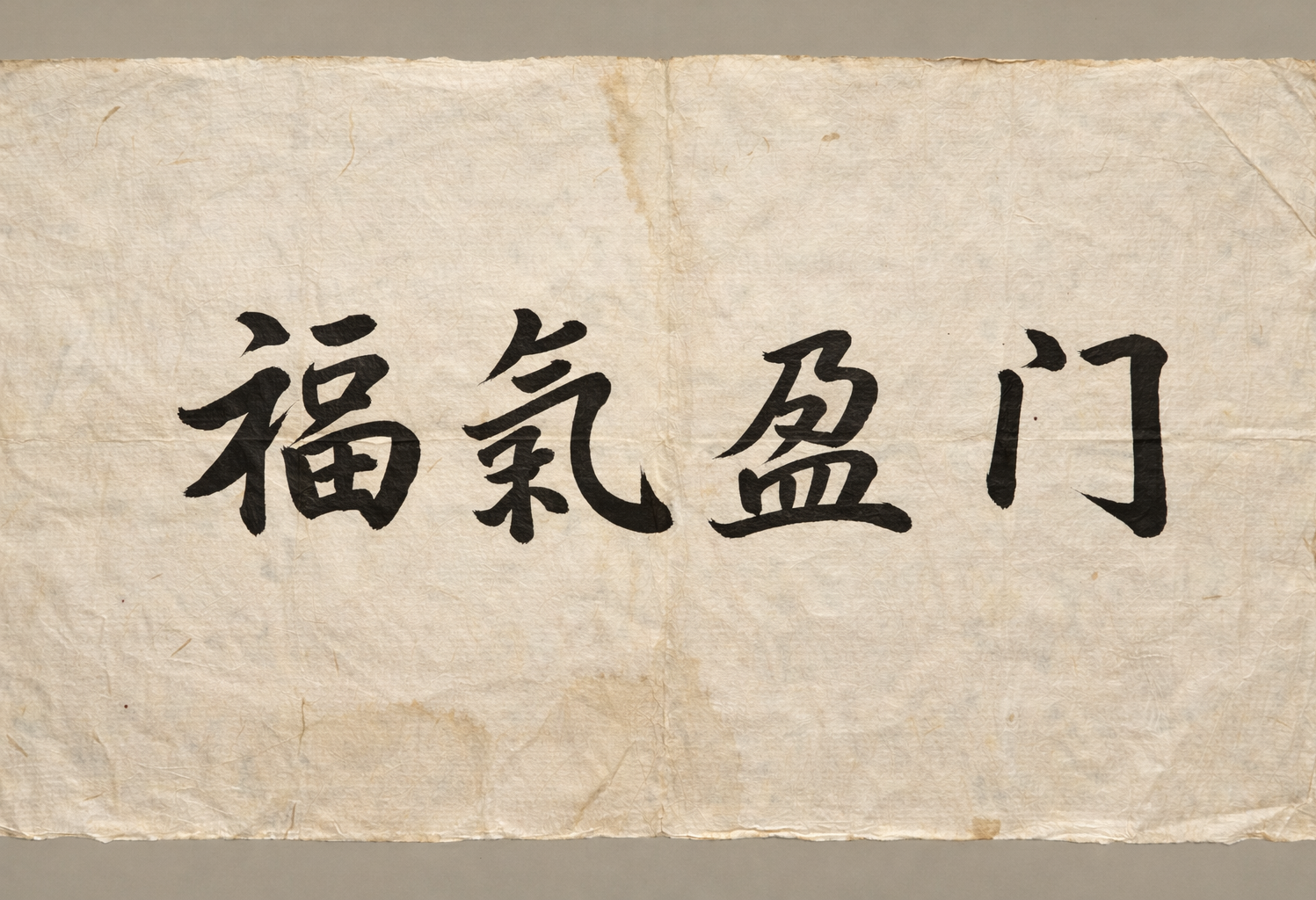
Image Healing: Mandala Stability Guidance 105
Imagine this mandala as a top-down view of the deep sea. The wavy lines on the outer edge represent the waves of emotion, perhaps turbulent and surging. But look beyond the waves to the dark, still dot at the very center of the mandala. That is a giant anchor sunk to the seabed. No matter how turbulent the surface, the seabed is always silent. Let your consciousness slowly descend along the anchor chain, clinging tightly to that central rock. Here, the wind and waves cannot move you in the slightest.
Traditional mandalas typically feature a harmonious and intricately varied circular structure, symbolizing the wholeness of the universe and the cycle of life. By viewing mandala images, individuals can perceive inner peace and strength, achieving psychological balance.
◉ Gaze at the mandala twice, while taking deep breaths.

Lesson 105: Establishing Your Personal Anchor Point (Drawing Guidance)
① Action guidance:Draw a symbol of "stability" in the center of the picture (dot, short line, or square are all acceptable), keeping it small and stable.
② Action guidance:Add a few soft, outward-spreading lines around it to symbolize "I draw strength from there".
③ Action guidance:Write a phrase that represents your anchor in a corner, such as "I am here" or "I can come back." Repeat it three times so that your body remembers it.
Please log in before submitting your drawings and feelings.
○ 105. Security Anchor Points & Log Guidance Suggestions
① Have I ever experienced a particular action, sentence, or scene that made me feel "relieved"?
② How did my body react to the "anchor point" during today's practice? (Relaxed/Neutral/Resistant)
③ Which anchor point would I choose as a "constantly available" stabilizing tool?
④ In which small scenario can I try using this anchor point tomorrow?
Please log in to use.
A safe anchor point is not an escape, but a home you can always return to.
 EN
EN  ZH
ZH  ES
ES  FR
FR  JA
JA