

Lesson 1110: Application and Techniques of Psychological First Aid (PFA)
Duration:75 minutes
Topic Introduction (Overview):
Psychological First Aid (PFA) is a practical intervention method used immediately to support individuals following sudden crises such as disasters, accidents, violence, and public health emergencies. It is not psychotherapy, nor does it require individuals to "talk it out immediately" or "face their emotions." Instead, it helps people regain basic feelings of security, stability, and control under extreme stress. The core principles of PFA are: focusing on basic needs, minimizing further harm, providing gentle companionship, and assisting them in reconnecting with resources. This course will help you understand how PFA is applicable in both non-professional and professional rescue settings.
PFA typically comprises eight key steps: ① Observe and listen; ② Assess safety and basic needs; ③ Provide stabilizing support; ④ Reduce confusion and panic; ⑤ Help connect with social support; ⑥ Assist in restoring daily routines; ⑦ Provide practical information; ⑧ Assist in planning follow-up assistance. You will learn the specifics of each step, including how to communicate with the client in a way that does not cause secondary harm, and which "well-intentioned suggestions" might actually cause them more pain. A mandala is not about drawing something, but about observation—the PFA process is about accompanying the client to "observe their chaos" and, without pressure or rushing, illuminating a path for them to move forward.
▲ AI Interaction: Are you giving yourself "psychological first aid"?
Many people are able to care for others during a crisis, but forget to take care of their own Personal Families (PFA). Please write down your situation based on the following questions:
- ① When you experienced a sudden surge in stress recently, what was your first reaction? To escape? To space out? To cry? Or to keep pushing through?
- ② At that moment, what did your body need most? Water, rest, companionship, distance, a sense of security?
- ③ Have you ever told yourself, "I should be stronger"? Does it make you better or worse?
Psychological first aid is not about "getting back on your feet," but about "settling down." Give these answers to AI, and we'll work together to identify the PFA steps you're most missing.
○ PFA-assisted sound grounding exercises
Under acute stress, the brain enters a "chaotic state," and emotions are like scattered fragments, difficult to piece together into a clear picture. Grounding your voice can help you restore stability with minimal stress.
step:
- Choose a steady, repetitive sound without sudden changes (light rain, fireplace, soft piano).
- Sit quietly, close your eyes, and focus your attention on the most stable part of the sound.
- If you have distracting thoughts, whisper to yourself, "Now just listen to the sound."“
- If your body starts to tense up, don't force yourself to relax; just let the sound stay there.
Mandala drawing is not about drawing something, but about observing; in this exercise, you use sound to observe how your own chaos slowly settles.
Aromatherapy Drinks: Soothing and Supporting After Acute Stress
Recommended drinks:Orange blossom and rose create a gentle, calming, and aromatic drink.
Orange blossoms are often used in naturopathy to soothe excessive tension, palpitations, and chest tightness; roses can alleviate emotions such as sadness, resentment, and anger. They are especially helpful for people experiencing emotional turmoil, sudden crying, or inexplicable blankness after a sudden event.
Suggested usage: Steep 1 gram of orange blossom and 2 grams of rose petals in 90°C water for 5 minutes. Before drinking, inhale the aroma to slightly open your chest; while drinking, take deep breaths to allow the warmth to enter your stomach and gradually bring your nervous system from a state of "high alertness" back to a "regulatory" state. Mandala is not about drawing something, but about observing—observing how the aroma softens a small part of you again.
○ American Natural Therapy Diet: Stable Energy Recovery Meal
Psychological first aid is often accompanied by physiological reactions such as decreased physical strength, stomach discomfort, and unstable blood sugar. American naturopathic diets emphasize helping the brain and body restore basic energy through "warm, easily digestible, and nutritionally stable" foods. This lesson recommends a "stable energy recovery meal": a base of warm brown rice porridge or oatmeal, with soft carrots, shredded chicken breast, or tofu cubes, topped with a little spinach or kale, and drizzled with a little olive oil.
Warm food sends a "you're safe" signal to the nervous system; brown grains help stabilize blood sugar; leafy green vegetables provide micronutrients to support immunity and nerve regulation; and healthy fats restore brain clarity. Even if you still feel confused or tired, eating a bowl of warm food is the first step in your body's psychological first aid.
Healing Recipes
/home2/lzxwhemy/public_html/arttao_org/wp-content/uploads/cookbook/xiang-cai-da-mi-zhou.html(Please confirm that the file has been uploaded: xiang-cai-da-mi-zhou.html)
Dream Mandala Healing · Mi Xiangwen 1110 · The Center After the Storm
In your dream, you are in a city that has just been battered by a storm: streetlights sway, leaves are scattered, and the air still carries a tense atmosphere. You stand in the middle of a crossroads, the wind rushing in from all directions, leaving you unsure which way to go.
Until you look down and see a faint circular mark at your feet, like someone gently drawing the center of a mandala on the ground. You crouch down and run your finger around the center, and the wind suddenly subsides. You slowly stand up along the edge of the circle and find that the surrounding noise and chaos begin to recede, and your breathing becomes audible.
You realize that psychological first aid isn't about making the storm disappear, but about finding a stable center within it. A mandala isn't about drawing something, but about observing—observing how the wind blows, how objects scatter, and how the body gradually returns to its place from chaos. The center doesn't need to be large, but it should be enough to help you regain your direction.

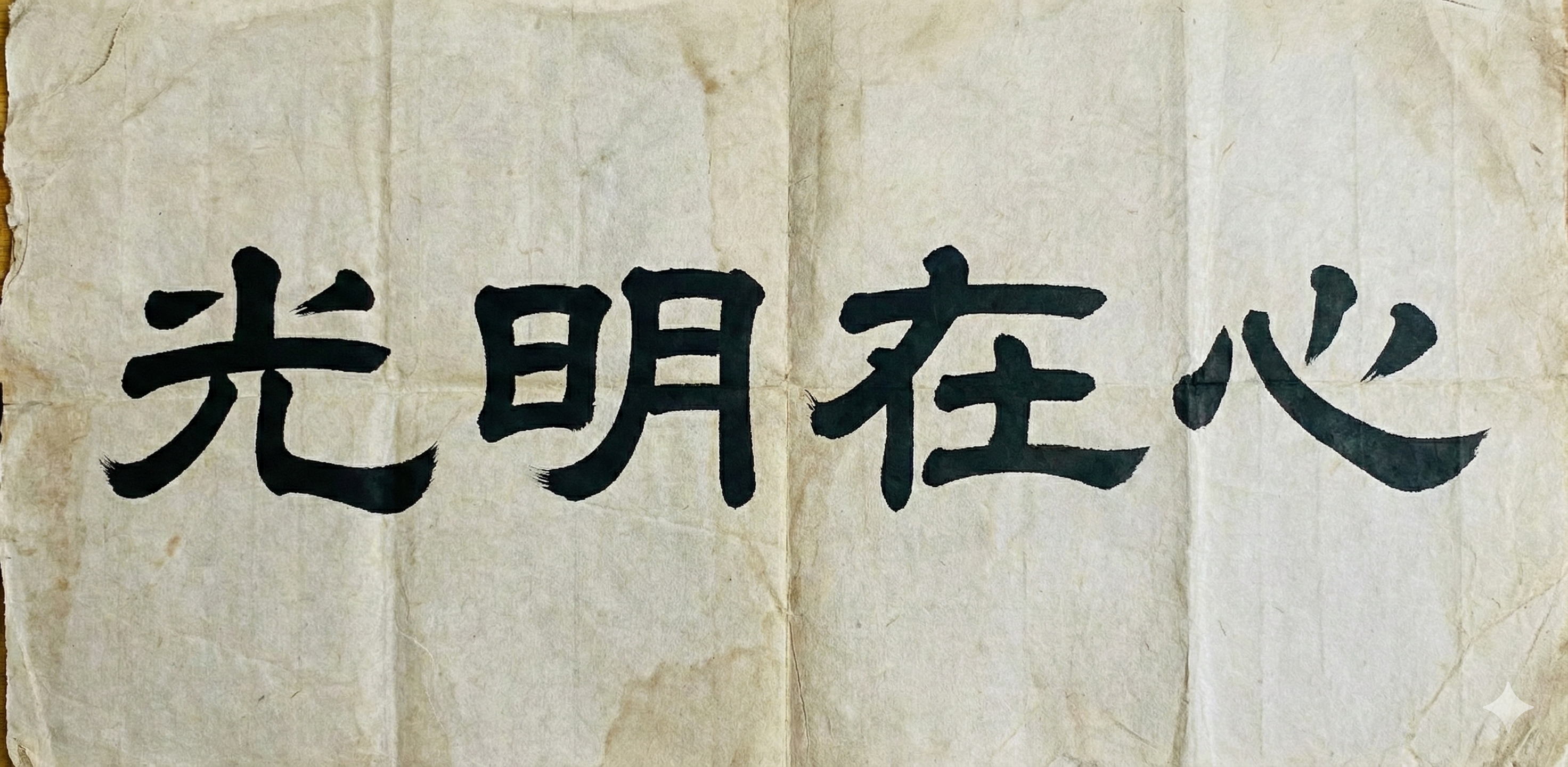
○ Medieval Gothic calligraphy: “I return to my center.”
The stable structure and clear boundaries of Gothic calligraphy are very suitable for practicing the feeling of "returning to the inner center" during psychological first aid.
- English sentences:I return to my center.
- Chinese equivalent:I returned to my center.
- Writing Tips:Inhale gently with each vertical stroke and exhale slowly with each horizontal stroke. Observe how the lines form a stable structure, and also observe whether you suddenly "relax a little bit" at any moment while writing.
Lesson 1110: Psychological First Aid (PFA) - Mandala Viewing Guide
Purpose:Transform PFA from a series of "steps" into an experiential and observable inner order, helping you find your center amidst chaos.
step:
Find a mandala image with a clear center and lines radiating outwards. First, focus your gaze on the center: What does it resemble? Is it a small, quiet area, a blank space, or a center that makes you uneasy? Then, move your gaze outwards along the radial lines, imagining each layer representing a step in the PFA (Planning, Observation, Needs Assessment, Stabilization, Companionship, Providing Information, Connecting Resources, Restoring Daily Life, and Planning for the Future).
Try silently asking yourself: Which level am I on now? Which level is the most difficult for me? Which level makes me feel a little more at ease? A mandala is not about drawing something, but about observing—observing the layers of your recovery process in the image, and also observing how you "return to your center" in a gentle and unhurried way during a crisis.
Please log in before submitting your drawings and feelings.
○ 1110. Application and Techniques of Psychological First Aid (PFA) · Journaling Guidance Suggestions
① What was the last time you needed psychological first aid? Please describe the environment and your physical condition at the time.
② In the eight steps of PFA, which step do you feel you are most lacking? For example: inability to settle yourself, inability to express your needs, inability to seek support.
③ Write down a sentence you wish someone would say to you, and write down a corresponding sentence you could say to yourself.
④ In the past three days, has there been any small action that made you feel "I seem to have recovered a little"? Please write it down specifically.
⑤ Set a "low-stress next step" for yourself, such as drinking a warm beverage, tidying up a corner of the room, going to bed early, or taking a 10-minute walk.
⑥ Finally, I'll end today's writing with a sentence that begins with "Even if the chaos continues, I will..."
Please log in to use.
Psychological first aid isn't a cure, but rather something that helps you stand firm in the storm; it doesn't make you instantly better, but rather gives you the strength to continue living. May you see a little bit of the power to reconnect with yourself in every act of returning to your center.
 EN
EN  ZH
ZH  ES
ES  FR
FR  JA
JA