

Lesson 1115: Guilt and Self-Blame of Disaster Survivors
Duration:75 minutes
Topic Introduction (Overview):
People who survive disasters, accidents, violence, public health crises, or major emergencies often find themselves trapped in an extremely heavy yet indescribable emotion—survivor's guilt. This is one of the most complex areas of trauma psychology: those who survive feel they "don't deserve to live," feel "I should have done more," feel "why didn't this happen to me," feel "if I had acted faster, if I had stopped it, if I had stayed there," and feel that "if I had acted faster, if I had stopped it, if I had stayed there," the events would have been different. Survivors often take the blame for the uncontrollable disaster upon themselves, as if only by taking responsibility can they explain this incomprehensible pain.
Survivor guilt isn't a matter of logic, but rather the way emotions struggle to find "meaning" and "explanation." It stems from four common paths: ① deep mourning for the lost; ② self-blame filling the huge gap between fact and emotion; ③ imagining alternative scenarios of "what if..."; ④ fear of the world order being disrupted. This lesson will guide you to understand the mechanisms of guilt, identify the language of self-blame, and learn to gently soothe those "irrational but real" emotions. A mandala isn't about drawing something, but about observing—observing the shape of guilt, observing the weight you bear, observing why you blame yourself so intensely.
▲ AI Interaction: What are you blaming yourself for?
Survivor guilt is rarely spoken aloud. Please write down the answers to the following three questions and let AI help you unravel the threads of guilt:
- ① What is the one self-blame you repeat to yourself most often?
- ② Was the thing you blamed yourself for something that you could control at the time? Please answer honestly.
- ③ If there's one thing you wish someone would say to you, what would it be?
Guilt is not a "sin"; it's an emotion's way of trying to help you understand pain. Click the button below to let AI accompany you through the experience of guilt, instead of being overwhelmed by it.
○ Guilt Regulation - Sound Bearing Method
Survivor guilt weighs heavily on the heart, but a voice can act as a container to support that weight and prevent it from crushing you.
Practice method:
- Play a soft cello or slow piano, keeping the volume "close to your ear".
- Close your eyes and let the sound feel like a soft cloth covering your chest.
- Pay attention to the most stable rhythm in the music, like a heartbeat.
- With each breath, let the music support that guilt, rather than letting it sink deeper.
A mandala is not about drawing something, but about watching—watching how guilt becomes bearable in sound, rather than expanding.
Aromatherapy Drinks: Gentle Support for Guilt Release
Recommended drinks:A soothing warm drink made with rose and verbena.
Roses symbolize both the openness and connection of the heart, offering the gentlest support for grief and guilt; verbena is used in naturopathy to relieve "chest tightness caused by excessive self-blame." The combination of the two can reduce chest pain, deep sorrow, and helplessness caused by guilt, freeing emotions from being suppressed within the body.
Usage: Steep 2 grams of rose petals and 1 gram of verbena in hot water for 5 minutes. Before drinking, hold the cup for 5 seconds to let the warmth seep into your palm, then inhale the aroma deeply—as if allowing gentleness to enter that place you always hesitate to care for. A mandala is not about drawing something, but about observing—observing how warmth transforms guilt from "stuck" to "flowing."
○ American Natural Diet: The Repair Bowl for When Your Heart Feels Heavy
Guilt can make many people lose their appetite or feel unwell after eating, leading to further physical weakness. The American naturopathic diet emphasizes supporting the mind and body with soft, warm, easily digestible foods that stabilize mood. This lesson recommends the "Heart-Healing Bowl": a base of warm quinoa or oats, topped with steamed pumpkin, cauliflower, finely chopped walnuts, and a spoonful of warm milk or almond milk.
Pumpkin and cauliflower provide vitamins and stable energy, walnuts help the brain repair cognitive fatigue after trauma, and warm milk can make the body feel nourished again. This is not "treatment," but a symbol: you deserve to be warmed, to be fed, and to be embraced by a living body.
Healing Recipes
/home2/lzxwhemy/public_html/arttao_org/wp-content/uploads/cookbook/a-yu-fei-tuo-xiang-liao-ji-xiong-rou.html(Please confirm that the following has been uploaded: a-yu-fei-tuo-xiang-liao-ji-xiong-rou.html)
Dream Mandala Healing · Mi Xiangwen 1115 · Weight and Light
In your dream, you are carrying a heavy bag filled with all the things you "believe you did wrong." The longer you walk, the heavier the bag becomes, until it's almost impossible to move forward. You stop and try to open the bag, only to find that it doesn't contain "mistakes," but rather dark stones—engraved with your unspoken self-reproach.
You sit on the ground, taking out the stones one by one and placing them in front of you. Suddenly, a halo of light appears around the stones, like the outer ring of a mandala, encircling them. The light isn't there to erase your guilt, but to help you see their shapes clearly. The stones are still there, but they are no longer pressed against your shoulders; instead, they are placed in front of you, for you to observe.
A mandala is not about drawing something, but about observing—observing how long you carry it, seeing the true shape of the weight, and observing how you first allow "light" to intervene in that heaviness.
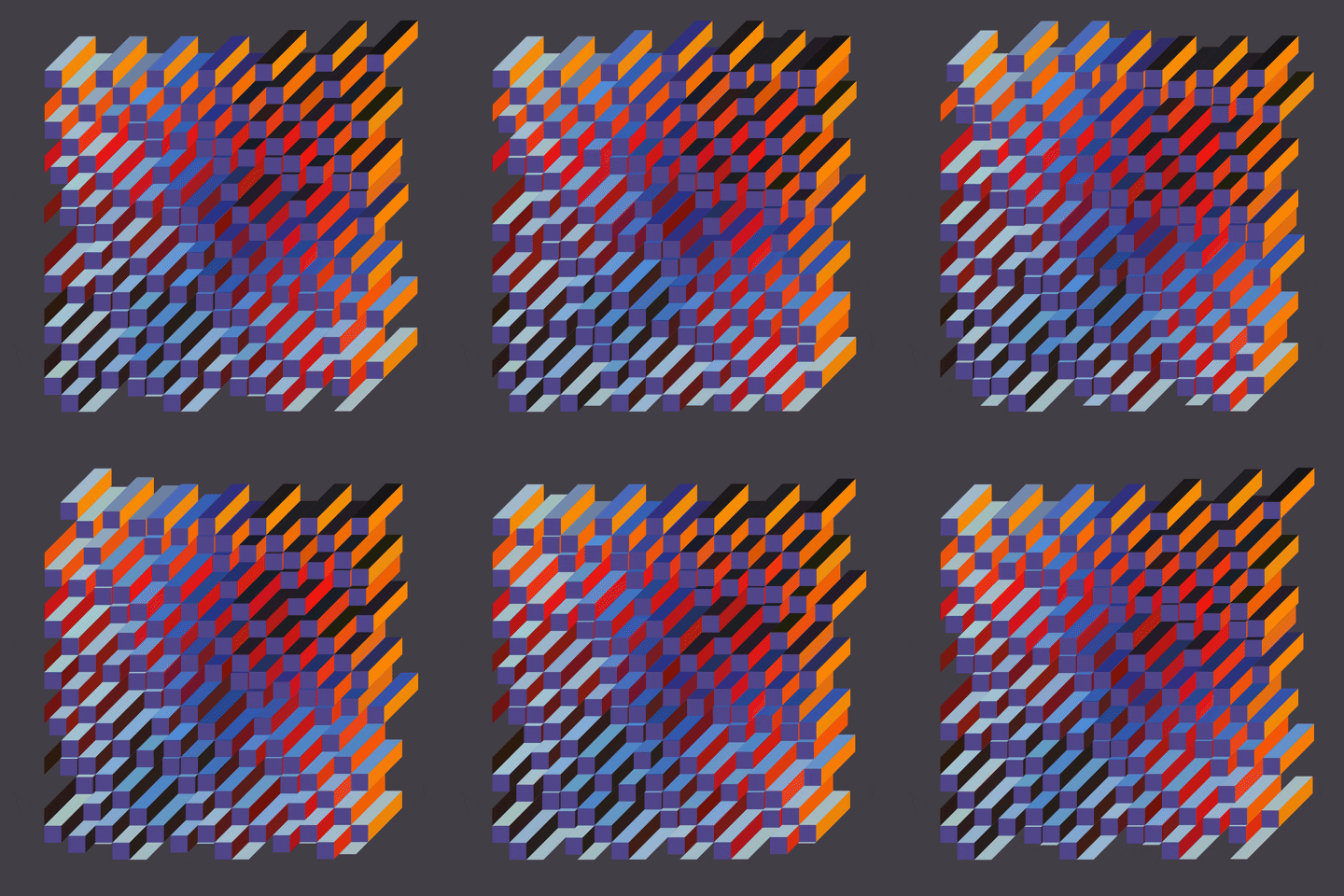
○ Medieval Gothic calligraphy: “My life is allowed to continue.”
The heavy lines of Gothic script are suitable for practicing the writing experience of "bearing weight without being crushed".
- English sentences:My life is allowed to continue.
- Chinese equivalent:My life was allowed to continue.
- Writing Tips:When writing vertical lines, inhale steadily, making the lines as solid as pillars; when writing horizontal lines, exhale slowly, feeling the weight of guilt gradually dissipate.

Lesson 1115: Guilt and Self-Blame - Guided Mandala Viewing
Purpose:It helps you transform "carrying it on your back" into "putting it in front of you," so that guilt can be seen and no longer overwhelm you.
Find a mandala with a darker center and a gradually brightening outer circle. Imagine the center as your deepest guilt. Hold the center for 10 seconds and observe your body's reaction: Does your chest feel heavy? Are your shoulders stiff? Then slowly move your gaze along the bright outer circle, letting your eyes move away from the center of guilt and towards a broader perspective.
A mandala is not about drawing something, but about observing—observing how guilt occupies space in your heart, and observing how you gradually move towards the outer circle, finding your direction again in the light.
Please log in before submitting your drawings and feelings.
○ 1115. Guilt and Self-Blame: Journaling Guidance Suggestions
① Write down the sentence you most often blame yourself for.
② Write down the factors in that event that you could not control (write at least three).
③ Write down a sentence you would like to say to yourself in that moment.
④ Write down a comforting sentence that makes you feel a little better, starting with "Even though I'm still in pain, I still..."
⑤ Write down whether there was a moment in the past week that made you feel "I don't seem so heavy anymore"?
⑥ Finally, write: "I am transferring the weight from my back to my front, so that it can be seen, understood, and carried."“
Please log in to use.
Survival is not a sin, but a mission to continue life. May you see light and your reason to keep living as you contemplate weight.
 EN
EN  ZH
ZH  ES
ES  FR
FR  JA
JA