

Lesson 1138: Establishing Self-Help and Mutual-Help Strategies
Duration:75 minutes
Topic Introduction (Overview):
In the aftermath of a crisis, people often instinctively focus on "how to get someone out of the crisis," neglecting the fact that trauma can spread within a group: one person's fear can trigger another's; one person's silence can leave those around them unsure how to speak. Therefore, self-help and mutual aid strategies are not about "how I can help others," but rather "how we can recover together." This lesson will guide you to understand that self-help is about maintaining basic stability and clarity amidst chaos; mutual aid is about building a resilient support network with limited resources.
We will learn how to build a "three-tiered support structure": the first tier is personal emotional regulation and grounded practice; the second tier is mutual care within family or close relationships; and the third tier is collaborative support from the community or peer groups. You will discover that mutual support is not heroism or self-sacrifice, but a gentle and continuous way of participating—like a cup of slowly clearing Chinese green tea, like a bowl of nourishing soup that needs time to simmer. The mandala is not about drawing something, but about observation—observing how a reliable support circle is formed between yourself and others, from fragmentation to connection, from isolation to companionship.
▲ AI Interaction: Sustainable Self-Help Behaviors You Can Engage In“
Please write down three small but consistent self-help actions that you can currently perform, and let AI help you organize them into a daily plan:
- ① Deep breathing and grounding exercises once a day (lasting up to 60 seconds).
- ② Record your sleep, diet, and body tension to maintain basic self-care.
- ③ Allow your emotions to be "seen": Say to someone you trust, "I'm having a tough day."
Self-reliance is not about "I must be very strong," but about "I am willing to take care of myself first, so that I have the capacity to stand on the same side as others."
○ Self-help Music Stabilization Method
Choose a piece of music with a steady and low-pressure rhythm and use it as your daily "psychological calibrator".
Practice method:
- Sit firmly with your feet on the ground and exhale gently in time with the loudest part of the music.
- If your heart is beating too fast, place your palms on your chest and slow down your breathing in sync with the melody.
- After the music ended, I asked myself, "Am I more stable now than I was five minutes ago?"“
○ Chinese Green Tea: A Self-Help Method for Tranquilizing the Mind
The three distinct flavor profiles of Chinese green tea—slightly bitter, slightly astringent, and slightly sweet—are like the emotions following a sudden event: first bitterness, then contraction, and finally a stabilizing sweetness. The process of brewing tea is also a form of self-training—adjusting the water temperature to just right, slowly adding the tea leaves, and watching them unfurl in the water. It's a way of establishing a "micro-order" for oneself: the world may be chaotic, but this cup of tea has rhythm, layers, and can be observed.
While brewing tea, silently repeat to yourself: I allow myself a moment of clarity amidst the chaos. I must take care of myself first before joining the network of mutual support. A mandala is not about drawing something, but about observation—observing the tea's color change from dark to light, just as observing oneself as one gradually relaxes from tension.
○ Chinese Food Therapy · Soup Dishes · Heartwarming Soups Shared by the Group
Offering a bowl of warm soup in a mutual aid group or disaster relief meeting is a form of support that needs no words. "Red Date, White Fungus, and Longan Soup" is recommended: it nourishes qi, calms the mind, moisturizes dryness, and harmonizes the body, symbolizing a gentle connection. When people lift the bowl, gently blow on the steam, and slowly sip it, that warmth is a physical memory of "we are together."
The slow-cooked, smooth broth requires patience, much like the rhythm of mutual aid itself—unhurried, unpushing, and unpressured, but rather a continuous companionship. Mutual aid is not a one-time act of giving, but a continuous process of cooking and sharing together.
Dream Mandala Healing · Mi Xiangwen 1138 · Three-Layer Circle
In your dream, you see a huge mandala: the innermost circle is a faint but steady light, symbolizing your self-reliance; the second circle is a group of people sitting around the light, not saying much, but keeping each other company, symbolizing mutual help; the third circle is the outermost community and strangers, whose footsteps and breathing form a circular rhythm.
You simply stand and watch: the lights haven't been extinguished by the wind, the people haven't scattered, and the rhythm of the outer circle hasn't disappeared. You suddenly understand that restoration isn't achieved by one person, but by the combined operation of these three layers. A mandala isn't about drawing something, but about observing—observing how light is transmitted, observing how people sit around it, observing how the outer circle provides space, allowing the inner circle to slowly regain its strength.
[mandala_gallery1138]
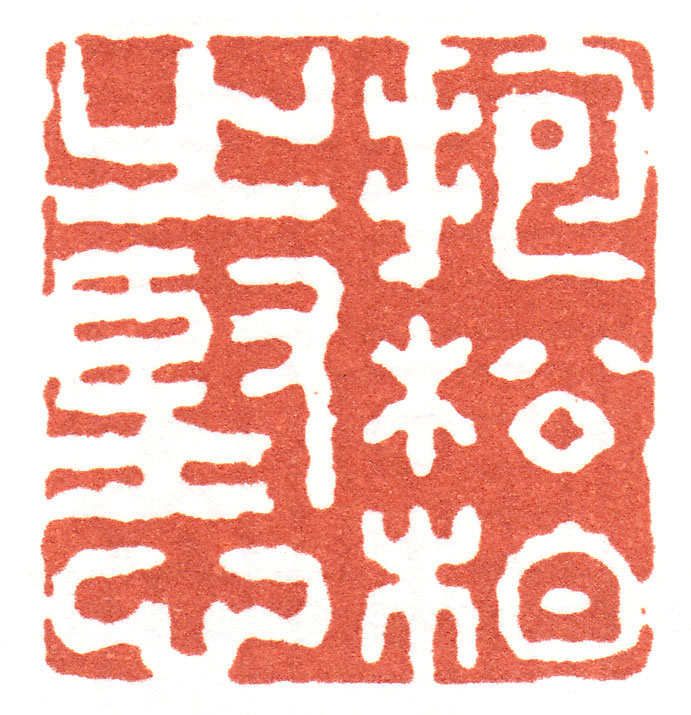
○ Regular script writing practice for “稳、共”
The regular script is robust and clear, like the basic structure of a mutual aid network.
- Written words:Stability and Common Development
- English equivalent:Steady Together
- Practice Tips:When writing the character "稳" (wěn), the left side should be written as if a weight has landed on the ground; when writing the character "共" (gòng), the horizontal strokes should be evenly spaced to symbolize a balanced and supportive relationship.
Lesson 1138: Self-Help and Mutual Assistance - Guided Mandala Viewing
Choose a mandala that gradually expands outward from the center, with colors transitioning from dark to light. First, look at the innermost circle, considering it the "starting point of self-help": your breath, your body, your stability. Then slowly look at the second circle: symbolizing family, friends, or partners willing to walk with you. Finally, look at the outermost circle: symbolizing the broader community or resources.
Don't rush to explain; simply observe how these circles support and depend on each other. When you see the outer circle providing space, the second circle offering warmth, and the inner circle maintaining a glimmer of light, you'll understand: mutual assistance isn't about vying to be the center, but about ensuring the stable existence of each circle. A mandala isn't about drawing something; it's about observing.
Please log in before submitting your drawings and feelings.
○ 1138. Self-help and Mutual Aid Strategies: Log Guidance Suggestions
① Write down three small self-help actions that you can do right now and assess their sustainability.
② Write down three “mutual aid points” in your life: these could be friends, groups, communities, or a stable ritual.
③ Are there any situations where you were afraid to seek help due to shame or pressure? Write down the reasons.
④ Imagine you could offer someone a “small but real” support, what would it be like?
⑤ Conclusion: Mutual assistance is not dependence, but companionship; it is not about being strong, but about being able to connect.
Please log in to use.
On the long road to recovery after trauma, self-reliance is your foundation, and mutual support is your network. May you, while building stability, also become a small but real ray of light in others' journeys.
 EN
EN  ZH
ZH  ES
ES  FR
FR  JA
JA