

Lesson 1344: Diagnosis and Assessment of Sleep Disorders
Duration:65 minutes
Topic Introduction:This course aims to help students understand the diagnostic criteria, assessment methods, and common types of sleep disorders. It will cover issues such as difficulty falling asleep, maintaining sleep, early awakenings, and non-restorative sleep, while also guiding students to explore the underlying psychological causes and coping strategies.
○ Key points for sleep disorder assessment
- Difficulty falling asleep:Assess whether it takes longer than 30 minutes to fall asleep and whether it persists for more than three months.
- Sleep maintenance issues:Understand the frequency and duration of nighttime awakenings and whether they affect overall sleep quality.
- Abnormal sleep structure:Identify whether there is more light sleep, less deep sleep, REM sleep disorder, etc.
- Psychological and behavioral factors:Explore the impact of stress, anxiety, depression, eating habits, etc. on sleep.
▲ AI interaction: Explore your current sleep status and psychological impact
Diagnosis and assessment are processes that help you find a more appropriate solution. They provide clarity rather than labeling you.
Please keep a sleep diary for the past month, including the duration of your sleep and the number of times you wake up during the night.
Write down how this affects your studies, work, or relationships. This will help professionals understand your situation more quickly.
Conclusion: Assessment is a bridge to build support, not a burden.
Click the button below to work with AI to sort out your sleep patterns, understand possible psychological causes, and get personalized suggestions.
○ Diagnosis and assessment of sleep disorders · Music therapy
The evaluation is to organize the scattered nights into a musical score, which is convenient for playing with your professional. Use a fixed sleep song to make the record more objective.
Write down the sleep onset latency, number of night awakenings, total duration, and the timing and effect of music intervention.
Also write down the sleepiness, concentration, and emotions that affect the day, like marking the secondary melody.
Prepare three questions you would like to know about: assessment method, sleep hygiene, and medication indication.
Conclusion: Clear data makes support more personalized.
○ Herbal tea healing drink
Recommended drinks:Lemongrass Tea
Recommended reasons:Lemongrass has relaxing and calming properties that can help relieve anxiety, soothe an upset stomach, and promote sleep. Its natural aroma can also help stabilize mood.
usage:Take 2 grams of dried lemongrass and brew it in hot water for 5-8 minutes. Add honey to taste. It is best to drink it 30 minutes before going to bed.
○ Turmeric honey drink
Warming and refreshing, it's perfect for morning or afternoon wake-ups. Its gentle sweetness, combined with a spicy base, offers a relaxing and focused experience, making it a pleasant alternative for those who need to relax and focus.
Healing Recipes
/home2/lzxwhemy/public_html/arttao_org/wp-content/uploads/cookbook/huang-jiang-feng-mi-yin.html(Please confirm that the file has been uploaded: huang-jiang-feng-mi-yin.html)🎨 Themed Mandala
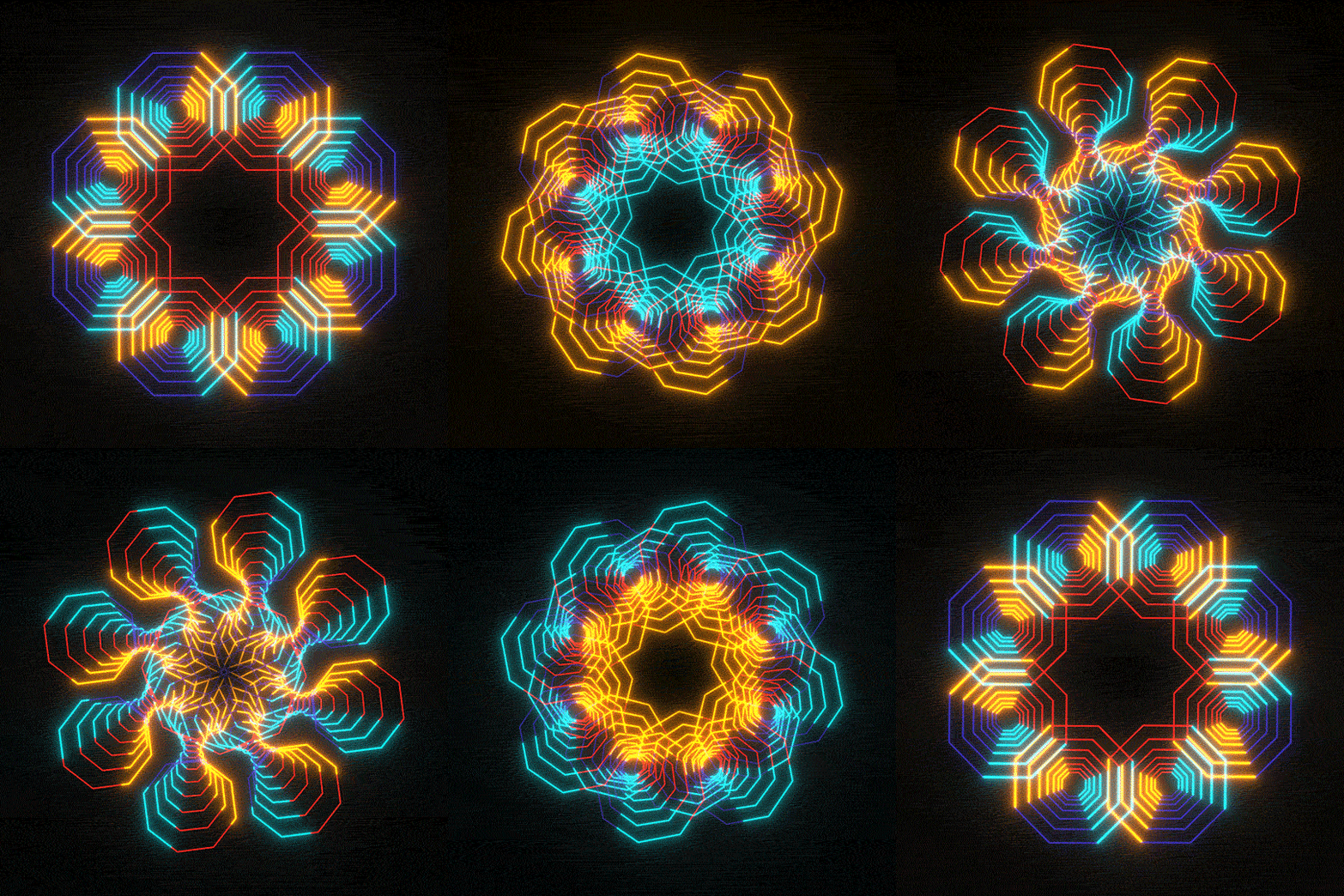
Thematic mandalas are a form of image therapy created around specific psychological themes, such as sleep, anxiety, and relaxation. By drawing a mandala around the theme of "sleep disorders," individuals can calm subconscious anxieties and create a sense of inner order.
Applicable issues:Difficulty falling asleep, waking up from dreams, night terrors, and waking up early and unable to fall asleep again.
○ Medieval Gothic calligraphy practice
Gothic script is a solemn and regular Western script widely used in the Middle Ages. Its visual style features a strong rhythm and vigorous strokes. Writing requires steady hand gestures and concentration, which can help relieve anxiety, focus consciousness, and induce a restful sleep.
Practice sentences:
"I let go of today's worries and sleep peacefully."
I release today's worries and sleep in peace.
It is recommended to use a fountain pen or a dip pen to write the above sentence repeatedly at a slow pace. Feeling the power and order of each letter will help to organize your inner emotions.

○ Diagnosis and assessment of sleep disorders: guidance and suggestions for painting therapy
This page uses creative drawing to transform the key points of sleep disorder diagnosis and assessment into images. Diagnosis requires comprehensive considerationSymptom frequency, duration, sleep architecture, and impairment of daytime functionDrawing can make abstract evaluative dimensions visible, aiding self-observation and providing visual material for communication with professionals.
1. Sleep frequency calendar
- Draw a monthly calendar and color-code each day: green = good sleep, yellow = mild distress, red = severe insomnia.
- Count the "red days" on the calendar to help you assess the frequency of your symptoms.
- Write a clue: "≥3 nights/week × ≥3 months = clue to diagnosis of chronic sleep disorder."
2. Sleep structure hourglass
- Draw an hourglass: the upper layer = sleep onset latency, number of night awakenings, and length of early awakenings; the lower layer = deep sleep/dream ratio.
- Write your most common difficulty in the sand (e.g., "falling asleep for >40 minutes").
- Remind yourself: structural imbalances are more worthy of attention than a single bout of insomnia.
3. Daytime Function Impact Diagram
- Draw a four-quadrant grid: Attention | Emotional Stability | Memory | Physical Vitality.
- Each dimension is scored 0–10, with the low scores colored in.
- Write the corresponding symptoms next to them (such as "irritable/forgetful/sleepy").
Tip: While drawing therapy can help with recording and expressing thoughts, the diagnosis and assessment of sleep disorders still require specialized tools (such as sleep diaries and polysomnography). If the disturbance persists or seriously impacts your life, please seek psychological or medical support promptly.
Please log in before submitting your drawings and feelings.
○ 1344. Diagnosis and Assessment of Sleep Disorders: Journal-Guided Recommendations
① Sleep diary: Record sleep onset latency, number of nighttime awakenings, total sleep duration, and subjective satisfaction for two consecutive weeks to form comparable data.
② Functional impact: Give examples in the four columns of study/work/emotion/relationships respectively, and avoid general statements such as "always/never".
③ Comorbidity clues: Write down the history of pain, snoring, suspected apnea, anxiety and depression to facilitate professional screening and referral.
④ Strategies that have been tried: Make a list and score the effects, retain the effective ones and eliminate the ineffective ones, providing a basis for the combination of solutions.
⑤ Three questions to ask during the interview: diagnostic ideas, preferred options, and re-evaluation time point. Bringing these questions with you to the doctor will help you be more focused.
⑥ Post-meeting arrangements: Confirm follow-up and self-help tasks to avoid information overload and being unable to start.
⑦ Conclusion: Evaluation is about connections, not definitions.
Please log in to use.
I hope this course will help you recognize and understand the psychological mechanisms behind sleep disorders, and gradually restore restful and fulfilling sleep quality through natural therapy, artistic expression and self-observation.
 EN
EN  ZH
ZH  ES
ES  FR
FR  JA
JA