

Lesson 1358: Relaxation Exercises and Techniques for Reducing Blood Pressure
Duration:75 minutes
Topic Introduction:
For insomniacs, the inability to "turn off" is a more fundamental problem than simply "difficulty falling asleep." This course will guide you to a deeper understanding of: why the more the brain tries to sleep, the more tense the body becomes; why the more effort is put into relaxation, the more counterproductive it becomes; and why lying in bed feels like being enveloped by a subtle electric current from toes to the forehead, despite being extremely tired, yet unable to truly sink into a deep sleep. This course will present a set of nighttime stress-reducing techniques based on neurophysiology, including: parasympathetic activation, slow breathing rhythms (especially prolonged exhalation), vagal nerve stimulation pathways, a low-intensity version of progressive muscle relaxation (PMR), body scanning, and a pre-sleep "sensory noise reduction" routine.
We will emphasize the core idea that "mandalas are not about drawing something, but about observing": let observation become a mechanism for regulating rhythm, rather than forced relaxation. Paired with herbal teas to soothe awakened nerves, Ayurvedic spice soups to stabilize body temperature and digestive rhythm, and the slow, repetitive movements of medieval Gothic calligraphy, you will learn how to let your body return to the rhythm of night, rather than relying on willpower to suppress anxiety. When the body can reduce stress, the brain can truly relax.
[arttao_Healing_Course_tts_group1358]
▲ AI Interaction: Find your "most easily tense areas"“
Tell the AI the areas of your body that are most tense before bed (such as chest, neck and shoulders, jaw, stomach, and around the eyes), and the system will give you corresponding nighttime stress-relieving tips based on the different areas.
Input example:
“"When I lay down, my neck and shoulders felt stiff, my stomach felt tight, and my jaw clenched."”
○ Music Therapy - Parasympathetic System Activation Soundscape
Choose low-frequency, sustained-tone, slowly spreading music to simulate the sensory state of "being away from danger" and allow the body to enter a recovery rhythm.
Relaxation exercises are not about making your body softer, but about making your nerves feel "safe".
- Choose a soundscape with no lyrics and no sudden sounds.
- When used in conjunction with prolonged exhalation, the effect is even stronger.
- Start playing it 20 minutes before bedtime, but don't bring it into bed.
○ Herbal Tea Healing Drinks: Lavender and Chamomile Tea for Relieving Tension
Recommended reasons:Suitable for insomniacs who experience full-body tension, muscle stiffness, and difficulty "stopping"; it can balance overactive sympathetic nerves.
usage:Drink 30–40 minutes before bedtime, and the effect is even better when combined with light stretching.
○ Ayurvedic Spice Soup - Nighttime Stress-Relieving and Warming Soup
Simmering turmeric, ginger, and nutmeg over low heat creates a gentle warmth that can improve poor microcirculation, cold hands and feet, and visceral tightness caused by stress.
A slight increase in body temperature can actually help the natural cooling process during sleep, making the overall circadian rhythm more stable.
Soothe your nerves
Improve cold
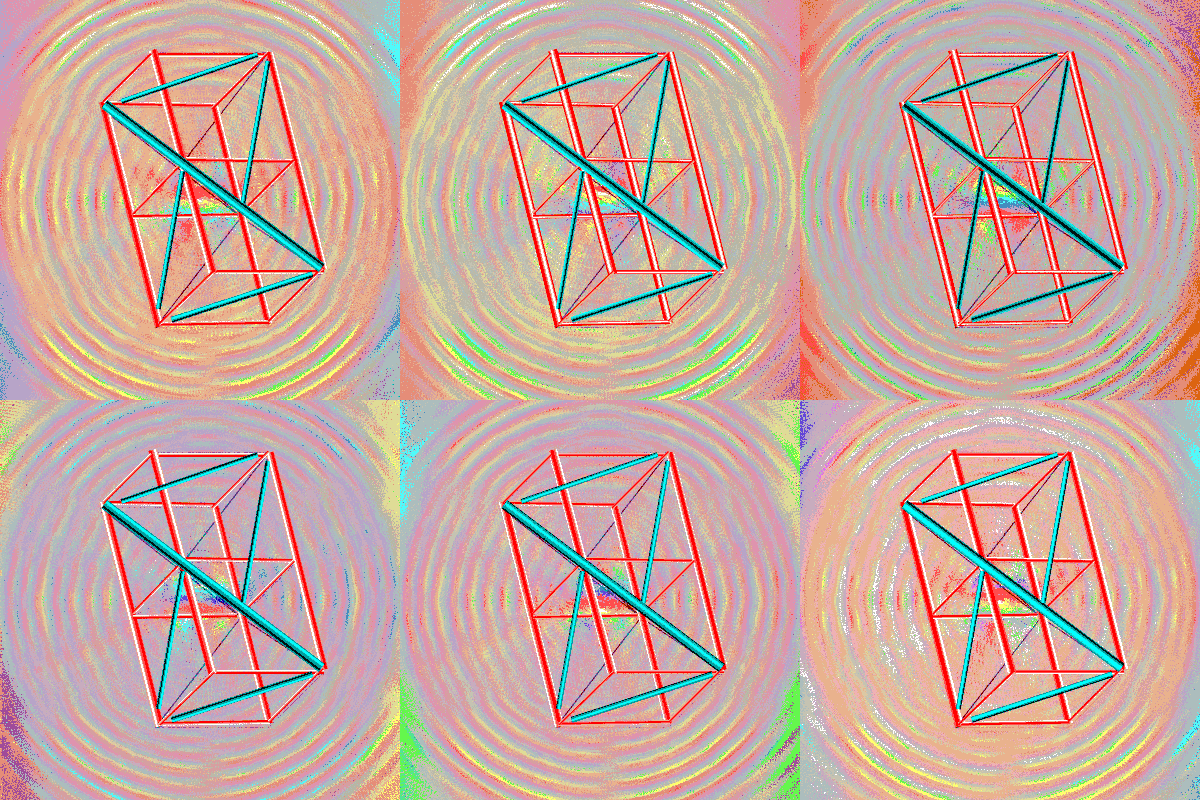
Mental Mandala (Viewing): Teaching the Body to "Slow Down"“
Psychological Healing: Psychological Mandala Imagery 104
The more you try to relax, the more tense your body becomes; please don't force yourself.
The purpose of viewing a mandala is not to put you to sleep immediately, but to stop your nervous system from running away and fighting back.
Staring at the center line, you'll find your breathing becomes less rapid and the pressure on your chest disappears.
Instead of forcing yourself to relax, you let the "watching" slowly slow you down.
A mandala is not about drawing something, but about observing it.
In watching, you regain the ability to "stop".
○ Medieval Gothic Calligraphy Practice: Let the Brushstrokes Help You Reduce Stress
The rhythm of writing directly affects your breathing rhythm, so the stable, repetitive structure of Gothic calligraphy is an excellent exercise for lowering blood pressure at night.
- I'm releasing today.
- I allow my body to slow down.
- Nighttime is for recovery, not for fighting.
[spiritual_mandala_v3_589-594]
Lesson 1358: Relaxation Exercises and Techniques for Reducing Stress: Guiding Suggestions for Art Therapy
This page transforms "relaxation" and "stress reduction" from abstract concepts into concrete physical pathways. You'll see in the diagrams how tension spreads from head to toe.
And how can it be released gradually in a certain order? The goal is: when you pick up this chart, it's like picking up a "blood pressure relief map," knowing where you can start taking care of your body, instead of being overwhelmed by discomfort throughout your body.
1. "Tense-Relaxed Body Comparison Chart"“
- Draw a simplified human body outline, dividing the body into several sections: head, neck and shoulders, chest and back, abdomen, pelvis, thighs, calves, and feet.
- On the left side of each block, use a dark color to represent a "tight" appearance (e.g., intersecting lines, thick, cracked), and on the right side, use a light color to represent a "relaxed" appearance (e.g., smooth lines, soft colors).
- Write down the corresponding relaxation exercises next to each section: slow stretching, abdominal breathing, progressive muscle relaxation, hot compress, foot soak, etc.
- Make this a visual checklist for your bedtime routine: you don't have to do it all, just choose one or two sections that you need most today and do a conscious "pressure-reducing check".
II. "Breathing Ripple" Stabilization Diagram
- Draw a soft, wavy line horizontally to represent your ideal breathing rhythm: inhale slowly, pause briefly, exhale for a longer period, and then pause again briefly.
- Write "Inhale" at the peak and "Exhale" at the trough, and draw the exhale segment longer to remind yourself that lengthening the exhale is a key to lowering blood pressure.
- Leave a few spaces below the waveform graph. After completing each 5-10 rounds of breathing exercises, mark it with a small mark in the grid to give yourself some visual affirmation.
- Make this wavy pattern a "stabilizing symbol" by your bedside. Just look at it at night and you'll remember that you have the ability to slowly turn your body and get closer to sleep.
Please log in before submitting your drawings and feelings.
○ 1358. Relaxation Exercises and Body Stress Reduction Techniques: Journal-Guided Suggestions
① Write down the two parts of your body that are most tense before you go to sleep.
② What does that tension feel like? (For example, a taut rope, something blocking your chest, or your chin being locked)
③ What physical stress-reducing techniques did you try today? How effective were they?
④ Write yourself a gentle sentence of self-permission: "I may not be perfect, but I can gradually loosen up."“
Please log in to use.
The tension in your body isn't your fault; it's the result of it protecting you for too long. Relaxing doesn't mean immediately letting it go, but rather accompanying it as it learns to go home.
 EN
EN  ZH
ZH  ES
ES  FR
FR  JA
JA