

Lesson 1429: Specific Methods to Reduce Symptom Monitoring
Duration:60 minutes
Topic Introduction:
This course focuses on the core strategy of "Symptom Monitoring Reduction," one of the most critical steps in improving somatic symptom disorder. Many clients are not trapped by the symptoms themselves, but by the behavioral cycle of "constantly staring at their body": constantly checking their heartbeat, breathing, chest tightness, body temperature, numbness in their hands and feet, stomach movement, slight dizziness, muscle tension, and even scanning their body in their minds dozens of times a day.
The more the brain "stares" at the symptoms, the more they are amplified; the more amplified the symptoms, the more anxious one becomes; the more anxious one is, the more attention is locked on the body, further increasing sensitivity. Ultimately, what are originally minor, reversible, normal physiological fluctuations are mistaken for "danger signals."
This course will guide you through an actionable “symptom monitoring reduction method”: including how to identify trigger points, how to interrupt attention scanning, how to shift to constructive activities, how to establish “non-monitoring periods”, how to replace monitoring impulses with behaviors, and how to allow the brain to relearn that the body can be trusted and does not need to be constantly checked.
This is an important step in getting back into a rhythm of life, reducing sensitivity to symptoms, and alleviating health anxiety.
○ The amplification effect of symptom monitoring
- The more focused your attention, the stronger the sensation:When your brain "hears" that you are looking for danger, it will become more alert.
- Misjudging normal fluctuations as abnormal:Even slight throbbing and changes in breathing were misinterpreted.
- Increased physical tension:Monitoring itself is a stressful behavior that can worsen symptoms.
- Reduce recovery space:The body doesn't have a chance to fluctuate naturally because you're constantly "watching".
[arttao_Healing_Course_tts_group1426_1430]
▲ AI Interaction: Identifying Your "Monitoring Trigger Points"“
Question 1: Which body parts do you monitor most frequently throughout the day?
Question 2: In what situations do you usually start "scanning yourself"? (e.g., sitting, preparing to sleep, walking, before or after meals, while working)
Question 3: Write down a time period during which you would like to reduce monitoring, for example: "The period from after breakfast to 10:00 is a non-monitoring period".
○ Music-guided external anchor for stable attention
The core problem with symptom monitoring is that "attention is fixed on the body."
Music can serve as an external anchor, allowing attention to gradually shift away from the inner self.
Practice method:
① Choose a track with a stable rhythm;
② Play it immediately when you feel the urge to monitor it, and focus your attention on the melody;
③ Use “listen to music for 30 seconds” as an alternative to interrupting the monitoring.
Over time, the brain learns that it can maintain a sense of security without constantly checking the body.
○ Eastern Healing Tea: Ginseng, Ophiopogon japonicus, and Licorice Tea
effect:It replenishes Qi and Yin, relieves excessive tension, and stabilizes the mind. It is especially suitable for drinking after strong impulse control, helping the body return from "excessive introspection" to "overall stability".
This is suggested as a small closing action for a "non-monitored ceremony":
Take a sip and tell yourself, "I'm allowing my body to function on its own; I don't need to keep watching it."“
○ Healing Soup: Codonopsis and White Hyacinth Bean Spleen-Strengthening Soup
Symptom monitoring often puts the body into a state of depletion: tension, fatigue, shortness of breath, and decreased appetite.
A soup made with Codonopsis pilosula, white hyacinth bean, Poria cocos, and a small amount of red dates can invigorate the spleen and replenish qi, improve physical fitness, and relieve the body from tension caused by being "monitored".
When the body has sufficient energy, the brain's "danger scanning system" will naturally lower its sensitivity.
Reduce sensitivity
Restore physical strength
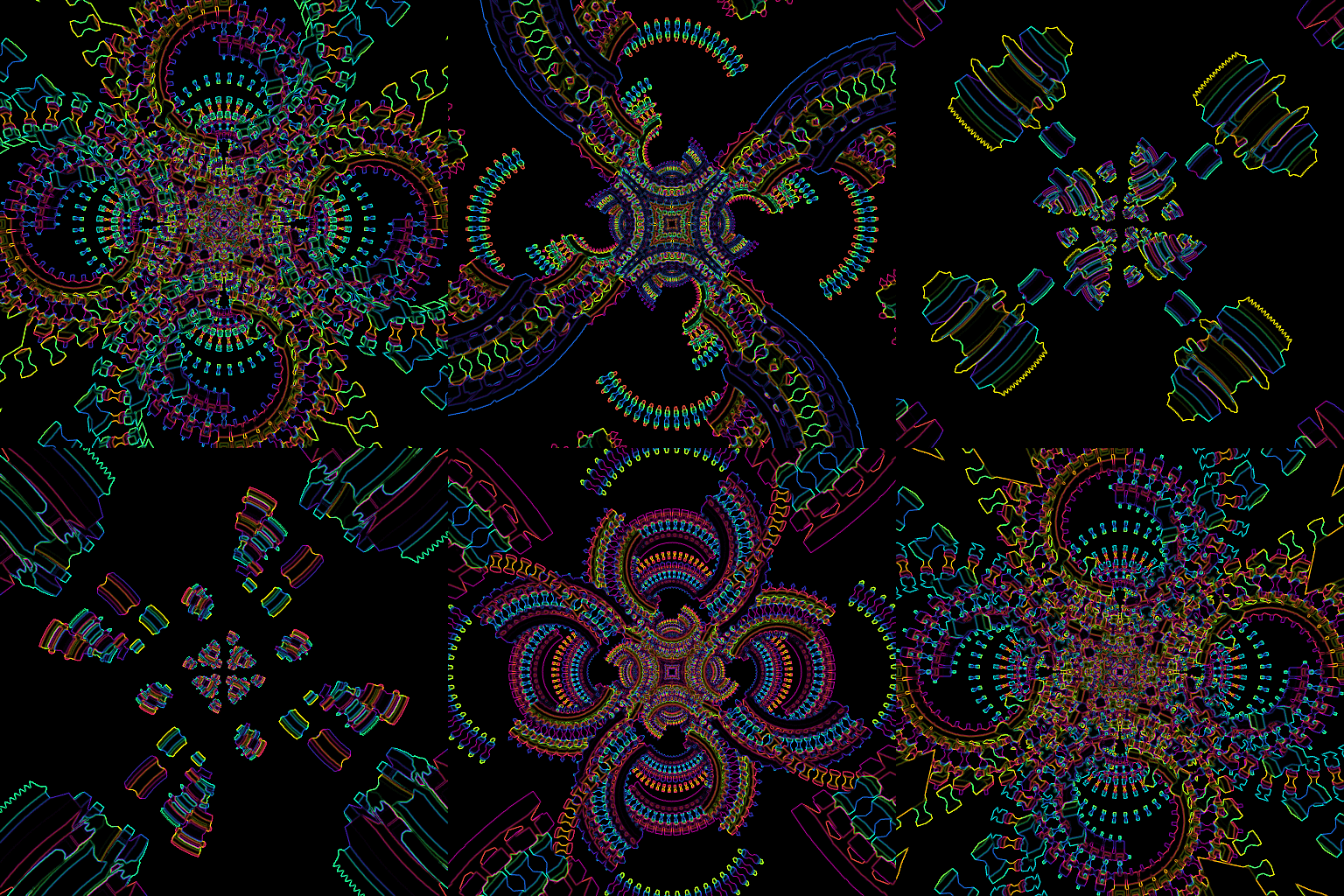
○ Mandala Viewing: Shift your attention from "inner scanning" to "outer wholeness"“
A mandala is not about drawing something, but about observing it.
Symptom monitoring is essentially "attention being trapped inside the body".
When you look at a mandala, let your gaze spread from the center to the entire pattern, and then back to the center from the outer circle, repeating this several times.
This is a visual version of "attention shifting training" that helps you move from "staring at your body" to "seeing the world".
Long-term practice will reduce introspective impulses and enhance a sense of stability.
○ Chinese Calligraphy - Regular Script Practice: Focus your attention on the tip of the brush, not your body.
Regular script requires steady, slow, and clear movements, which allows attention to naturally flow to the strokes rather than to the body.
Each stroke of the pen is an exercise in "detaching your attention from your body".
This is more effective than forcibly not monitoring, because you establish a new attention path through behavior.
Practice sentences:“"I let my body work on its own."”

○ From “Over-monitoring” to “Natural Flow” · Art Therapy
This exercise helps you understand that when your attention is constantly focused on your internal body, the image will appear crowded and tense.
When your attention expands outward, the scene will appear more open and free.
Through visual metaphors, you can experience that "changes in attention equal changes in bodily sensations".
1. Draw the "center of contraction".“
- Draw a dense array of small circles to symbolize that you are focusing all your attention on your body's interior.
- The addition of lines symbolizes "continuous scanning".
II. Draw the "expanded field of vision".“
- Draw soft, slowly spreading lines from the center outwards.
- Experience the looseness as your attention expands outward.
Once completed, you can upload your work and let AI help analyze your attention shifts.
Please log in before submitting your drawings and feelings.
○ 1429. Specific methods to reduce symptom monitoring: Log-guided approach
① Write down the times you monitored your body most frequently today.
② Describe the alternative behaviors you tried to interrupt the monitoring (music, walking around, writing, observing the outside world, etc.).
③ Record evidence of “the body recovering on its own” to allow the brain to accumulate the feeling that “it is safe without monitoring”.
Please log in to use.
When you stop monitoring, your body begins to regain its freedom. True security comes from "stopping watching" and allowing your body to function naturally.
 EN
EN  ZH
ZH  ES
ES  FR
FR  JA
JA