

Lesson 1441: An Overview of Illness Anxiety Disorder
Duration:60 minutes
Topic Introduction:This course will introduce the core concepts of "illness anxiety disorder" (also known as hypochondriasis), including behavioral characteristics such as excessive worry about health, exaggerated interpretation of mild symptoms, and repeated medical treatment. It will help students gain a preliminary understanding of this psychological state and its relationship with physical perception.
○ Typical features of illness anxiety disorder
- Ongoing health concerns:A deep belief that one has a serious illness, even without clear medical basis.
- Repeated self-examination:Take your temperature and heart rate frequently and observe small changes in your body.
- Iatrogenic anxiety:Going to the doctor frequently is a worry that the doctor may miss the condition or misdiagnose it.
- Anxiety Cycle:The more you worry and pay attention to your body sensations, the more it increases your discomfort and hypochondriacal behavior.
▲ AI interaction: Are you in a state of "disease anxiety"?
Illness anxiety disorder often causes people to overly focus on their health, magnifying minor discomforts into serious threats. This is not your fault, but a psychological dilemma that needs to be understood.
Please record the three times in the past when you were most worried about getting sick, including the situations, physical sensations, and inner thoughts at that time.
Think about how these worries are affecting your studies, work, or relationships, and describe them in a gentle, non-critical way.
Give this worry a gentle name, like "the alarm in my heart," to make it seem less scary.
Conclusion: When you choose to see it, you have taken the first step towards healing.
Click the button below to explore with AI whether you are overly concerned about your health and get preliminary understanding and suggestions.
○ Overview of Illness Anxiety Disorder · Music Therapy
Please play a slow and gentle piano piece and focus on the melody and your breathing. Let the music be like a hand, gently supporting your concerns about your health.
As you listen, write down the most recent moment you were most worried about getting sick: where it happened, what you saw, and how you felt in your body. Just describe, don't judge.
Give this worry a non-threatening name, like "the alarm in your heart." When it comes back, nod and say hello to it before deciding how to respond.
Write down one small act you'd like to do today: drink warm water, take a ten-minute walk, and go to bed early. Music will guide you, and action will follow.
I would like to end with a gentle word to myself: I am learning to be placed instead of being led away by fear.
Aromatherapy drinks
Recommended drinks:Vanilla Rose Tea
Recommended reasons:Rose soothes the mood, and vanilla brings a warm and reassuring scent. The combination helps relieve nervous tension and panic caused by illness anxiety.
usage:3-5 roses, a few vanilla beans, and hot water for 5-8 minutes. Honey can be added for a warming effect. Recommended for daily afternoon consumption.
○ Spiced Lamb Stew
Warming the body, while iron and B12 support energy and focus, making it ideal for those experiencing cold spells and recovering from the effects of cold. The spice blend soothes the mind and body, providing a satisfying and satisfying meal, making it a perfect seasonal dinner.
Healing Recipes
/home2/lzxwhemy/public_html/arttao_org/wp-content/uploads/cookbook/xiang-liao-dun-yang-rou.html(Please confirm that the file has been uploaded: xiang-liao-dun-yang-rou.html)🎨 Themed Mandala
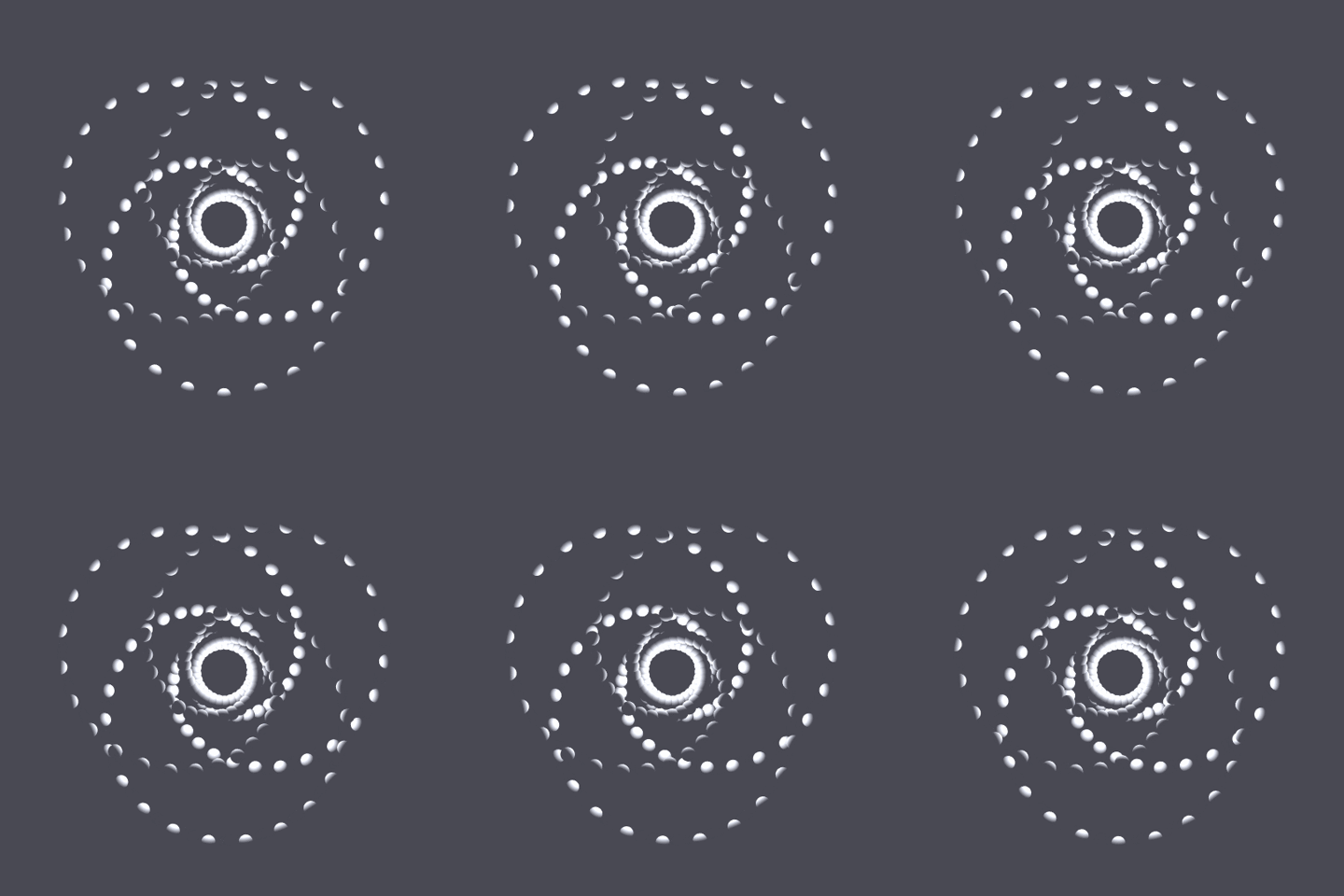
We recommend creating a mandala themed around "Peace and Trust," guiding the body from a state of intense tension to a state of gentle care. A spiraling, gradual structure can symbolize a return from external fear to inner peace.
Applicable issues:Health fears, excessive self-examination, and lack of trust in the body.
○ Medieval Gothic calligraphy practice
Calligraphy practice can help us transform tense thoughts into regular and orderly line rhythms, and is one of the ways to practice a sense of stability.
Practice sentences:
“I chose to trust my own path to recovery.”
I choose to trust my path to recovery.
It is recommended to repeat the writing three times a day, using dark ink and a slow rhythm to guide the establishment of inner stable beliefs.

○ Overview of Illness Anxiety Disorder: Suggestions for Drawing Therapy
This page uses drawings to externalize "persistent worry about serious illness." Illness anxiety disorder often manifests asCatastrophizing, double-checking, and seeking reassurance about body signalsBy mapping out our triggers, automatic thoughts, and behavioral patterns, we can identify areas that can be gently adjusted and gradually shift our focus to healthy behaviors that are controllable.
1. Worry Cloud Map (Clues—Hypotheses—Evidence)
- Draw several "clouds" on paper and write a common concern sentence on each cloud, such as "chest tightness may be a serious heart disease."
- Use arrows to connect the cloud to the “trigger tags” below: coffee, staying up late, arguments, weather changes, sitting for a long time, etc.
- There are two columns under each cloud: the left column contains facts that support the concerns, and the right column contains disproven or more balanced facts. Only observable information is recorded, such as "relieved after activity" and "recent physical examination was normal."
- Add a list of "controllable actions" on the edge of the cloud map: hydration, stretching, regular sleep and rest, limited time to search for information online, etc., to shift the focus from results to process.
2. Perception-Interpretation-Action Cycle (IIA Cycle)
- Draw three connected circles:Feel(rapid heartbeat, stabbing pain, bloating) → explain(Is it a serious illness?) → action(Search, check, seek comfort, avoid.) Then from "action" back to "feeling," forming an amplification loop.
- Draw an "intercept bar" on the arrows between "Explanation" and "Action" and write three steps of micro-intervention: the first is abdominal breathing for 60 seconds, the second is to delay for 10 minutes before deciding whether to search, and the third is to record an objective observation (intensity 0-10, duration, trigger clues).
- Write an alternative sentence template next to the picture: the original sentence "I must be sick" is rewritten as "This may be a short-term fluctuation caused by tension. I will do some breathing and stretching first, and then re-evaluate the intensity after 10 minutes."
Tip: Drawing is for awareness and communication, not a substitute for medical treatment. If acute red flags appear, seek medical attention immediately. Carrying this page with you will help you communicate effectively with your doctor or psychologist about "when it becomes more obvious and what can help me."
Please log in before submitting your drawings and feelings.
○ 1441. Overview of Illness Anxiety Disorders • Journal-Based Guidance Suggestions
① Gentle understanding: Illness anxiety isn't just pretentiousness; it's a long-term experience of fear. Please allow yourself to be seen.
② Write down the three times in the past when you were most concerned about your health, and record the situation, feelings, and physical reactions at that time.
③ Take stock of the impact these worries have on your life: study efficiency, social relationships, or sleep quality, give one example each.
④ Try giving these worries gentle names, such as "body reminders," to make them less threatening.
Please log in to use.
Illness anxiety is a desire to control the unknown, but trust and relaxation are the responses the body truly needs. May you transform fear into understanding from today.
 EN
EN  ZH
ZH  ES
ES  FR
FR  JA
JA