

Lesson 1449: Web Search and Information Overload
Duration:60 minutes
Topic Introduction:This lesson focuses on the common phenomenon of "internet search and information overload" in illness anxiety. When you experience even the slightest discomfort, you might habitually open a search engine, eagerly searching for answers among thousands of pieces of information, only to become increasingly fearful, as if all symptoms point to a serious illness. This lesson will help you understand why the brain tends to only see the most frightening results when in an anxious state, how to distinguish between reliable and unreliable information, how to set search boundaries and pace for yourself, practice stopping the impulse to "check again to feel at ease," and gradually shift your attention from catastrophic imaginings back to your actual physical sensations and present life, allowing the internet to become a helpful tool rather than an amplifier of panic.
How does online searching amplify fear during illness anxiety?
- Negative filtering effect:When anxious, the brain is more likely to focus on information about the "worst-case scenario" and ignore normal and benign interpretations.
- Symptom matching illusion:Many common symptoms can appear in both serious illnesses and minor discomforts. It is difficult to make an accurate judgment by searching alone, but it is easy to be misunderstood as a "high match".
- Information fragmentation:The constant switching between multiple tags and web pages makes it impossible for you to form a clear judgment, leaving you with only a vague and intense sense of fear.
- Comfort dependency cycle:Each time panic strikes, searching temporarily alleviates anxiety, but the next time discomfort arises, the reliance on searching becomes even stronger, forming a new conditioned reflex.
Key points of the healing class:
This course will guide you through the formation of a "conditioned reflex to internet searching," teaching you to record the triggers, timing, duration, and emotional changes associated with each instance of "searching for symptoms." Together, we will design safer information usage principles, such as limiting search times, choosing reliable sources, and setting "stop lines" for yourself. Through breathing exercises, guided music, and artistic writing, we will help you reconnect with your body and the real world during moments of quiet when you are no longer in a rush to search.
[arttao_Healing_Course_tts_group1446_1450]▲ AI Interaction: Record your "Search Intensity Curve"“
Please answer the three questions in the interaction below:
1. In what circumstances did you last search online because you were worried about a certain symptom? How did you feel physically at that time?
2. How did your emotions change from entering keywords to opening multiple web pages? What percentage of your emotions were anxiety, fear, numbness, or relief?
3. After the search ended, how did your lifestyle change? Did you repeatedly check your body, schedule multiple check-ups, or find it difficult to concentrate on anything throughout the day?
In conclusion: Once you can clearly depict the "search surge curve," you've already distanced yourself from it. Next, we'll use gentler methods to replace the false sense of security derived from over-reliance on the internet.
Click the button below to work with AI to organize your search history, distinguish between "real signs that need medical attention" and "exaggerated disaster imaginations," and set small, actionable changes for yourself.
○ Web Search and Information Overload · Music Guidance
When you feel the urge to open the search engine again, try temporarily switching to "listening to music for three minutes before deciding." Choose instrumental music with a steady rhythm and relatively simple layers, and focus your attention on a few elements: changes in timbre, the interplay between instruments, and the fluctuations in volume, rather than the mental images of your illness.
During practice, draw a horizontal line on a piece of paper and mark the "anxiety intensity" from 1 to 10 from left to right. While the music is playing, mark a point on the line every 30 seconds to indicate the level of tension at that moment. You don't need to force yourself to relax immediately; just honestly record each slight change.
If your anxiety remains high after three to five minutes, write down "one problem" that you're truly worried about, instead of continuing to search vaguely. The role of music here is to give you more time to allow reason and self-care to intervene.
In conclusion: Every time you make a different choice between "searching immediately" and "stopping to listen to a song first," you are subtly rewriting your reaction path.
Herbal healing tea drinks
Recommended drinks:Lemon balm and chamomile herbal tea
Recommended reasons:Melissa and chamomile are commonly used in traditional herbal medicine to relieve tension, reduce palpitations, and alleviate stomach upset. They are suitable for establishing a gentle intermediate step before "wanting to look up symptoms online." Let your body receive the signal that "it's okay to slow down" before deciding whether further action is needed.
usage:Take 3 grams of lemon balm and 3 grams of chamomile, and steep in hot water at about 90°C for 8 minutes. You can add a small amount of honey according to your taste. It is recommended to drink this in the evening or before checking your physical condition. While drinking, take three deep breaths, letting the temperature and aroma remind you: take care of yourself first, instead of rushing to find the worst answer.
○ Alkaline Therapy: Green Vegetable and Nut Energy Bowl
Long-term anxiety about illness and constant searching consume a lot of psychological and physiological energy, making people more susceptible to relying on fast food and sweets to "compensate," which further exacerbates fatigue and mood swings. An alkaline diet, mainly consisting of dark green vegetables, small amounts of whole grains, and nuts, helps stabilize blood sugar and provides continuous and gentle energy support, making you more capable of making real medical decisions instead of endlessly searching through a sea of information.
Healing Recipes
/home2/lzxwhemy/public_html/arttao_org/wp-content/uploads/cookbook/alkaline_1449(Alternatively, you could try relaxed="1" or use an existing filename.)○ Theme Mandala: A Quiet Island in the Sea of Information
Mandalas are not about drawing something, but about observing. The theme mandala for this lesson can be imagined as a quiet, slowly rotating island in the center of a vast ocean of information. You can make the outer circle dense and slightly cluttered, symbolizing constantly refreshing web pages and pop-up headlines; the closer to the inner circle, the simpler and softer the lines, representing the facts you can truly confirm at this moment: you are breathing, sitting in a chair, and you still have the choice to deal with fear.
When practicing, don't focus on "drawing beautifully," but rather on observation: observe the movement of your gaze from the tension of the outer circle to the tranquility of the inner circle, and ask yourself, "Which circle should I stay in?" This visual experience will provide you with an inner image to evoke the next time you want to open a search engine.

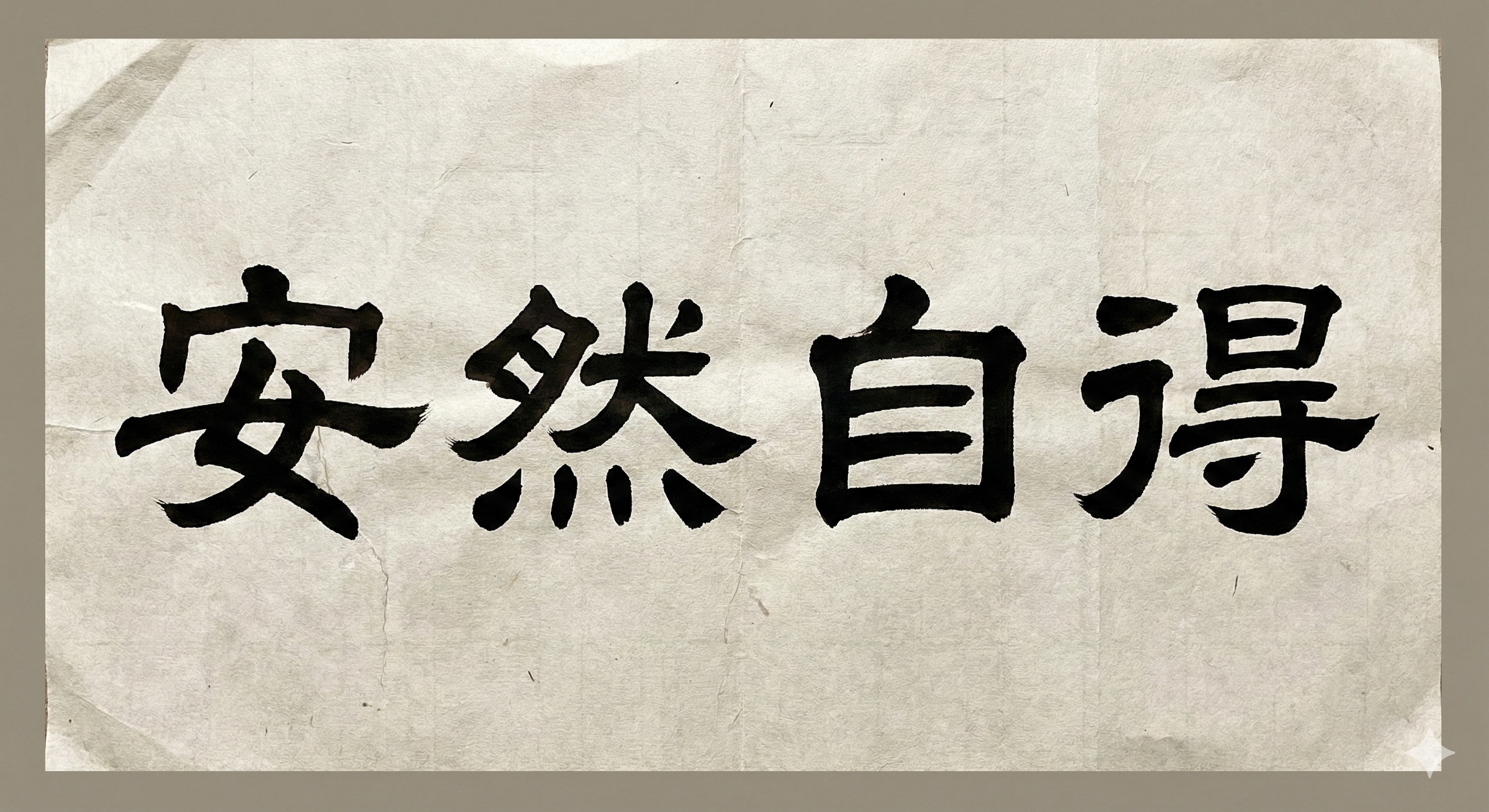
○ Modern art calligraphy practice
Modern calligraphy does not emphasize the neatness of traditional characters, but focuses more on emotion and rhythm. You can use pens of different thicknesses to write a sentence multiple times on the same piece of paper, allowing the flow of lines to express your process from tension to relaxation.
Practice sentences:
“"I can stay in this moment instead of being dragged away by the worst outcome."”
I can stay with this moment, not with the worst scenario.
First, write the first half of the sentence with heavier pressure, then gradually lighten the pressure to write the second half, allowing the change in wrist strength to synchronize with the easing of internal tension. After finishing, quietly observe the undulations of the lines across the entire page, and feel which part best resembles your ideal rhythm. Circle that small section as a "safe passage" for future repetition.
○ Internet Search and Information Overload: Guiding Suggestions for Art Therapy
This page uses creative illustrations to externalize the effects of "internet searching and information overload" on you. Anxiety about illness isn't just about how many pages you search; it's about how your heart rate, breathing, sleep, and daily rhythm are disrupted before and after each search. By drawing and writing down these experiences, you can see more clearly how you are gradually drawn into a vortex of fear, giving you a better chance to make different choices at crucial moments.
I. Search Spiral Diagram
- Draw a spiral line on a piece of paper from the outside in. Label the outer circle as "Seeing symptoms", "Starting to worry", and "Opening a search". Label the inner circle as "More fear", "Repeated self-checking", and "Difficulty falling asleep".
- Write a typical thought next to each node, such as "What if it is a serious illness?" or "I will feel even more uneasy if I don't get checked."
- Finally, draw a small square in the center of the spiral and write "Pause," "Take a deep breath," and "Ask a professional" to symbolize the new options you want to join in the future.
II. Information Traffic Lights
- Draw three squares side by side and write "Reliable Information", "Ambiguous Information", and "Scare Information" on them respectively.
- Recall what you saw in your most recent search, write keywords into different boxes, and observe which category has the highest percentage.
- Below “Reliable Information”, write down a principle you are willing to follow, such as “Only look at official medical institution websites” or “Stop making horror claims that are repeated more than twice.”
Tip: You don't need to completely stop searching all at once. Instead, use drawing and recording to see when you've been driven by information. If you are persistently troubled by fear or it affects your medical decisions, please consult a professional doctor or mental health worker promptly to ensure your decisions are based on realistic assessments rather than isolated keywords.
Please log in before submitting your drawings and feelings.
○ 1449. Web Search and Information Overload: Log Guidance Suggestions
① Search Trigger Log: Write down the three most recent scenarios that made you unable to resist searching for information about diseases online, including the time, how you felt, and the most terrifying result you could think of at the time.
② Search process description: Record how many web pages you usually open, how long you stay, whether you repeatedly return to the same text, and the change curve of your mood from 0 to 10.
③ Real-world action comparison: Write down what you did in reality after each search, whether it was helpful self-care or repetitive checking or avoidance that aggravated anxiety.
④ New experimental plan: Design a small experiment to try next time similar concerns arise, such as taking three deep breaths, writing down a question to ask a doctor, or limiting the search time to no more than five minutes, and record the experimental results in a log.
Please log in to use.
Through this course, you will gradually see how "internet searches and information overload" contribute to and amplify your anxiety about illness, and begin to build a gentler and more sustainable system of peace for yourself through music, herbal teas, alkaline diets, mandala viewing, and modern calligraphy practice.
 EN
EN  ZH
ZH  ES
ES  FR
FR  JA
JA