

Lesson 146: The Fear of Losing Control—The Core of Fear
Duration:70 minutes
Topic Introduction:
Behind almost every intense fear lies a core belief:“"I will lose control."”
Losing control can mean: losing control of emotions, losing control of the body, losing control of behavior, being seen at my worst, or doing something irreversible.
This lesson will help you understand the psychological roots of the "fear of losing control" and how to shift your focus from the feeling of losing control to "I can still hold onto a little bit of what I can control".
The essence of the fear of losing control: not danger, but weighing the pros and cons.
- Panic-induced loss of control:They worry about sudden physical breakdowns, such as fainting, suffocation, or heart problems.
- Cognitive loss of control:I worry that my brain will get stuck, I won't be able to speak, or I'll experience a mental breakdown.
- Social outburst:They worry about being seen as vulnerable, misunderstood, or judged.
Lesson 146: The Fear of Loss of Control—The Core of Fear (Click to listen to the reading, view the content)
Of all the experiences of terror and chronic anxiety, the "fear of losing control" often lies at the deepest level. What you truly fear isn't the racing heart, dizziness, mood swings, or environmental changes, but the worry that if these experiences continue, you will lose control of yourself, be unable to maintain basic functions, or even cease to exist as a "normal person." This fear doesn't stem from the present reality, but from the imagined collapse of your personal boundaries. The brain interprets brief, intense feelings as an irreversible slide, constantly sounding alarms to try and prevent any experience that might approach "loss of control." The problem is, the more you try to control, the more tense your nervous system becomes, making the feeling of losing control even more likely. It's important to understand that the feeling of losing control is not the same as actual loss of control. Even in the most intense terror, your consciousness remains; you can still breathe, stand, move, and hear. The brain constantly emphasizes "about to lose control" because it cannot tolerate uncertainty, thus treating the unknown as danger itself. The core of healing is not proving you will never lose control, but establishing a new experience: even when feelings are intense, I can still exist within them, and they will naturally change. What you need to practice is not controlling the outcome, but allowing the process. When you stop focusing entirely on "Will I completely break down?" and instead focus on the concrete experience happening in the present moment, fear loses its core fuel. Losing control is not the endpoint you must avoid, but a misinterpreted signal. When you can maintain a sense of presence amidst fluctuations, you will find yourself much more stable than you imagined.
▲ AI Interaction: What part of your life are you most afraid of "losing control"?
What you fear is not the event itself, but the feeling of "I will lose control".
Tell me the image that scares you the most, and I'll help you break it down.
Some fears, once broken down, become loose and less overwhelming.
You're not close to losing control; you're just too concerned about losing control.
A sense of loss of control is often accompanied by a loss of rhythm. Music can help the body "reset its beat".
Let the melody take you from the frantic internal rhythm back to a reliable external rhythm.
○ Eastern Healing Tea: Longan and Goji Berry Calming Tea
Recommended reasons:Calming the mind and relieving tension helps reduce feelings of "internal chaos".
practice:Soak 2-3 longans and a small handful of goji berries in warm water.
○ Stable Dietary Therapy: Black Rice and Longan Heart-Nourishing Porridge (ID146)
In the depths of fear of losing control, the body often experiences energy depletion and an inner emptiness, requiring nourishment that is both supportive and gentle. Black rice provides substantial and stable energy, while the warm sweetness of longan helps soothe the mind. This porridge is suitable for consumption after emotional fluctuations or at night. Through a real and lasting feeling of fullness, it helps the body reaffirm its integrity and boundaries, allowing a sense of stability to slowly build from within.
Stable energy
Restore a sense of boundaries
Open Recipe
◉ Dietary Therapy: Black Rice and Longan Porridge
Black rice, also known as "black rice," is warm in nature and nourishes the kidneys and blood, while also having a certain qi-tonifying effect. Longan pulp is sweet and warm, tonifying the heart and spleen, and calming the mind. When these two are cooked together into porridge, the porridge has a deep color and a mild aroma. It provides a feeling of fullness while offering stable energy to the body without being too greasy, making it a suitable small bowl of nourishment for those who use their brains for long periods, sit for long periods of time, or are prone to low mood.
Nourishing blood and kidneys Calming and warming Relieve fatigue
I. Recommended Dietary Therapy and Reasons
Recommended dishes:Black rice and longan porridge (ID 20)
Recommended reasons:Compared to regular white rice porridge, black rice contains more dietary fiber and anthocyanins, which helps improve chronic fatigue and a feeling of emptiness. Longan, on the other hand, is more nourishing to both the heart and spleen, making it suitable for those who are prone to overthinking, have unstable sleep, or are recovering from menstruation. Overall, this is a mild and nourishing porridge, suitable for consumption during cooler weather, after exertion, or when emotions need to be "supported."
2. Recipe and Method
Recipe (1–2 servings):
- 30g black rice
- 20g of rice (to increase the smoothness of the porridge)
- 8–12 dried longan fruits
- 700–800 ml of water
- 10–15 g of rock sugar or brown sugar (optional)
practice:
- Wash the black rice and white rice separately and soak them for 30 minutes in advance to shorten the cooking time and increase the softness and stickiness of the porridge.
- Rinse the dried longan pulp briefly and set aside.
- Add water, black rice, and white rice to a pot, bring to a boil over high heat, then reduce to low heat and simmer for 25–30 minutes, stirring occasionally to prevent sticking.
- Add the dried longan pulp and continue to simmer over low heat for 10–15 minutes, until the black rice grains crack open and the rice soup turns a deep purple color and becomes slightly viscous.
- If you prefer a slightly sweet taste, you can add an appropriate amount of rock sugar or brown sugar and cook for another 3–5 minutes until completely dissolved.
- After turning off the heat, let it simmer for 3 minutes to allow the porridge to thicken slightly before serving.
3. Small rituals for body and mind
The process of cooking porridge is itself a form of "slowing down." While simmering on low heat, you can tidy up the table, do a few slow stretches, and allow yourself to briefly escape from the high-pressure mode.
When you pick up a bowl of black rice and longan porridge, you can first observe its color and aroma, and bring your attention back from your chaotic thoughts to the sensory experience of the present moment.
Hold each bite for a few seconds, feeling the warmth travel from your mouth to your stomach. Use this bowl of sweet-smelling porridge to remind yourself that both your body and your emotions deserve to be taken care of.
4. Dietary Therapy Experience Record
- Record the time of consumption (breakfast/dinner/after working overtime) and the physical and mental state at the time (tired, tense or empty).
- Observe mental clarity, body warmth, and mood changes within 1–2 hours after consumption.
- If consumed for several consecutive days, you can record your sleep quality, your mental state upon waking in the morning, and changes in physical strength before and after your menstrual cycle.
V. Instructional Videos (approximately 4–7 minutes)
◉ Video Title:Black Rice and Longan Porridge: The Warming and Nourishing Power of Dark Grains
6. Precautions
- Black rice is glutinous, so those with weak digestive function or prone to bloating should eat it in small amounts or increase the proportion of white rice to reduce the burden.
- Longan is warm in nature and tends to be hot. People who are prone to getting a sore throat or have a red tongue and dry mouth should reduce the amount or frequency of consumption accordingly.
- For those who need to strictly control their sugar intake, it is recommended to reduce the amount of sugar or omit it altogether. The sweetness of the porridge itself can be increased by extending the cooking time.
hint:This recipe is suitable as part of daily nourishing and conditioning; if you experience persistent palpitations, fatigue or significant sleep disturbances, please seek medical attention promptly and do not rely solely on dietary therapy.
○ Humanist Script from the Italian Renaissance Period · Lesson 146 Writing Exercises
Today's healing phrase:
Walk steadily, rest easy.
In-depth analysis:
The fear of losing control is essentially the worry of "not being able to stand firm".
Humanist Script's proportions and stable center of gravity train you to maintain a sense of movement amidst uncertainty.
Walk steadily, rest easy. It's not about demanding that you remain calm all the time, but rather reminding you that as long as you keep moving, rest will come.
Writing Skills (Advanced Version):
- The center of gravity of the letters drops:Strengthen the physical imagery of "standing firm".
- Uniform row spacing:Avoid sudden changes in your mental pace.
- Do not write too many consecutive characters:Prevent your thoughts from spiraling out of control.
- Restraint in the first stroke:Not applying force suddenly symbolizes allowing the process to unfold.
- Repeat the entire sentence:Build a sense of security through rhythm.
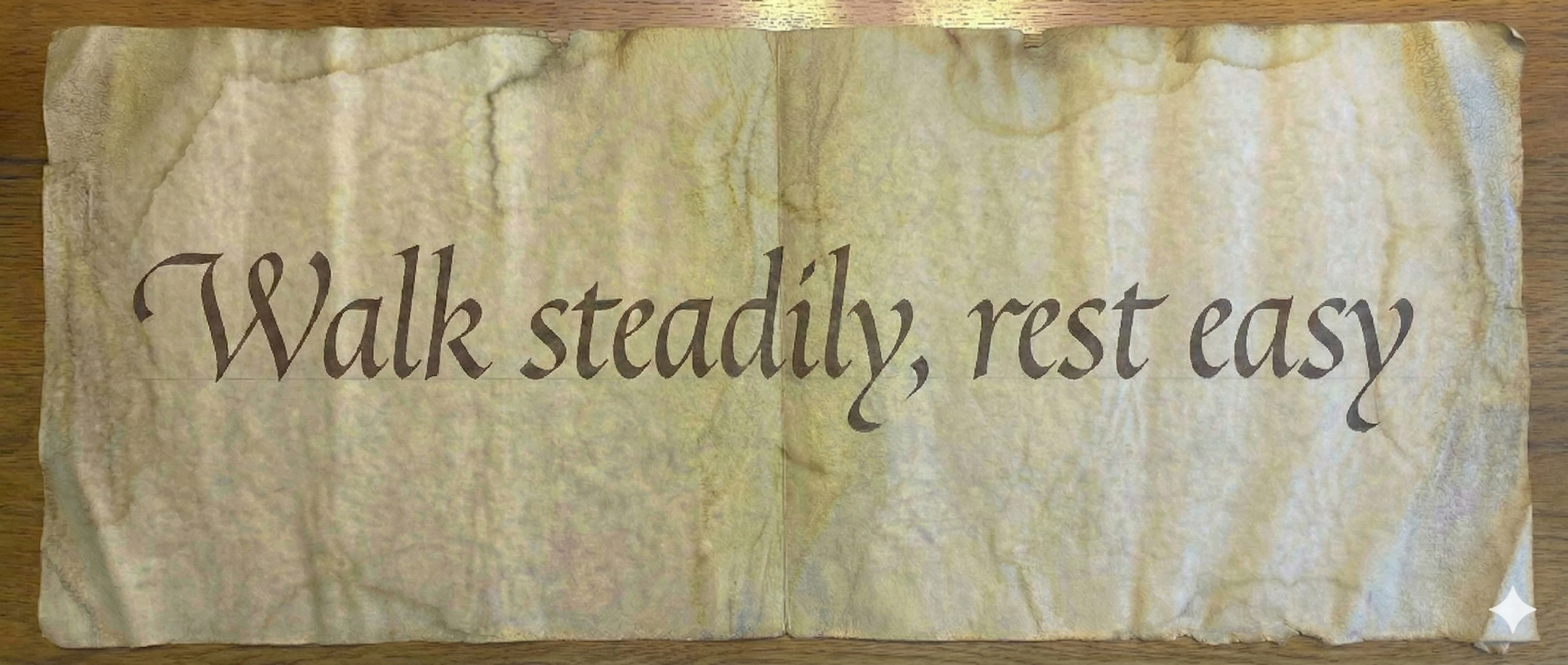
Image Healing: Guided Mandala Viewing - Lesson 146
Please observe a mandala with a solid center and stable structure. The image should have a clear center of gravity, rather than appearing floating or sharply diffused.
Focus your gaze on the central area, feel a sense of "standing still," and then slowly move your gaze outwards.
If you feel a sense of loss of control, there's no need to avoid it. Simply bring your attention back to the center and reassure yourself, "I'm still here."
Mandalas are not about drawing something, but about observing. When you experience a stable center of gravity in your vision, your body will gradually learn to maintain its existence amidst fluctuations.
The mandala in this lesson is based on a "stable center and solid structure," symbolizing the rebuilding of self-support within the core of fear.
◉ One gaze is sufficient; no need to repeat.

Lesson 146: Guided Drawing - Finding a Stable Point
① Draw a small square in the center of the paper, symbolizing the small, controllable area you can manage.
② The outside is drawn with concentric circles of surging lines, representing external stimuli, but without touching the cube.
③ Add a colored dot inside the block as a reminder: chaos can be on the outside, but stability remains inside.
Please log in before submitting your drawings and feelings.
○ 146. Fear of Loss of Control: Journaling Guidance Suggestions
① At what moment today am I most worried about "losing control"?
② What signals did my body give me? (For example: sudden tension, sudden confusion)
③ Which part is still under my control?
④ If I were to give today a "stability rating", what score would I give it?
Please log in to use.
What you fear is not the loss of control itself, but the "imagination of losing control." Regaining even the slightest bit of control is the most powerful response to fear.
 EN
EN  ZH
ZH  ES
ES  FR
FR  JA
JA