

Lesson 1550: Cognitive-Behavioral Strategies: Trigger-Desire-Response Closed-Loop Training
Duration:75 minutes
Topic Introduction:This course focuses on using cognitive-behavioral strategies to train the complete "trigger-craving-response" loop, making cravings no longer the only option. We will help you identify the emotional and situational cues that trigger cravings, recognize the addictive beliefs that automatically pop into your brain, such as "I can't take it" or "It's okay if it's just this once," and then learn how to intervene with new, more realistic ideas. At the same time, the course will guide you through practicing delayed responses, alternative behaviors, craving curve observation, and self-recording cards, gradually transforming the originally automatic chain into smaller, breakable steps. The goal is not to completely eliminate cravings, but through repeated training, to get the brain used to having multiple alternative outlets when cravings arise, thereby enhancing self-efficacy and a sense of security.
○ Trigger-Desire-Response Closed-Loop Training: Key Points
- Identify trigger:Record the emotions, times, places, people, and situations in which cravings are particularly likely to occur, such as lonely nights, after arguments, when payday arrives, or invitations to specific gatherings.
- Observe the desire:Treat your desires as a curve of "rise-peak-fall," not as an unchanging monster. Learn to label their intensity on a scale of 0–10, and practice delaying your reaction in the middle of the curve.
- Challenge Automatic Ideas:Identify typical addictive beliefs (I can't live without them, I'm already like this anyway), and rewrite them with evidence and balancing statements, such as "Just because I want to use it this time doesn't mean I can't do it forever."
- Design alternative reactions:Prepare 2-3 specific alternative behaviors for high-risk situations, such as leaving the room, making a phone call, writing in a journal, doing breathing exercises, or drinking a hot beverage, turning "use it immediately" into "do something else first".
- Closed-loop review:Post-use review is equally important: What triggered it? What were you thinking at the time? What other possible forks were there? Use the records to transform the experience into training material for the next time.
▲ AI Interaction: Create Your "Trigger-Desire-Response Training Card"“
The key to cognitive behavioral training is not to prevent yourself from ever being triggered, but to learn to insert new options between triggering and responding. This exercise invites you to create your own training card.
Please describe the most recent instance of a strong urge or use: What happened? Where were you? Who were you with? How did you feel, both physically and emotionally? Please be as specific as possible.
Next, write down the three automatic thoughts that come to mind at that moment, along with a rating of the intensity of your craving (0–10). Then try to write a more balanced response for each automatic thought.
Finally, design two actionable alternative responses for similar situations, such as "go outside for five minutes before making a decision" and "write three lines in your journal before considering whether to see that person."
Click the button below to input your scenario, thoughts, and preparatory actions into the AI. The AI will then help you organize them into a reusable "trigger-craving-response training card" and work together to optimize the alternative strategies within it.
○ Trigger-Desire-Response Closed-Loop Training: Music Therapy
Choose upbeat but not overly stimulating music, and treat the "5-10 minutes of peak training" as a training period that needs to be accompanied by music, rather than a black hole that you can only endure.
While listening to the music, you can take deep breaths and silently describe your current state to yourself: "I'm currently in the upward phase, I'd rate it a 7 out of 10," "I have the urge to use it, and I'm trying to hold on for a few more minutes." Use language and music together to name this experience, instead of just leaving behind a vague feeling of discomfort.
When the music ends, note whether the intensity of the craving changes, and how long you successfully delayed. Each additional minute or two of delay allows the brain to learn a new curve pattern.
In conclusion: Music is not meant to suppress desires, but to provide a "training partner" that keeps you company during peak moments.
○ Oriental healing tea
Recommended drinks:Aged Pu-erh Grounding Tea
Recommended reasons:Pu-erh tea is mellow and smooth, with a deep and stable flavor profile, making it suitable as a "fixed ritual during training." Pair it with a cup of warm Pu-erh tea during each delayed reaction or craving practice session to remind your body: as I distance myself from old patterns, I am also being stabilized by a cup of tea.
usage:Take 5 grams of ripe Pu-erh tea, and after waking it up, brew it with 95℃ hot water at a tea-to-water ratio of approximately 1:30. Keep the first two infusions to 20-30 seconds, and then gradually extend the time thereafter. It is recommended to brew a small pot before and after high-risk periods, and use it in conjunction with training.
○ Japanese medicinal food: Miso Soup with Brown Rice
This refreshing soup, made with miso, broth, tofu, and various vegetables, paired with a small amount of brown rice, provides mild carbohydrates and plant-based protein, helping to stabilize blood sugar and mood swings. It's suitable as a main meal on "training days," allowing the body to feel full and grounded without overburdening it.
Healing Recipes
/home2/lzxwhemy/public_html/arttao_org/wp-content/uploads/cookbook/sakamushi-asari.html(Please confirm that sakamushi-asari.html has been uploaded)Free Mandala Healing
Image Healing: Free Mandala Stability Guidance 12
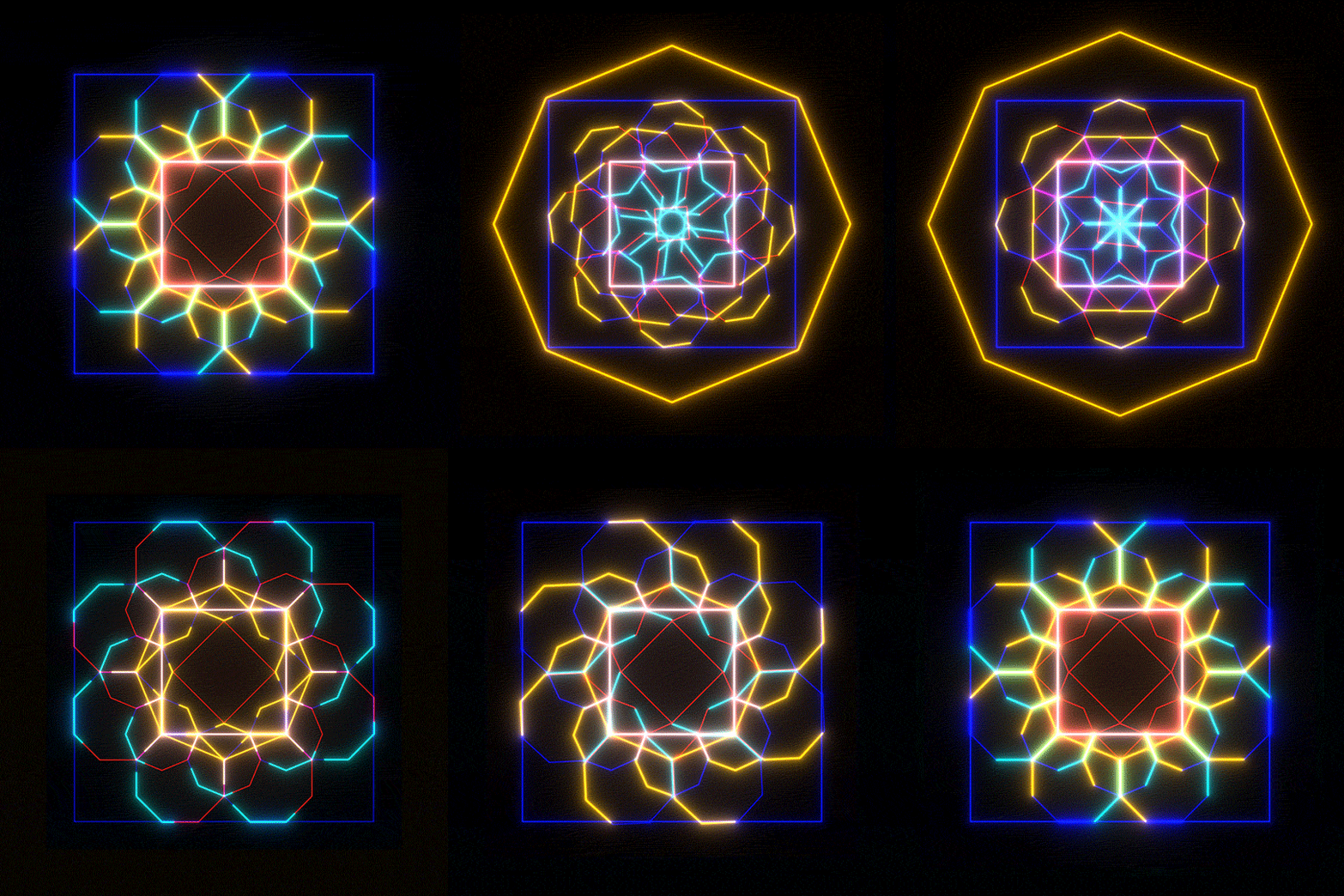
Please focus your gaze on a point on the outer circle of the mandala, then slowly move your gaze around the outer circle once, and then gently move towards the inner ring, feeling the rhythmic change from the outside to the inside, rather than rushing to reach the center.
The trigger-craving-response closed-loop training is essentially an observation exercise moving from the "outer circle to the inner circle." Remember: a mandala is not about drawing something, but about observing. You don't need to design a pattern; simply be aware of your own changes while observing—when craving arises, does your gaze become impatient? When you consciously slow down your observation, does your breathing also slow down?
When the craving arises again, you can return to the mandala and move your gaze between different bands for a short time, treating this pause as a new "reaction option." Let your body remember: before reacting automatically, I still have room for observation and selection.
○ Suggestions for seal carving calligraphy practice
When training the trigger-craving-response loop, seal carving and calligraphy can serve as a physical exercise that "breaks down impulses into individual strokes," helping you experience the process of transitioning from automatic reactions to rhythmic movements.
- Introduction to the characteristics of seal carving:
Seal carving emphasizes structural layout and line continuity. Each cut requires pre-planning of the position and direction, which is highly similar to the process in cognitive behavioral training of "first seeing the trigger and idea, then deciding on the reaction". - Written words:
Guarding the Heart to Form a Ring
Steady the Heart, Rewrite the Loop - Psychological Intention:
When you inscribe the phrase "Guard your heart to form a loop," remind yourself: closed-loop training is not self-punishment, but a form of protection. You are using conscious choices to gradually rewrite the loop that originally automatically pushed you towards use. - Knife skills:
Practice the rhythm of "first set the point, then make the cut": first lightly touch the stone surface with the tip of the knife to determine the starting point, then steadily make the cut in the middle of your exhale. Let each stroke be a symbolic action of "I have seen the trigger, and then I have chosen to respond in this way". - Emotional transformation:
When you feel like you're being led by your desires and it's hard to stop, put your phone or other objects away for a moment, and instead pick up a carving knife to complete a few lines on the stone. Turn the feeling of helplessness of "I can only follow my desires" into the experience of "At least I can finish this one stroke."

○ Trigger-Desire-Response Closed-Loop Training: Guiding Suggestions for Art Therapy
This page uses visual aids to help you draw the chain of "trigger-craving-response," and then gradually add new outlets. The drawings are for self-awareness and preparation for medical communication only, and do not replace medical diagnosis or standardized addiction treatment.
I. Desire Curve and Time Buffer Zone
- Draw a coordinate system on paper with time on the horizontal axis and the intensity of desire (0–10) on the vertical axis. Draw the "desire curve" that you are familiar with: from the initial feeling of the trigger, to the highest point, and then slowly declining.
- Mark a few key points on the rising part of the curve: starting to notice thoughts, body tension, increased heart rate, starting to make excuses, etc., and write down your common automatic thoughts.
- On either side of the highest point of the curve, draw a short "buffer zone" (e.g., 5–10 minutes) in different colors, and write down alternative behaviors you would like to try during this time, such as walking, journaling, drinking tea, or contacting supporters.
- After you finish, write a reminder next to the chart, such as: "Desires have peaks, but they will naturally fall back. My task is to get through the buffer zone, not to make a decision immediately."“
II. Trigger-Thirst-Reaction Flowchart and New Exit Design
- Draw several consecutive boxes from left to right: External triggers (situation, interpersonal, place) → Internal feelings (emotions, bodily signals) → Automatic thoughts → Rising cravings → Old behavioral responses → Results and consequences.
- Write down real details of your most recent experience in each box, such as "being home alone at night", "feeling empty", "why not indulge myself once", "craving a 9", "contacting an old friend", "feeling guilty and feeling unwell the next day".
- Then, draw a small branch box above each box and write down new exits you can try, such as "give yourself a score and take a deep breath", "text a friend", "step outside for ten minutes first", "write three lines of feelings before deciding".
- Ultimately, use an arrow to circle the new exit that you are most realistic and willing to try, and make it the focus of your practice for the coming week, rather than demanding that all aspects be perfectly changed at once.
Tip: You can continuously accumulate these curves and flowcharts to serve as a basis for communication with yourself and professionals. If you find yourself frequently in high-risk situations or experiencing a strong risk of self-harm, suicide, or overdose, please contact professionals or emergency services immediately. Safety should always be your top priority.
Please log in before submitting your drawings and feelings.
○ 1550. Cognitive-Behavioral Strategies: Trigger-Craving-Response Closed-Loop Training • Log-Guided Suggestions
① Recall the most recent situation in which you had a strong craving or had already used the product, and write down the external environment (time, place, people) and internal feelings (emotions, physical reactions) in a few sentences.
② Break down that experience into three parts: "trigger - craving - response": write down what the trigger was, how strong the craving was at the time, and what you ultimately did. Be as specific as possible, and avoid judging yourself.
③ Design two possible new exits for this link: for example, "When the demand exceeds 7 points, leave the scene for five minutes" or "Write three lines in the log before using it." Write down your concerns and expectations for these new exits.
④ At the end of the journal, write an encouraging or promise-making sentence for yourself today, such as "I am learning to understand my own path, rather than being defined by it," and let this sentence serve as a reminder for the next practice.
Please log in to use.
Triggers and cravings won't completely disappear, but you can learn to coexist with them step by step and rewrite "automatic reactions" into "conscious choices" through closed-loop training, thus protecting yourself with more clarity and safety.
 EN
EN  ZH
ZH  ES
ES  FR
FR  JA
JA