

Lesson 1556: Law and Occupational Safety: Prescription Drug Abuse, Driving, and Work Compliance
Duration:75 minutes
Topic Introduction: This course focuses on the intersection of prescription drug dependence and legal, driving safety, and workplace compliance. Many people initially take prescriptions for insomnia, anxiety, chronic pain, or post-traumatic symptoms, but unknowingly develop patterns of overdosing, exceeding the permitted duration, or using medications interchangeably. Once high-responsibility roles such as driving, operating machinery, medical teaching, or finance are involved, legal and occupational safety risks increase significantly. We will help you understand that prescription drugs are not "absolutely safe." In cases of dependence and abuse, they can also impair judgment, reaction speed, and self-control. This course will guide you to examine the relationship between your medication habits and your work and driving behavior, understand common principles regarding drunk driving, driving under the influence of drugs, and workplace medication use in different countries and regions, consider how to find safer compromises between real-world pressures and legal requirements, and collaborate with professionals to gradually establish a "compliant and feasible" adjustment path. The goal is not to create additional fear, but to help you uphold ethical standards in real-world situations and protect your own and others' safety.
○ Law and Occupational Safety: Key Points
- Prescription drugs do not mean "can be used casually": Even medications prescribed by doctors can pose legal risks and serious safety hazards if used in excess, mixed with other medications, or taken with alcohol or other substances.
- The effects of medication on driving and operational abilities:Sedatives, anti-anxiety medications, some painkillers, and certain sleeping pills can significantly reduce reaction time and judgment, increasing the risk of traffic accidents and workplace injuries.
- Workplace compliance requirements:Some positions (such as driving, medical, education, finance, and public safety) have stricter requirements regarding alertness and medication use, and it is necessary to communicate with the employer or occupational health department in advance.
- Honest communication is safer than "hiding it out":Concealing dosage from doctors, requesting medication from multiple doctors repeatedly, or privately increasing the dosage can all lead to uncontrolled risks and create additional legal problems.
- Safety is always the top priority.If you experience confusion, slowed reaction, or emotional instability, you should proactively avoid driving and high-risk work, and consult with a professional as soon as possible to adjust your medication and find alternatives.
▲ AI Interaction: Create Your "Medication-Driving-Work" Risk Map
Many people rely on a vague "feeling" rather than a clear safety plan when balancing medication use with work and driving. The goal of this interactive session is to help you clarify this gray area.
The first step is to write down the names of your commonly used prescription medications (you can just write the category, such as "sleep medication", "pain reliever", "anxiety medication"), as well as the approximate dosage and duration of use.
The second step is to list three daily scenarios related to your "driving", "work", and "family responsibilities", such as: driving during the morning rush hour, coming home from a night shift, and taking care of children alone at home.
The third step is to write down three possible effects of medication in each scenario: attention, reaction speed, and emotional stability. You can label them as "low risk/moderate risk/high risk" based on your own experience.
Send the above information to AI, and we will work together to create a clearer "risk map" and help you extract several actionable safety priorities for future discussions with your doctor or occupational health services.
○ Law and Occupational Safety · Music Therapy
When considering legal responsibility and occupational safety, people easily fall into two extremes: either completely denying the risks and telling themselves "don't think about it too much"; or being overwhelmed by fear and feeling "it's all over." Music therapy can serve as a transitional space here, allowing you to calmly review your behavioral patterns in a relatively gentle rhythm.
You can choose a piece of instrumental music with a steady, non-overly rousing rhythm and silently count in your mind as it plays: four inhales and six exhales. With each exhale, gently ask yourself a question, such as, "Do I need to reassess my medication timing two hours before driving?" or "Are there any safer alternatives to commuting to get off work?"“
After the music ends, please write down the three things you want to prioritize protecting today: for example, "the safety of your family," "your career development," and "avoiding new legal risks." Use these as three anchors when developing your medication and behavior modification plan.
In conclusion: When you are willing to pause for a moment to reflect in the midst of the rhythm, you are already taking responsibility for your own future, instead of simply being dragged along by past patterns.
○ Oriental healing tea
Recommended drinks:Hawthorn & Ophiopogon Harmony Tea
Recommended reasons:Hawthorn aids digestion and relieves heaviness and greasiness, while Ophiopogon japonicus nourishes yin and moistens dryness, symbolizing a state of "peace without stagnation." When facing legal and professional pressures, people often experience chest tightness and loss of appetite. This formula symbolically helps you "relieve pent-up emotions and restore your internal rhythm," reminding you to face responsibilities in a more stable way.
usage:Take a small amount of hawthorn and an appropriate amount of Ophiopogon japonicus, and steep them in hot water for about 10 minutes. It is recommended to drink this tea when organizing work plans, reviewing medication records, or checking compliance requirements, and use the aroma of the tea to remind yourself: I am "preparing," not "punishing myself."
○ Japanese dietary therapy, chicken and vegetable stew (Tori Yasai Nimono)
This stew is made by simmering chicken, carrots, lotus root, konjac noodles, and shiitake mushrooms in a light broth over low heat. It has a moderate amount of fat and is rich in fiber. This warm stew helps replenish essential nutrients during high-pressure work and irregular schedules, while avoiding excessive oiliness and significant blood sugar fluctuations, allowing your body to support you in making clearer and safer decisions.
Healing Recipes
/home2/lzxwhemy/public_html/arttao_org/wp-content/uploads/cookbook/tako-su.html(Please confirm that tako-su.html has been uploaded)🎨 Freedom Mandala Healing
Image Healing: Free Mandala Stability Guidance 18
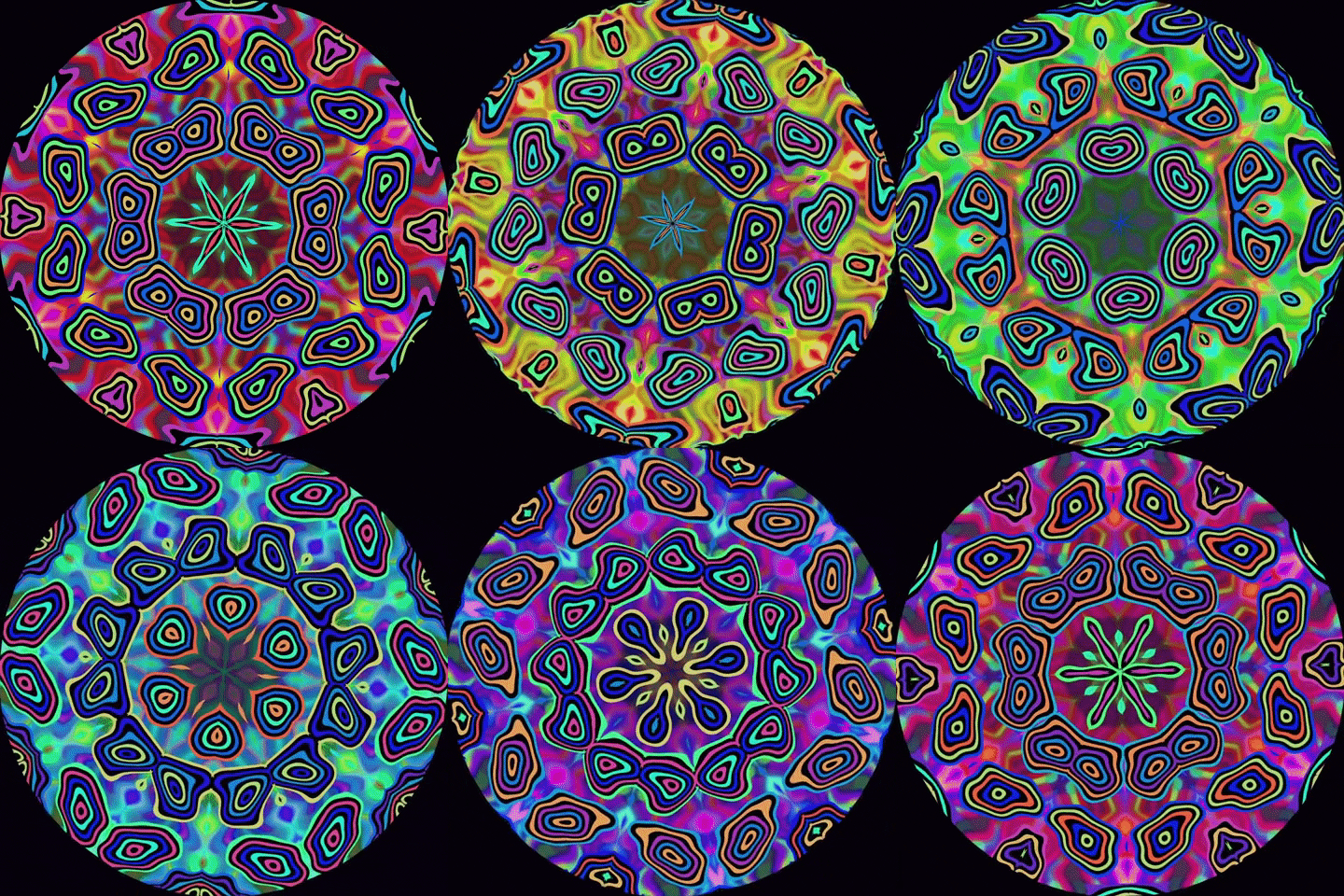
When viewing a mandala, pay attention to the lines and patterns that slowly extend outward from the center, like paths leading to the outside world. Don't rush to "find the answer," just let your gaze slowly move along one of the paths, feeling how it turns, branches, and then returns to a wider area.
A mandala isn't about drawing something, but about observing. Adjusting to legal and occupational safety is like slowly navigating a complex path: you don't reach the end immediately, but rather gradually move away from high-risk areas and closer to a safer space. When you practice focusing your attention on the "route" rather than "self-punishment," your brain has the opportunity to detach from panic and rethink realistically feasible options.
If you feel suffocated by a compliance issue or work pressure today, you can put the problem aside for a while, look at the mandala for just one minute, and convince yourself: I can first learn to "see the path" before deciding "which step to take".
○ Suggestions for seal carving calligraphy practice
In the theme of "Law and Occupational Safety", seal carving can serve as a gentle and sobering practice that helps you put the invisible rules and boundaries into the tangible strokes of your hand: instead of just thinking "I want to be more compliant", you gradually confirm "how I am willing to uphold the bottom line" through the process of carving.
- Introduction to the characteristics of seal carving:
Seal carving emphasizes the balance of the overall structure, the contrast between thick and thin lines, and the distribution of blank space. Every inch requires prior planning and repeated consideration, just like designing safety rules for medication, work, and driving: one cannot be completely unrestrained, nor should one go to rigid extremes, but rather find a suitable layout between restrictions and flexibility. - Written words:
Guarding the border ensures safety
Steady Within Safe Boundaries - Psychological Intention:
When copying or designing the "Guard Your Boundaries for Peace" seal inscription, you can first write down: In the three areas of medication, driving, and employment, what is the line you want to adhere to that you "will never cross"? Take these three bottom lines with you when you begin the seal engraving process, so that the words are not just a slogan, but choices that correspond to your actual situation. - Knife skills:
When drawing vertical strokes, deliberately slow down to keep the blade vertical and the center of gravity stable; pause slightly at the turning point, then slowly turn, symbolizing "when encountering ambiguous situations, pause before making a decision." Each pause trains you to retreat from impulsive reactions to a rhythm of "observe first, then evaluate, then act." - Emotional transformation:
If you feel ashamed because of past medication mistakes or near-accidents, you can write a statement of your current attitude next to the seal after completing it, such as: "I acknowledge the risks of the past, but I also choose to start building new safety habits from today." Let this seal be a symbol of your reconciliation with yourself and your commitment to taking responsibility.

○ Law and Occupational Safety: Guiding Suggestions for Art Therapy
This page uses a simple graphic layout to help you visualize the relationship between "medication behavior—driving—work—legal responsibility," making it easier to see which areas are approaching danger. All exercises are for self-awareness and professional communication only and do not constitute legal advice; specific compliance issues should be discussed with legal and medical professionals, taking into account local laws and professional norms.
I. Three concentric circles: From the "comfort/luck zone" to the "safe zone"“
- Draw a large circle, then draw two concentric smaller circles inside it, dividing it into three layers: the center is marked as the "safe zone", the middle circle is the "fuzzy/lucky zone", and the outer circle is the "high-risk zone".
- Write down examples of behaviors relevant to you in each cycle: such as "strictly following medical advice to take medication and avoid driving", "barely feeling that I can still drive", "persisting in driving or working when obviously drowsy or confused", etc.
- Use different colors to mark the circles that are closest to your current life, and honestly see which circle you spend the most time in, instead of just writing "ideal state".
- Finally, at the boundary between the "safe zone" and the "fuzzy zone," write down one adjustment you are prepared to try, such as "avoid driving or making important decisions during the two hours when the drug is most effective."
II. The Balance Between Responsibility and Support
- Draw a balance scale. On the left side, write "Responsibility and Risk," and on the right side, write "Support and Resources." On the left side, write down items that cause you stress, such as "Possible involvement in illegal drug use," "Worry about affecting professional qualifications," and "Fear of being discovered."
- Write down the support you already have or can seek on the right side, such as "a doctor who is willing to listen to your honesty", "consultation from the occupational health department", "a superior who can discuss adjusting shifts", "legal consultation resources", etc.
- Draw an "action bridge" below the scale with lines, and write down a small action you're willing to take, such as scheduling a doctor's appointment or proactively learning about your workplace's medication policies. Let the image remind you that taking responsibility isn't about being punished one way, but about simultaneously adding the weight of support.
Tip: If you feel intense fear or hopelessness while drawing, please pause your practice and prioritize connecting with real-world support systems rather than immersing yourself in imagining the "worst-case scenario."
Please log in before submitting your drawings and feelings.
○ 1556. Legal and Occupational Safety: Log Guidance Suggestions
① Record the three risk scenarios that you are most worried about right now (e.g., driving after taking medication, being excessively drowsy while on duty, or being unconscious in an important decision-making position), and write down the possible consequences of each.
② Write down a near-disaster you experienced in the past year: What happened? How did you escape unscathed? How did you evaluate yourself afterwards? Looking back now, what new insights do you have?
③ List at least three safety measures you can take immediately, such as: adjusting medication time, discussing medication changes with your doctor, avoiding night driving as much as possible in the short term, and communicating work arrangements with your supervisor.
④ Finally, write down your goals for "medication and compliance" in the coming year in one paragraph. They don't need to be perfect, just realistic and actionable. Let the words be the starting point for your communication with professionals and your family.
Please log in to use.
Prescription drugs are meant to protect you, but in the complexities of reality, they can sometimes become entangled with risks. May this lesson help you move beyond relying solely on luck and self-blame, and instead safeguard your own and others' safety boundaries with clarity and planning.
 EN
EN  ZH
ZH  ES
ES  FR
FR  JA
JA