

Lesson 1586: The Psychological Impact of Social Media and Instant Feedback
Duration:70 minutes
Topic Introduction: This course focuses on the psychological impact of social media and instant feedback, particularly how signals such as likes, comments, shares, and unread messages subconsciously influence self-worth and emotional fluctuations. We will break down notification dots, message sounds, and constantly refreshing dynamic walls to see how they activate the brain's reward system, leading to a habitual "check again." We will also discuss common dilemmas faced by teenagers and adults in comparison, fear of missing out (FOMO), image management, and dependence on online evaluation. This course will not simply encourage "not using it at all," but rather, through self-awareness exercises, boundary-setting strategies, and emotional self-soothing methods, help you understand: why you care so much about "whether anyone responds to me" and "whether my content is popular"? And how to gradually practice shifting your attention from instant feedback back to real relationships, inner feelings, and the present moment.
[arttao_Healing_Course_tts_group1586_1590]▲ AI Interaction: Why do I care so much about "whether anyone likes my posts"?
Many people, when scrolling through social media, unconsciously link the number of likes and comments to whether they are seen and needed. When notifications decrease or there is no response, they are prone to self-doubt and depression.
Think back to the last time you frequently checked your phone or refreshed a page: Was it after posting an update? Waiting for someone's reply? Or when you were in a bad mood and wanted to "find something to look at"? At that moment, what did you truly need: distraction, validation, or understanding and companionship?
Write down three moments when you are most emotionally affected by social media, and discuss with AI below: If I don't look at likes and comments, what other ways do I have to confirm that "I am worthy of attention"?
Click the button below to share your relationship with social media and gradually transform the feeling of being "dominated by digital technology" into a gentler, more boundary-bound connection.
○ Instant social media feedback · Music therapy
Choose a piece of soothing instrumental music with a clear beat. Before playing it, mute your phone and place it face down out of sight. Give yourself the time it takes to listen to the song, focusing solely on the melody and rhythm.
While listening, whenever you feel the urge to check your phone, make a small dot on a piece of paper as a note, then gently bring your attention back to the music and your breathing. There's no need to criticize yourself; just be honest with what you see.
After the piece ended, I checked how many dots were on the paper and wrote down a new practice promise: "Today I will reduce one unconscious screen-swiping action and dedicate this time to myself."“
In conclusion, when you learn to choose between "wanting to see if anyone replies" and "I also deserve some undisturbed peace and quiet," you are regaining control over your attention and emotions.
○ Oriental healing tea
Recommended drinks:Chrysanthemum Oolong Tea
Recommended reasons:The refreshing taste of oolong tea combined with the soothing properties of chrysanthemum helps relieve eye strain and head tension caused by prolonged screen time. It is also suitable as a "post-screening ritual" to remind yourself to disconnect from the information flow and return to your body and the present moment.
usage:Take 3g of oolong tea and 3-5 chrysanthemum flowers, steep in 85℃ hot water for about 2 minutes, and it's ready to drink. It's recommended to brew a cup and drink it quietly after finishing your evening social media use, taking a few deep breaths as a sign that "today I can temporarily disconnect from the internet."
○ Greek-Mediterranean Diet: Greek Yogurt, Nuts, and Berry Bowl
Using plain Greek yogurt as a base, add blueberries, strawberries, a few walnuts or almonds, and drizzle with olive oil or honey. This combination offers high-quality protein, probiotics, healthy fats, and antioxidants, helping to stabilize blood sugar and mood swings, and reducing the "escapist urge" to use your phone caused by hunger, overeating, or sudden energy drops. It can provide a more stable mental state as a breakfast or afternoon snack.
○ Free Mandala Healing
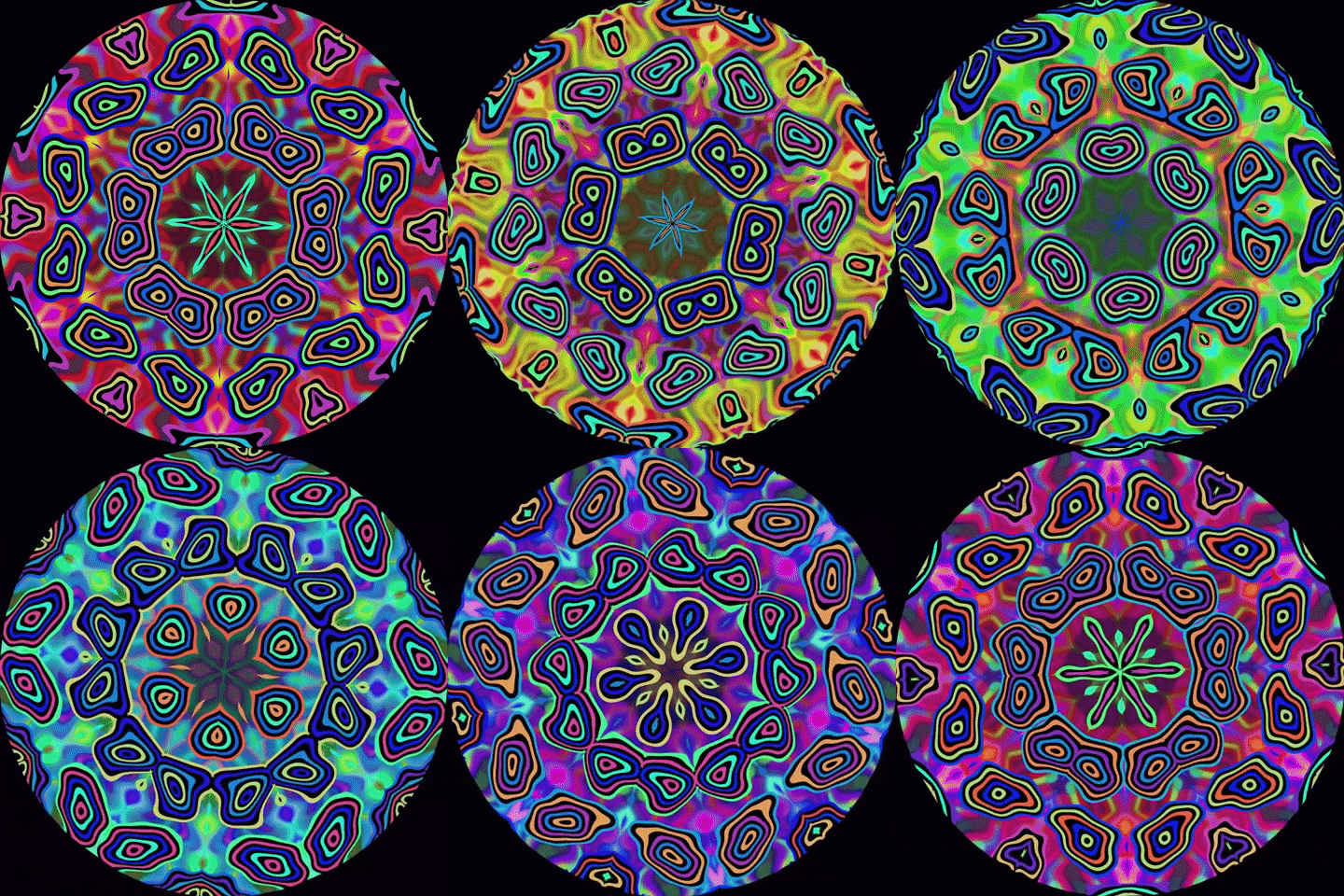
Image Healing: Returning to the Inner Center from the Red Notification Point
As you quietly observe the textures, lines, and layers of the mandala, pay attention to whether you recall notifications, the number of red dots, or a particular comment. You don't need to suppress these thoughts; simply say softly, "I saw it, and I'm back here."“
Mandala drawing isn't about creating something; it's about observation—by continuously contemplating a relatively stable image, you're practicing slowly shifting your attention from immediate external feedback back to your own breath and present experience. This observation time can be a small daily exercise to maintain a little distance from your phone.
○ Suggestions for practicing Roman script
In this lesson, ancient Roman script is used to conduct exercises on "presence and self-awareness." The neat, symmetrical letters remind us that true value is not determined by numbers, but by whether you can be with yourself.
- Writing words:
Latin:Presentia(Presence, Presence)
Meaning in Chinese: To fully engage with the present moment, instead of being led astray by your phone. - Psychological Intention:
When writing "Presentia," you can silently repeat: "I exist not only in the likes and comments of others, but also in my breath, my bodily sensations, and the space of this moment." Let each letter be a gentle reminder: I don't need to be online all the time to truly exist. - Writing method:
Choose a slightly thicker ballpoint pen or calligraphy pen, and slowly trace the height and spacing of each letter on lined paper. Intentionally slow down your pace, allowing the rhythm of your strokes to synchronize with your breathing. Be careful not to crowd the letter spacing; leave enough blank space, as if reserving time for yourself to avoid being disturbed. - Emotional transformation:
When you feel frustrated by low post engagement or delayed message replies, pause and type "Presentia" three to five times, along with a specific non-social media activity you did that day, such as "I read a few pages of a book" or "I had a face-to-face conversation with someone." Let words bear witness to the multifaceted nature of your being, rather than just the screen.

○ The Psychological Impact of Social Media and Instant Feedback: Guiding Suggestions for Art Therapy
This page uses illustrations to analyze the use of social media.Immediate Feedback LoopHow do cues such as likes, comments, shares, read statuses, and "typing" affect emotions, self-worth, and attention? Drawing these processes helps clarify your interactions with the platform and allows you to consider how to establish gentler boundaries. Drawing is for self-awareness and communication purposes only and does not replace medical, legal, or emergency safety interventions.
I. Feedback Loop Diagram: The trajectory from sending to waiting to refreshing
- Draw a circular or oval loop arrow on a piece of paper, labeled sequentially as "Post/Send Message" → "Wait for Feedback" → "Receive Likes/Comments or No Response" → "Emotional Response" → "Continue Posting or Keep Refreshing".
- Write down your most common feeling next to each stage, such as "expectation", "anxiety", "emptiness", "being seen", "awkwardness", etc., and mark the part that makes you the most tired with different colors.
- Finally, draw two or three small boxes outside the loop and write down the "breakpoints" you are willing to try: such as "go for a walk after sending it" or "only check the feedback within a specific time period".
II. Comparison of Light and Shadow in Self-Image
- Draw two silhouettes or outlines of people side by side. On one side, write "How others look in motion," and on the other side, write "How I really look in my daily life." On the left side, add some scenes you often see: travel, success, a refined life; on the right side, write down your real but overlooked moments: tired, an ordinary day, a small act of dedication.
- Draw a slowly transitioning grayscale band between the two silhouettes to symbolize that real life is not simply black and white, but rather a continuous spectrum between highlights and shadows.
- Write a sentence at the bottom of the image, such as: "I don't need to edit myself into a perfect scene in order to be allowed to exist."“
Note: Social media is designed to emphasize instant feedback and comparison, which can easily evoke emotions. Drawing isn't about completely shutting yourself off the internet, but rather about helping you maintain a clearer perspective and more choice between "using the platform" and "being led by it." If you experience severe depression, self-harming thoughts, or safety risks, please seek professional help or emergency resources immediately.
Please log in before submitting your drawings and feelings.
○ 1586. The Psychological Impact of Social Media and Instant Feedback: Journaling Guidance Suggestions
① Use scanning: Record the total number of times you checked social media today, especially the number of times you "clicked on it even though there were no new messages". This is just for observation and not for drawing conclusions.
② Emotional hooks: Write down three emotional scenarios that are most likely to be triggered, such as "no one responds after posting", "seeing that other people's lives are wonderful", and "the other person has read but does not reply", and describe the automatic thoughts in your mind at that moment in one sentence.
③ Gentle response: Write a gentler alternative statement for each of the above situations, such as "This does not mean I am not important", "He may be busy right now", "I have my own pace too".
④ Small Practices: Set up a small social media-related experiment for tomorrow, such as "delay checking your phone for 15 minutes after waking up in the morning" or "leave your phone in another room while eating," and review the experience the next time you write in your journal.
Please log in to use.
When you see how likes, comments, and red dots affect you, you have the opportunity to gradually turn your attention back inward. May you stay connected with your true self while using social media.
 EN
EN  ZH
ZH  ES
ES  FR
FR  JA
JA