

Lesson 1589: The Dangers of Distracted Attention and Detachment from Reality
Duration:70 minutes
Topic Introduction: This course focuses on a crucial, often overlooked aspect of prolonged internet addiction: as your attention is fragmented by countless pieces of information, you gradually become disconnected from reality. When you habitually watch videos while replying to messages, or play games while dealing with work or studies, your brain is forced to constantly switch between multiple tasks. Superficially, you appear to be "doing everything," but in reality, you find it difficult to truly engage with anything. Over time, this leads to decreased memory, shallower thinking, reduced emotional tolerance, and subtle damage to interpersonal relationships and academic/work performance. It also makes you more prone to feelings of emptiness, decreased self-worth, and a sense of weariness towards the real world. This course will examine the specific harms of distraction and disconnection from reality from four perspectives: cognition, emotion, physical health, and relationships. Through exercises, it will help you gradually regain the ability to "live in the present moment," allowing the internet to return to its place as something you use, rather than something you are dragged along by.
[arttao_Healing_Course_tts_group1589_1593]○ The core risk of distraction and disconnection from reality
- Cognitive level:A large amount of fragmented information crowds out working memory, making it difficult to concentrate for long periods of time, and gradually weakening the ability to read deeply and think systematically.
- Emotional level:After becoming accustomed to immediate stimulation, the brain's tolerance for "calmness" and "boredom" decreases, making it more prone to anxiety, irritability, emptiness, or depression.
- Relationship level:Face-to-face interactions are interrupted by mobile phones, listening skills deteriorate, and genuine intimacy is replaced by "always online" but not by the presence of the mind.
- Practical functions:Decreased academic and work efficiency, increased procrastination, blurred life plans and long-term goals, and a tendency to feel that "reality is boring and only the internet is fun."
- My personal feelings:Prolonged immersion in virtual feedback reduces real sense of accomplishment and gradually erodes confidence in one's own abilities and life direction.
▲ AI Interaction: What gradually steals your attention?
Many people realize that their attention span has deteriorated, but find it difficult to pinpoint when it started or how it gradually disappeared. This course invites you to look back with curiosity, rather than blame, at how the internet has slowly fragmented your attention.
Please write down three situations in the past week in which you were most likely to "use your phone/computer while doing other things," such as: during a meeting, while doing homework, while eating, and while walking.
After each scenario, add two reflective sentences: "What was I originally going to focus on?" and "What makes the internet more attractive?"“
Next, you can explore with AI: If you no longer define yourself as "a person with poor self-control" but instead regard attention as a "mental muscle" that needs to be trained, where would you be willing to start making the smallest change today?
Click the button below to reclaim your attention from daily distractions and practice being "truly present" in real life.
○ Stabilize attention - Music therapy
Choose a piece of instrumental music with no or very few lyrics, such as classical strings, a piano solo, or a natural sound environment, and turn the volume down to a level that doesn't distract from your attention.
Try a "mini focus exercise" in music: choose a simple real-world task, such as tidying your desk, folding clothes, washing fruit, or copying a few lines of text.
The key to practice is not "how well you do", but when you have the urge to "check your phone", simply be aware: "Oh, my attention has been drawn away again", and then gently bring your gaze back to the movements and music in front of you.
In conclusion, attention doesn't "recover" overnight, but it can gradually become more stable and solid through repeated, gentle practice of returning to the present moment.
○ Oriental healing tea
Recommended drinks:Oolong Tea with Aged Tangerine Peel
Recommended reasons:Oolong tea has a refreshing and mellow aroma, while the aged tangerine peel has a calming fragrance. It can invigorate the mind without being overly stimulating, making it a suitable transitional drink for "returning from high stimulation to calm and focused attention." The slow sipping rhythm itself is a way to train attention to stay in the present moment.
usage:Take 3g of oolong tea and a small amount of dried tangerine peel, steep in boiling water, let it cool slightly until warm, and then savor it slowly. It is recommended to drink this tea while planning your day's tasks or reading a physical book, focusing your attention on the aroma of the tea, your breathing, and the feel of the paper, rather than scrolling through the screen at the same time.
○ Greek-Mediterranean Diet: Olive Oil Roasted Vegetables with Whole Wheat Bread
Featuring colorful vegetables such as bell peppers, eggplants, zucchini, and cherry tomatoes, drizzled with olive oil, a touch of sea salt, and herbs, this dish is baked in the oven and served with a slice of crispy whole-wheat bread. Rich in antioxidants, healthy fats, and dietary fiber, it helps stabilize blood sugar and energy levels, reducing unconscious phone use caused by hunger or fatigue. While focusing on the texture of the vegetables and bread, you're also practicing shifting your attention from the flow of virtual information back to real taste and bodily sensations.
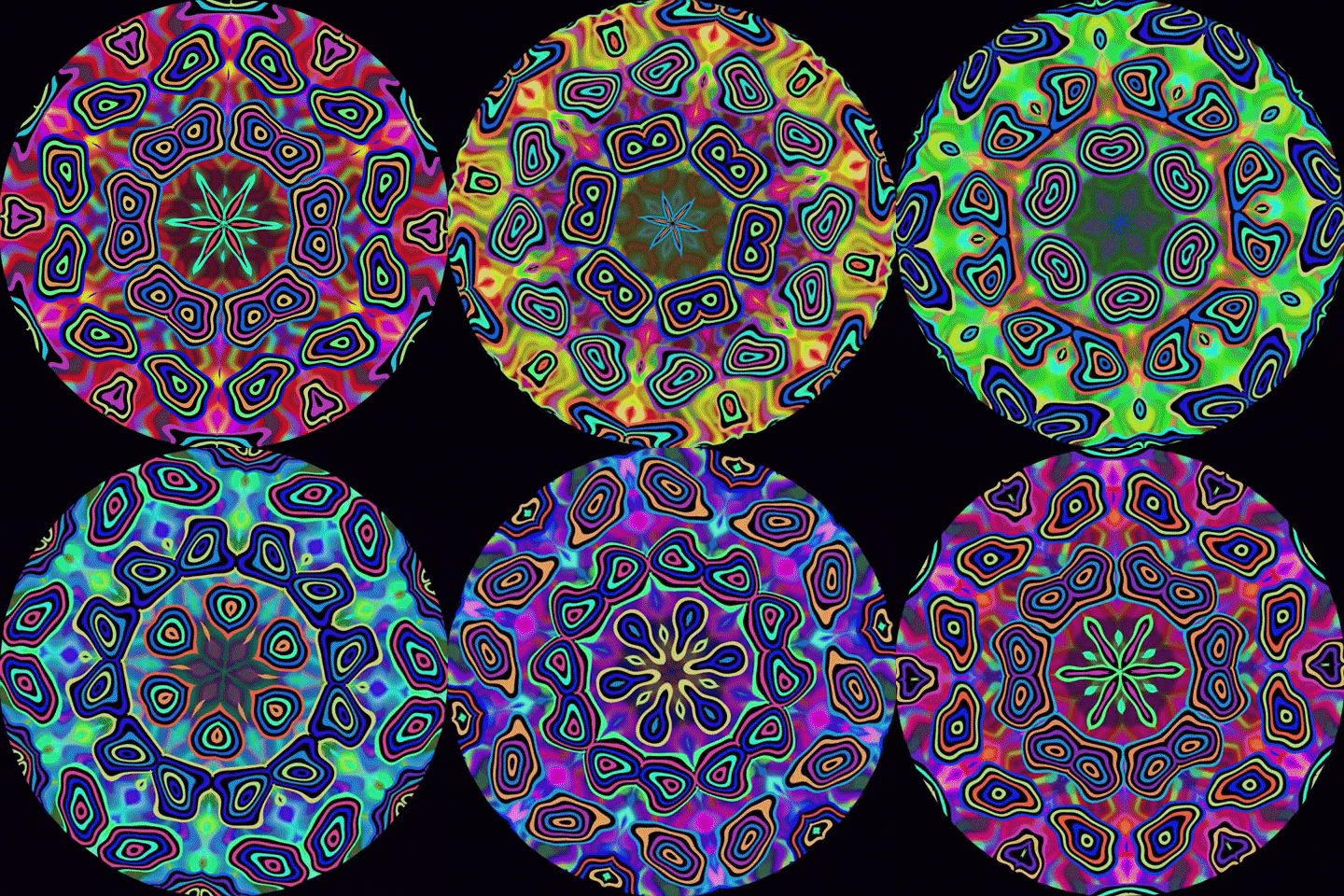
○ Free Mandala Healing
Image Therapy: Returning to the Center from Fragmented Perspectives
When you observe the layered structure of a mandala, you can subtly notice whether your gaze is jumping around like scrolling through a screen, or whether it lingers on a particular shape or color for a moment. You don't need to "see any meaning"; simply allow yourself to experience a rare kind of quiet contemplation.
Mandala drawing isn't about drawing something; it's about observing. When you allow your eyes to slowly move, pause, and breathe over the mandala, you're practicing giving your attention a clear "landing point," instead of being pushed around by endless information. Treat these few minutes as a "realistic anchor" for your brain, reminding yourself: I can choose to stop and look, instead of being constantly drawn in.
○ Suggestions for practicing Roman script
In this lesson, ancient Roman script is used to embody the spirit of "focused presence." The neat and rhythmic structure of the letters acts like clear tracks being re-established for scattered attention.
- Writing words:
Latin:Attentio(Attention, focus)
Meaning in Chinese: To focus one's heart and eyes on the same place. - Psychological Intention:
As you repeatedly write "Attentio," you can tell yourself, "At this moment, I allow myself to do only this one thing." Let each letter become a gentle adjustment, slowly bringing the mental energy scattered across various applications back to the paper and your breath. - Writing method:
Using a slightly thicker ballpoint pen or Roman numeral pen, slowly trace the height and spacing of the letters on lined paper. Keep the vertical lines stable and the horizontal lines slightly extended, deliberately maintaining uniform letter spacing, as if defining clear boundaries for the day. - Emotional transformation:
When you find yourself overwhelmed by multitasking, stop and write "Attentio" three to five times, along with a concrete action, such as "For the next ten minutes, I will focus solely on this task." Let writing become a transitional ritual that helps you return to focused reality from a jumble of information.
○ The Dangers of Distraction and Detachment from Reality: Guidance and Suggestions for Art Therapy
This page uses drawings to visualize the process of "attention being torn apart" and "gradually drifting away from reality," allowing you to see when and how you are gradually led astray by the internet. The drawings are for self-awareness and communication purposes only and do not replace medical, legal, or emergency safety interventions.
I. Attention Leakage Map: Dispersed Nodes from Morning to Night
- Draw a timeline from morning to night, marking key times such as waking up, commuting, studying/working, eating, resting, and before going to bed.
- Draw a small icon or symbol under each time period to represent your most frequent online activities, such as watching short videos, browsing social media, playing games, or reading online articles.
- Circle the time periods that "should have been focused on real-world tasks" with different colors, such as attending classes, meetings, doing homework, or spending time with family, and mark the consequences of being distracted (such as delays, increased errors, or decreased conversation quality).
- Finally, write down a new attitude you'd like to try next to the timeline, such as: "I hope to have at least a small part of each day that belongs solely to real-world tasks and relationships."“
II. The Island of Reality and the Sea of Information: Connecting, Not Escaping
- Draw a solid island in the center of the picture and write "Real Life" on it. On the island, you can mark several areas that you care about: learning/work, health, interests, relationships, personal growth, etc.
- Draw a surging "sea of information" around the island, and use wavy lines or fragmented graphics to write "message reminders," "number of likes," "achievements," "recommendation algorithm," etc., to represent the constant influx of online stimuli.
- Draw several bridges on the small island, connecting them to the parts of the information sea that are still valuable to you, such as "necessary information," "moderate entertainment," and "learning resources." Write down the usage rules next to the bridges, such as "watch at fixed times" and "complete a real-world task before watching."
- Write a sentence below the image: "What I want is not to disconnect from the internet, but to bring attention back to the island before deciding whether or not to go out to sea."“
Tip: Distractibility and disconnection from reality are often not mistakes made in a day or two, but rather the accumulation of long-term habits. Drawing out your own patterns can help you find a starting point for adjustment that you can begin today, without blaming yourself. If you are already experiencing significant depression, anxiety, or severe impairment in your studies or work, please seek professional evaluation and support promptly.
Please log in before submitting your drawings and feelings.
○ 1589. The Dangers of Distracted Attention and Detachment from Reality: Journaling Guidance Suggestions
① Today's observation: Record the three moments when you were most "absent-minded" today, and write down what real-world task you were doing at the time, and what you were watching/browsing at the same time.
② Real-world consequences: Add a real-world consequence to each moment, such as "What should have taken ten minutes took half an hour", "Missed a sentence the other person said", "I am obviously more irritable".
③ Attention Desires: Write down the attention states you truly desire, such as "being able to read a chapter of a book quietly", "being able to listen to someone speak completely", and "being able to concentrate on completing a small task".
④ Mini-experiment: Design an "attention-restoring experiment" for tomorrow, such as "not looking at your phone while eating" or "setting a 25-minute focus timer before studying." In the next blog post, simply record your feelings about the experiment, rather than giving yourself a score.
Please log in to use.
Attention is the bridge that allows you to establish a genuine connection with the world. When you are willing to gradually step back from the fragmented flood of information and allow your eyes, body, and mind to reunite in the same present moment, reality will no longer be just "background noise," but will slowly regain its texture, weight, and meaningfulness.
 EN
EN  ZH
ZH  ES
ES  FR
FR  JA
JA