

Lesson 1603: The Social Media Comparison Effect and the Mechanism of Declining Self-Esteem
Duration:70 minutes
Topic Introduction: This course focuses on how the "social media comparison effect" gradually erodes self-esteem. Constantly refreshing social media feeds and browsing others' meticulously edited photos and highlight moments, the brain unconsciously engages in "upward comparison": others are more attractive, more successful, and happier, while one's own daily life seems lackluster. Simultaneously, likes, comments, and shares are internalized as quantifiable metrics of self-worth; once the data falls short of expectations, shame, frustration, and self-doubt follow. This course will dissect the interaction mechanisms between algorithmically amplified selective presentation, filter culture, peer evaluation, and internal vulnerability patterns, helping you understand that it's not "you're not good enough," but rather that you're caught in a carefully designed comparison game. Through awareness exercises, narrative rewriting, and body settling exercises, we will gradually loosen the habit of "defining yourself by the highlights of others," allowing you to return to a more authentic and gentle sense of self.
○ The core mechanisms of social media comparison effect and declining self-esteem
- Selective display:While others share their "highlight moments," you compare yourself to others by focusing on your daily routines and difficulties, creating a systemic imbalance.
- Upward comparison tendency:The brain is more likely to focus on those who are "better than oneself," activating feelings of inferiority, jealousy, and shame.
- Quantifying Yourself with Data:Likes and followers are treated as "interpersonal value," easily negating intrinsic richness.
- Vulnerability patterns are amplified:People who are already sensitive, perfectionistic, or lack affirmation are more likely to be repeatedly triggered on social media platforms.
▲ AI Interaction: Who "scores" your self-worth on the other side of the screen?
Recall the last three times you scrolled through social media. Did your mood improve, worsen, or become numb? Record what you saw, the emotions you felt, and the judgmental sentences that popped into your mind, such as "Everyone else is so successful" or "I'm still stuck in the same place."
Next, work with AI to break down these automated thoughts into three categories: facts, speculations, and evaluations, and see how many of them are actually illusions caused by algorithmic recommendations and localized information.
You can tell the AI your usage scenario (such as scrolling through short videos before bed or checking updates during work breaks) and ask it to design a few "self-protection phrases" for you to read before you start scrolling through your feed, such as: "What I see is an edited corner, not the complete life."
This course invites you to gradually correct your "data-defined sense of self" with the help of AI, and shift your attention from comparing yourself to others to understanding your own true needs and pace.
Click the button below to let AI identify your emotional trajectory on social media and help it pinpoint which comparisons are quietly damaging your self-esteem.
○ Music therapy after feeling quite tired
After repeated unconscious comparisons with those above us, a complex and indescribable feeling often arises: exhaustion and emptiness, envy and self-reproach. This section suggests choosing gentle, warm instrumental music or vocal humming to temporarily pull your nervous system out of the "judgment mode."
When the music starts, you can temporarily put your phone out of reach, take your eyes off the screen, and focus only on the melody, your breathing, and the weight of your body. Especially when you find yourself unconsciously opening social media again, you can listen to this short piece of music first before deciding whether you really want to continue browsing.
The goal is not to force yourself to "not use it at all," but to insert a buffer through music, giving you the opportunity to make a new choice instead of being automatically pulled away.
○ Western Herbal Healing Tea: Lavender & Passionflower Soothing Tea
Recommended reasons:Lavender and passionflower are traditionally used in the West to relieve tension, reduce anxiety, and alleviate pre-sleep mental arousal. For those who ruminate on social comparisons and mentally replay others' lives before bed, this formula can help ease tension and shift focus from external perspectives back to their own feelings.
Usage suggestions:Steep 1g of lavender and 1g of passionflower in about 250ml of hot water for 5-8 minutes. You can drink this during the time when you are most likely to be on your screen in the evening, and combine it with the "brief screen-off" exercise to shift your attention to the aroma and the temperature in your throat.
Awareness Tips:While drinking, silently repeat a sentence in your mind, such as, "I don't need to be rated by anyone for the time being," and observe if your body feels any loosening.
○ Ancient Roman Natural Dietary Therapy: Olive Oil, Tomato, and Whole Wheat Salad
Combining whole-wheat grits or crushed whole wheat with ripe tomatoes, olive oil, and a touch of herbs embodies the principles of the ancient Roman natural diet: "simple, fresh, and minimally processed." Stable complex carbohydrates and healthy fats help maintain stable blood sugar levels, reducing impulsive screen time and emotional eating triggered by a mix of emotions and hunger.
Healing Recipes
/home2/lzxwhemy/public_html/arttao_org/wp-content/uploads/cookbook/roman-natural-08(Alternatively, you could try relaxed="1" or use an existing filename.)○ Mandala Viewing Healing: Shifting from "Others' Gaze" to "Self-Center"“
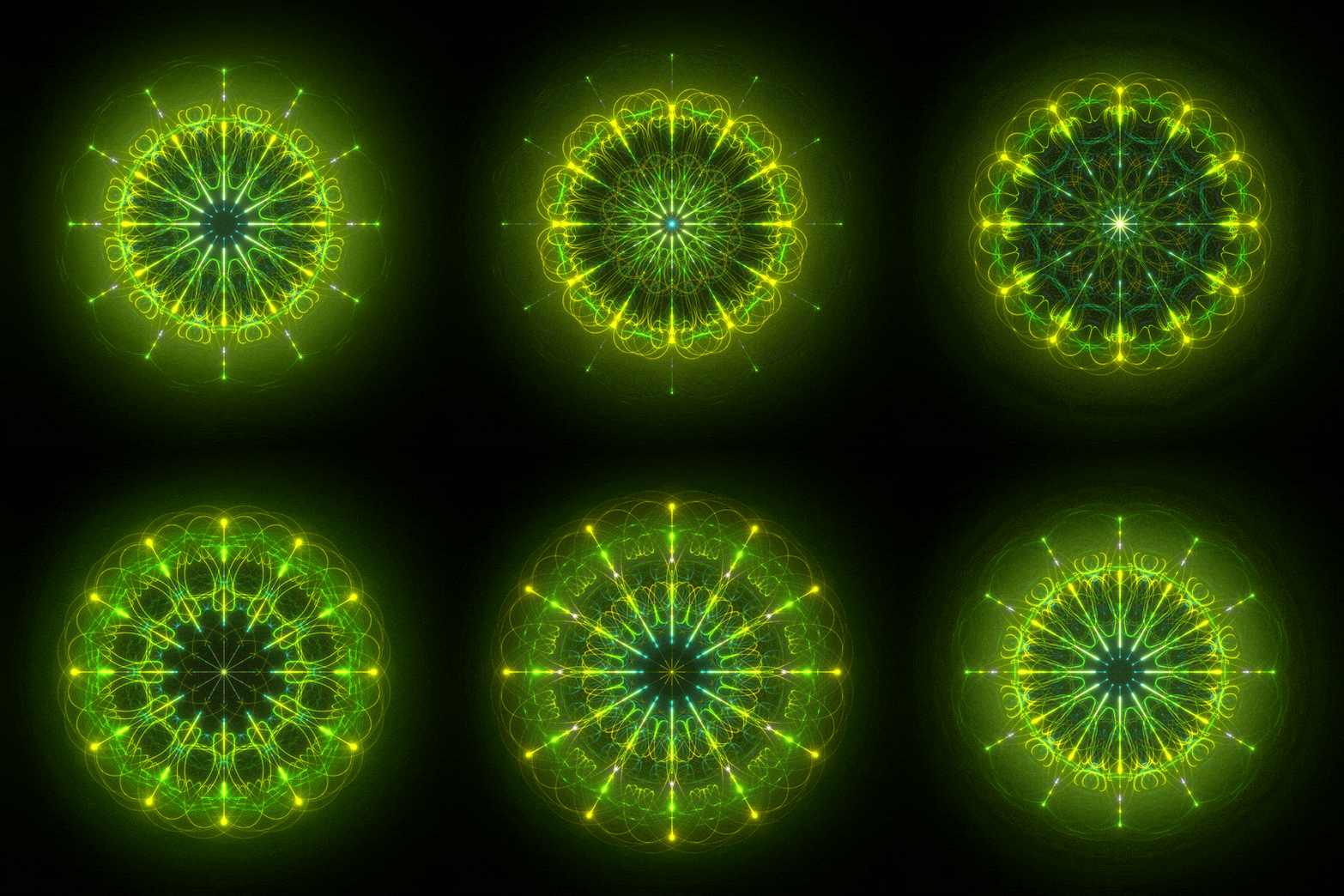
This lesson continues to emphasize that mandalas are not about drawing something, but about observing. Social media tends to make you constantly evaluate yourself from "others' perspectives," while mandala observation practices invite you to return to a quiet center that belongs only to yourself.
Please choose a mandala image, sit quietly, and do only one thing: focus your gaze on the center or a point within the inner circle of the image, and observe how the lines and color blocks expand outwards. If thoughts such as "What will others think of me?" or "Am I not good enough?" automatically pop into your mind, simply acknowledge their presence and then bring your attention back to the image.
You don't need to "become a better person" in a mandala; you're simply practicing: not being swayed by external evaluations for a short period of time, but being briefly present with the image, with your breath, and with yourself in the present moment.
○ Suggestions for practicing medieval Gothic script
In this lesson, Gothic calligraphy embodies the intention of "building self-respect from comparison." Solid vertical lines and rhythmic repetitive structures help you experience an inner sense of support while writing, rather than being swayed back and forth by external evaluations.
- Writing words:
Latin:Dignitas Interior
Meaning in Chinese: Inner dignity. - Psychological Intention:
Every time I write "Dignitas Interior", I remind myself that true value comes from the whole life journey, resilience, and kindness, not from a post or a number under a profile picture. - Writing method:
Using a square-tipped pen, write slowly on lined paper, keeping each vertical stroke firm and each turn clear. While writing, you can silently repeat to yourself, "My value is not determined by data." - Emotional transformation:
When you are pulled by comparison, jealousy, or shame, stop and write "Dignitas Interior" a few times, and write down a small act of kindness or effort you did today, letting the words be a testament to your inner value.

○ Visualization of Social Comparison and Self-Evaluation: Guiding Suggestions for Art Therapy
This page uses drawings to visualize your "comparison path" on social media and the process of declining self-esteem, helping you see which aspects can be adjusted. The drawings are for self-awareness only and are not intended for others to see.
I. Comparison Spiral: The Path from Browsing to Self-Doubt
- Draw a downward spiral, gradually contracting from the outer circle to the inner circle.
- Write "Open social media" and "See others' highlights" on the outer circle; write "Start comparing" and "Feel inferior to others" on the middle circle; write "Self-doubt" and "Feeling depressed" on the innermost circle.
- Mark the parts you are most familiar with with different colors, draw a "side exit" next to the spiral, and write down the interruption action you would like to try, such as "get off the screen to drink water, stretch, or write a line of text".
II. The Flower Chart of Self-Worth: Rediscovering the Neglected Aspects
- Draw a flower, and write "The Real Me" in the center. Write a valued aspect of yourself on each petal that is not easily seen on social media, such as "taking care of family," "kindness to friends," "striving to complete studies," or "curiosity about the world."
- Draw some "noise clouds" around the flower, write down "likes", "followers", "popularity", "appearance rating", etc., and mark with arrows how they obstruct your view of the flower.
- Finally, write a message you want to give yourself in a corner of the screen, such as: "I deserve to be seen, not because of the data, but because I am living a real life."“
Tip: You don't need to change all your usage habits at once. Just start by seeing it, start with a small interruption, and the damage of the comparison effect on self-evaluation will be gradually reduced.
Please log in before submitting your drawings and feelings.
○ 1603. Social Media Comparison Effect and the Mechanism of Declining Self-Esteem: Log-Guided Suggestions
① Recall the three moments you scrolled through social media today, and write down what you saw and your first self-evaluation for each moment.
② Mark which of these self-evaluations are "factual descriptions" and which are "harsh labels" (such as "I am a failure" or "I am ugly").
③ For the most hurtful self-evaluation, write a gentler, more realistic alternative, such as "I am still on my way" or "I am learning".
④ Record a successful attempt to interrupt your scrolling session before or during the process (even if it's only for a minute), and write a thank-you note to yourself.
Please log in to use.
When you stop letting cold data define your value and instead gradually return to a true and nuanced understanding of yourself, social media will find it harder to steal your self-esteem and sense of security.
 EN
EN  ZH
ZH  ES
ES  FR
FR  JA
JA