

Lesson 162: Breaking Free from the Imagination of an "Inescapable" Disaster
Duration:70 minutes
Topic Introduction:Many people with agoraphobia fall into catastrophic fantasies of "If I have a seizure, no one can save me." This lesson will help you identify how these automatic fantasies are activated, and use cognitive and imagery strategies to break their control, gradually building the psychological freedom to "leave or stay."
○ Common manifestations of “inescapable” thoughts
- Enclosed imagination:The image of "I'm locked somewhere" comes to mind.
- Respiratory restriction anxiety:Intense focus on the possibility of “not being able to breathe” or “not being able to call for help.”
- Early withdrawal:When you think that "you may not be able to escape", just don't go, don't try, and don't get close.
Lesson 162: Breaking Free from the Imagination of "Inescapable" Disaster (Click to listen to the reading and view the content)
“The "inescapable" fear of disaster is one of the most persistent psychological mechanisms in panic disorder and space-related phobias. It doesn't necessarily appear as a clear image, but rather as a strong premonition: if symptoms appear, I will be unable to leave, unable to control myself, and unable to get help. It is this imagination of "inescapability" that puts the body into a state of high alert in advance. It's important to understand that this imagination doesn't stem from a realistic judgment, but rather from the brain's extreme simplification of uncertainty in a state of high arousal. To ensure survival, the brain compresses complex situations into a single conclusion: dangerous and irreversible. When you believe this conclusion, the body's reaction is rapidly amplified, forming a self-validating cycle. The key to breaking free from fear of disaster is not repeatedly telling yourself "nothing will happen," but changing your relationship with these thoughts. When fear of disaster arises, what truly needs to be addressed is not the content itself, but your level of trust in it. You can view it as a familiar psychological signal, not a prophecy. Furthermore, the fear of "inescapability" is often mixed with anxieties about losing control of the body, such as fainting, losing consciousness, or collapsing in public. However, based on extensive clinical experience, these most extreme consequences rarely actually occur. What actually happens is often just a strong but limited physical reaction. Breaking free from catastrophic imagination doesn't mean forcing yourself into discomfort, but rather learning not to immediately resort to escape or safety measures when such imaginations arise. Even a delay of just a few minutes allows the brain to gain new experience: the imagination appeared, but the outcome didn't happen. Each such experience weakens the certainty of inescapable fate. Over time, you'll find that what truly changes isn't the environment, but your capacity to bear those thoughts. When catastrophic imaginations are no longer perceived as reality, fear loses its basis for continued expansion.
▲ AI Interaction: Have you ever constructed a scenario in your mind that you “can’t escape”?
The thought of "not being able to escape" often hangs over one's mind like a shadow.
Please try to have a conversation with this thought: it is just imagination, not fact.
You can use a gentle self-reminder: "I still have choices, I am not trapped."
Over time, you'll learn to turn down the volume on your catastrophizing thoughts.
Click the button below to explore your common disaster associations with AI and build alternative images and ideas.
The imagination of a disaster that is "inescapable" often makes people feel helpless.
Try playing an upbeat song and let the beat open a window to your thoughts.
Music, like light, slowly undermines those exaggerated images of fear.
You will find that there is not only darkness, but another possibility waiting for you.
○ Herbal Tea· Dianhong Tea
Recommended drinks:Dianhong Tea
Recommended reasons:It has a rich aroma and a stable taste, helping to restore central consciousness during anxiety.
practice:3g Dianhong tea, brewed with 95°C hot water for 3 minutes, can be paired with a small piece of orange peel to enhance sensory alertness.
○ An Ding Food Nourishment - Salmon and Walnut Sauce (ID162)
During periods when catastrophic imagery is frequent, the body needs nourishment that provides stable energy without overstimulating the nervous system. Salmon is rich in healthy fatty acids, which help support nervous system regulation; the mild texture of walnuts symbolizes consistent and reliable support. This dish is suitable for consumption during the recovery period after psychological exposure or outdoor challenges, helping the body return to a balanced state.
Stable support
Neurotrophic
Open Recipe
◉ Mediterranean-DASH Fusion Diet: Salmon with Walnut Sauce
This dish is based on the core elements of the Mediterranean diet—the combination of deep-sea fish and nuts. It combines the Omega-3 fatty acids from salmon with the polyphenols and healthy fats from walnuts to create powerful anti-inflammatory and cardiovascular protective benefits. The walnut sauce is seasoned with olive oil, lemon, garlic, and herbs, resulting in a light and refreshing flavor that is suitable for daily brain health maintenance and aligns perfectly with the low-sodium and anti-inflammatory principles of the DASH diet.
Omega-3 anti-inflammatory Cardiovascular protection Improved cognitive function MIND Diet
I. Recommended Dishes and Reasons
Recommended dishes:Salmon with walnut sauce (ID MIND-02)
Recommended reasons:Omega-3 and nut fats work together to strengthen brain and cardiovascular health; the plant-based fats and antioxidants in walnut butter help reduce inflammation, making it a valuable main dish in the MIND Diet.
2. Recipe and Method
Recipe (Serves 2):
- Two salmon fillets (approximately 140–160 g each)
- 40g walnuts (lightly roasted)
- 2 tablespoons of olive oil
- 1–1.5 tablespoons lemon juice
- A small bunch of fresh parsley or basil
- 1/2–1 clove of garlic (can be reduced)
- Black pepper to taste
- Very little or no sea salt added (DASH principle)
practice:
- Pat the salmon fillets dry and lightly sprinkle with black pepper and a very small amount of sea salt.
- Add a little olive oil to a skillet and pan-fry the salmon over medium heat until golden brown on both sides (about 3–4 minutes per side), or bake it to your liking.
- Put walnuts, lemon juice, olive oil, garlic, and parsley into a food processor and blend until smooth.
- If it's too thick, add a little olive oil or lemon juice to adjust.
- Simply drizzle the walnut sauce over the pan-fried salmon and enjoy.
3. Small rituals for body and mind
Before eating, take a 10-second slow breathing cycle to relax your chest and neck.
While savoring the rich, oily flavor of salmon and the nutty aroma of walnut sauce, feel your body stabilized and your energy replenished.
Record your protein and healthy fat intake for the day, and observe your feelings of fullness and mental focus.
4. Dietary Therapy Experience Record
- Physical sensations (warmth/strength/fullness).
- Emotions (calm/clear/stable).
- Record the amount of walnut butter used and the protein balance status for today.
5. Tutorial Video (approximately 4–6 minutes)
◉ Video Title:Salmon with walnut sauce: Anti-inflammatory and boosts cardiovascular health
6. Precautions
- Those allergic to walnuts can use cashew or pumpkin seed butter instead.
- Those who need to control their fat intake can reduce the amount of olive oil and add a small amount of plain yogurt to increase the thickness.
- People with high uric acid should moderate their intake of nuts.
hint:This dish is suitable as part of a diet of deep-sea fish 2-3 times a week; if you have a chronic illness, please follow your doctor's advice to adjust your diet.
○ Suggestions for Modern Calligraphy Writing Practice
The topic of this lesson:Let the imagination of disaster lose its absoluteness
In-depth analysis:
The characteristics of disaster imagination are "single path" and "inevitable outcome".
The open structure of modern art calligraphy is precisely what breaks this rigid expectation.
When glyphs are allowed to change, shift, and retract, the brain gradually learns that the process can be diverse and the outcome is not limited to one.
Imperfections in writing are, in themselves, a gentle loosening of the "must-control" principle.
Writing skills (relaxed understanding):
- Directional Shift:Deliberately changing the direction of strokes within the same word symbolizes a shift from a single conclusion to multiple possibilities.
- Delayed Landing:Pause briefly before the final stroke to experience the security of "not finishing immediately".
- Soft Return:Allow the strokes to naturally return to the baseline, reinforcing the body's memory of "being able to recover even if they deviate".
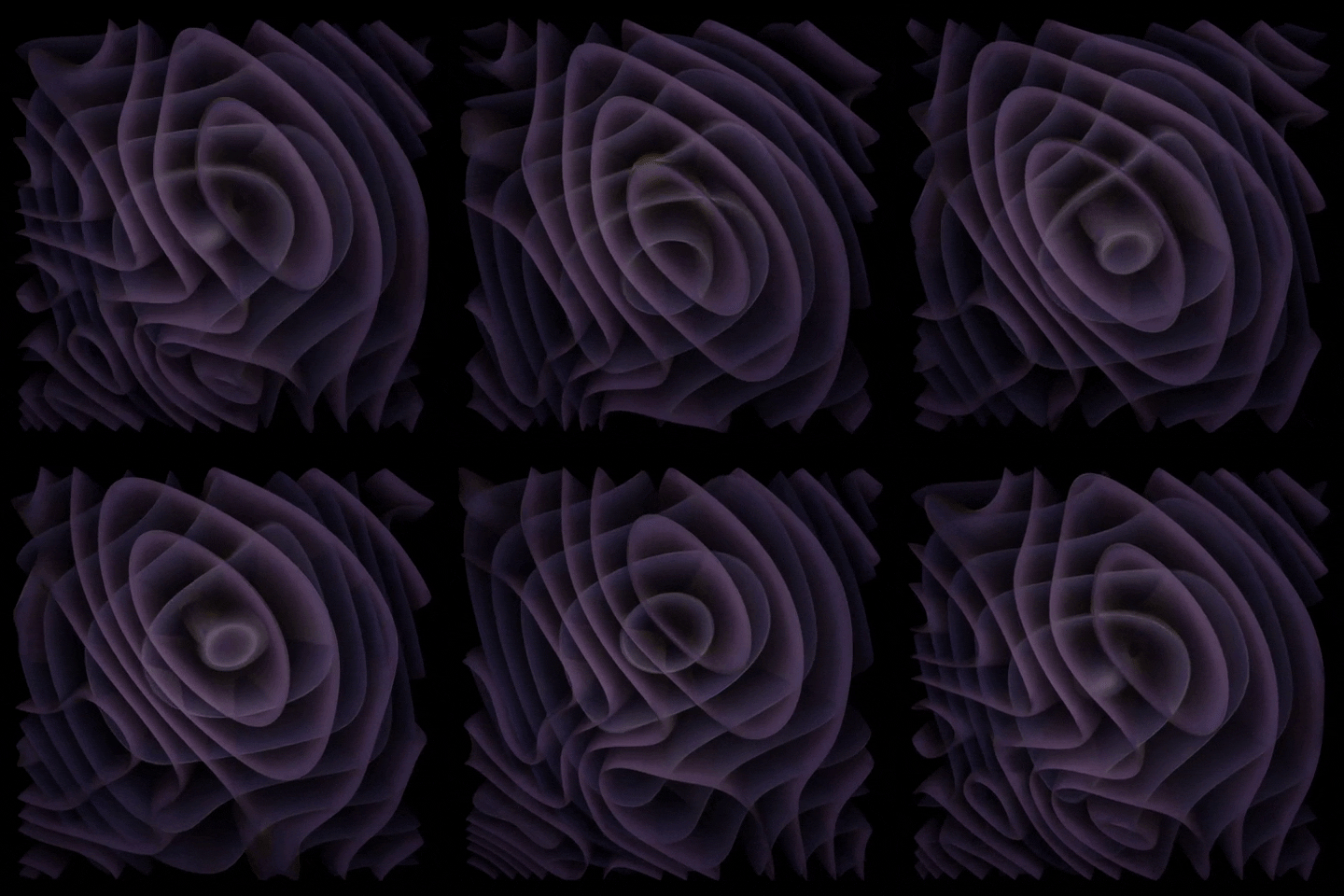
Image Healing: Guided Mandala Viewing - Lesson 162
Please select a mandala with multiple paths and a non-single-center structure.
Move your gaze in different directions and experience a variety of possibilities.
When your attention naturally returns to a certain point, feel stable rather than constrained.
A mandala is not about drawing something, but about observing it. When there is no longer just one path, fear loosens.
The theme of this lesson's mandala is "Multi-path security," symbolizing the deconstruction of disaster imagination.
◉ One gaze is sufficient; no need to repeat.
Lesson 162: Breaking Free from the Imagination of an "Inescapable" Disaster
Objective: To identify exaggerated fear images in the mind and bring them back to a realistic scale.
Steps: Draw a "disaster imagination diagram" and a "realistic diagram". Write the fearful scene on the left and the actual result on the right. Connect them with lines for comparison and highlight the realistic part.
Please log in before submitting your drawings and feelings.
○ 162. Suggestions for breaking free from the "inescapable" disaster imagination journal
① Write down today’s disaster scene truthfully: I am most worried about the specific scenes and lines of “not being able to get out/falling down/no one can help”, and let them be seen first.
② Three pieces of evidence and three pieces of counter-evidence: What facts support the claim that "there is no escape"? What experiences show that "I have successfully left, someone is willing to help, and there is an exit from the space"?
③ Language Shift Card: Change "I will be trapped" to "I can choose to stay or leave, and I have the means to take care of myself." Write down the physical impact of this sentence (0–10).
④ Redistribute attention: 5 sights, 4 touches, 3 sounds, 2 smells, and 1 taste; record the natural decline of the discomfort curve.
⑤ Gentle Script: If the discomfort escalates, how will I seek help from those around me? How will I evacuate step by step? Write down the steps clearly and let the plan become a guiding light in your mind.
⑥ Tomorrow’s micro-experiment: Stay in a semi-open scene for 1–3 minutes, observe the distance between the “disaster scene” and reality, and collect new evidence.
Please log in to use.
Freedom is not "I can always leave", but "I am willing to stay here, face the fear, and believe that it will pass."
 EN
EN  ZH
ZH  ES
ES  FR
FR  JA
JA