

Lesson 18: Allowing for Help and Rebuilding Support Systems – “I Can Be Helped”
Duration:70 minutes
Topic Introduction:When chronically anxious, stressed, or depressed, the brain develops a paranoid self-defense mechanism that makes it feel like "I can only rely on myself." This course focuses on rebuilding connections with others and understanding that asking for help is not weakness, but a crucial part of rebuilding a safety system. You will learn how to identify trustworthy people, how to make appropriate requests, and how to gradually acclimate your body to the new experience of "I deserve support."
○ Core Principles for Rebuilding Support Systems
- Allow to be seen:Acknowledging that "I'm not feeling well right now" is the starting point for recovery, not a burden.
- Trustworthy object identification:Learn to observe stable, gentle, and non-judgmental people, and build a sense of security starting with small interactions.
- Please state your specific requirements:“"Could you walk with me for 10 minutes?" is more likely to elicit a response than "What should I do?"
- The body's relearning of support:When someone responds, pause for a moment and realize, "I am not alone."
Lesson 18: Allowing for Help and Rebuilding Support Systems – “I can be helped 🎧 Click to watch/listen to the reading”
Many people, under anxiety and stress, develop a seemingly strong but actually isolated way of life: bearing everything alone, rarely asking for help, and unwilling to trouble others. Deep down, they often harbor a belief—"If I need help, it means I'm not good enough." This belief equates asking for help with failure and causes the support system to gradually disappear without them realizing it. In fact, humans have never survived entirely independently. A support system is not a compensation for weakness, but an important component of psychological stability. When stress accumulates continuously without external support, anxiety becomes more stubborn. This is not because you have a low tolerance, but because any system will become unbalanced under prolonged isolation. The first step in allowing yourself to ask for help is to re-understand the meaning of "being helped." Asking for help is not about shifting responsibility to others, but about acknowledging that the current burden has exceeded your personal capacity. Just as the body needs external support when injured, psychological support is also part of the recovery process. You can remain independent at the same time, and you can also be supported when needed; these two are not contradictory. Many people are afraid to ask for help because they worry about rejection, judgment, or becoming a burden to others. But in reality, most support does not require a huge sacrifice. A single listening ear, a word of understanding, a little companionship is often enough to ease tension. The real issue isn't "whether others will help me," but whether you allow yourself to send those signals.
Rebuilding your support system doesn't mean opening up to many people all at once. You can start at a very small, very safe level. For example, choose someone you trust and share only a part of your current feelings, not everything. Support systems can be layered; different people play different roles, and no one needs to take on everything for you. At the same time, you can understand the scope of support more broadly. Professional help, a stable community, a regular interaction environment, and even a fixed time structure are all part of a support system. They work together to help you avoid feeling completely overwhelmed during emotional ups and downs.
When you begin to allow yourself to be helped, a significant change occurs: you stop internalizing all the stress as "I have to solve this myself." Anxiety doesn't disappear immediately, but it becomes more manageable. You begin to experience a new sense of security—not from struggling alone, but from connection. "I can be helped" is not about giving up your strength, but about acknowledging that people inherently need each other. When you allow support into your life, you are also creating a more stable and humane environment for recovery for yourself.
▲ AI Interaction: Would you like to practice "asking for a small favor"?
When a person is under prolonged stress, their brain tells them, "Don't bother others."“
But the truth is, connection can restore a sense of security to the brain.
Today you can start by practicing a simple request for help, such as, "Can you listen to me for two minutes?"“
Asking for help is not about demanding, but about creating a flow in the relationship.
When you allow yourself to be helped, you are also re-allowing life to come closer to you.
Click the button below to practice crafting a small, specific request for help with the AI.
Music can often provide companionship when you "don't know how to start a conversation".
Let the melody be like a gentle bridge, leading you from isolation towards connection.
Close your eyes and feel that you are not alone, but being carried by sound and rhythm.
Allow yourself a moment to rest in the music and feel the support.
○ Oriental Healing Tea - White Peony Tea
Recommended drinks:White Peony Tea
Recommended reasons:White peony tea is mild and gentle, and has the effect of "relieving heart fire and calming the mind." It is suitable for drinking when practicing asking for help or establishing gentle interactions with others.
practice:Take 3 grams of tea leaves and steep them in 85°C hot water for 3 minutes. The tea soup is light and slightly sweet, which helps to relieve tension.
○ Stable Dietary Therapy: Corn and Loofah Clear Soup (ID18)
When feeling internally hot and fatigued, a sweet and nourishing soup can help rebalance the system. The natural sweetness of corn brings a soothing sensation, while loofah helps to clear heat and relieve discomfort. This clear soup is suitable for consumption during periods of emotional distress or in the summer, helping the body regain stability with a light and refreshing feeling.
Relieve fatigue
Light and soothing
Open Recipe
◉ Japanese Dietary Therapy: Corn and Loofah Soup (ID 18)
This is a refreshing summer recipe originating from Okinawa and southern Kyushu, Japan, where loofah is called "Hechima." This soup utilizes the natural properties of corn (especially corn silk) and loofah, resulting in a clear, slightly yellow broth with a sweet and smooth texture. When the weather is humid, or you feel stuffy, heavy, or as if wrapped in a damp towel, this soup acts like a cool breeze, carrying away excess moisture and heat, leaving your chest and abdomen feeling refreshed.
Clearing heat and promoting diuresis Relieve the stuffiness Stable and restless
I. Recommended Dietary Therapy and Reasons
Recommended dishes:Corn and loofah soup (ID 18)
Recommended reasons:Both Traditional Chinese Medicine and Japanese Kampo believe that loofah has excellent effects in "clearing the meridians, resolving phlegm, cooling the blood, and detoxifying," and can clear heat from the chest and diaphragm; corn silk (dragon's beard) is a mild diuretic that can expel dampness retained in the body. Anxiety is sometimes not purely a psychological problem, but rather a disturbance caused by "excessive damp heat" in the body. This soup, through physical diuresis and cooling, calms emotional agitation from a physiological level.
2. Recipe and Method
Recipe (Serves 2):
- One loofah (approximately 200–300g)
- One ear of sweet corn (with silks included)
- 600–800 ml of clean water
- Two slices of ginger (to balance the cooling properties of the loofah)
- 1 teaspoon of salt
- A few goji berries (optional, as a garnish)
- A pinch of white pepper powder (warms the stomach and removes dampness)
practice:
- Processing corn:Cut the corn into sections.Key points:Please be sure to keep the washed corn silk, and it's best to tie it into a knot and cook it together, as it's a key ingredient for removing dampness and reducing swelling.
- Simmering the soup base:Add water, corn pieces, corn silk, and ginger to a pot. Bring to a boil over high heat, then reduce to low heat and simmer for 15–20 minutes, until the soup turns yellow and releases a rich, sweet corn aroma.
- Processing loofah:Peel the loofah (if it is tender, you can leave a little bit of the green skin), and cut it into chunks.
- Remove the corn silk:At this point, remove and discard the boiled corn silk (as the medicinal properties have been infused into the soup).
- Cook together:Add the loofah pieces to the soup and continue cooking for 3–5 minutes. Loofah cooks very quickly; overcooking will cause it to turn black and become soft. It is recommended to cook it until just tender to maintain its bright green color.
- Seasoning:Season with salt and a pinch of white pepper, then sprinkle with goji berries and it's ready to serve.
3. Small rituals for body and mind
While washing the corn silk, imagine that these fine silks are smoothing out the tangled mess of worries in your body, one by one.
Watching the loofahs float and sink in the soup, like tiny emerald boats, I told myself, "My body is becoming more relaxed, and the lingering burdens are flowing away with the water."“
After drinking the soup, close your eyes and feel how the sweet, refreshing liquid nourishes every cell and takes away the sweltering heat.
4. Dietary Therapy Experience Record
- Record whether the frequency of urination increases after drinking (this is a normal reaction of the body to expel moisture).
- Observe whether the feeling of "suffocation" in the chest is relieved after drinking hot soup.
- Notice if the heavy sensation in your body has become lighter.
V. Instructional Videos (approximately 3–5 minutes)
◉ Video Title:Corn and loofah soup – a refreshing drink that removes dampness from the body and mind.
6. Precautions
- Cold weather reminder:Since loofah is cooling in nature, it is recommended that women who are prone to diarrhea or who are menstruating add more ginger slices, or stir-fry the loofah with a little oil before cooking it in soup, to neutralize its cooling properties.
- Material selection suggestions:If it's the angular "Guangdong loofah (or shenggua)", it will have a crisper texture; if it's the cylindrical "water loofah", it will have a smoother texture. Either is fine.
- This soup has an extremely light and sweet flavor. Please do not add heavy meats or oils, so as not to destroy its "cleansing" effect.
hint:This dietary therapy regulates fluid balance through its diuretic effect, making it suitable for consumption during humid summer days or when experiencing edema or irritability.
○ Seal Carving Practice Suggestions • Lesson 18: Allowing for Help and Rebuilding Support Systems – “I Can Be Helped”
The seal carving practice in this lesson helps you loosen the belief that "everything depends on yourself" and experience the sense of stability that comes from connection and support.
- Introduction to the characteristics of seal carving:
Seal engraving emphasizes composition and coordination; the stability of a single character comes from the support of the overall structure. - Written words:
Leisurely thoughts from ancient times to the present - Psychological Intention:
Writing "I am not alone" allows others, the environment, and resources to be part of the support. - Knife skills:
Prioritizing the overall layout and not getting bogged down in a single part symbolizes acceptance of external support. - Emotional transformation:
Transform the feeling of isolation into a psychological space where there is "someone to rely on".
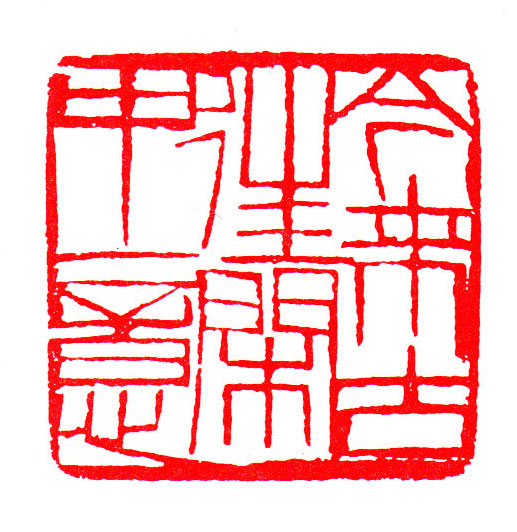
Image Healing: Mandala Stability Guidance 18
Imagine a hand reaching out to you from the center, gentle and unhurried. The surrounding lines are like concentric circles of support, radiating outwards from the center, stable and solid. As you gaze at it, try to feel: someone is willing to approach, and you are willing to be approached. Inhale, letting the light enter your chest; exhale, slowly releasing the old pattern of "I must bear it all alone."
Traditional mandalas symbolize connection, order, and stable relationships. When the image presents layers of surrounding and supporting elements, your nervous system gradually remembers: "I can be supported."“
◉ Please stare and watch twice.

Lesson 18: Draw a diagram showing "Where does the support come from?"“
Objective: To help the brain transition from an "isolated" mode to a "connected" mode, and to make the support system visible through drawing, so that you can truly feel: I am not alone.
Steps: Draw a small dot in the center of the paper to represent "yourself"; draw soft connecting lines outwards from the dot, and at the end of each line, use a symbol to represent a possible source of support (friends, family, professionals, pets, music, books, etc.). Use warm colors to symbolize the feeling of being gently received. After completion, write a sentence in a blank space on the paper about what you are willing to ask for help with today's practice.
Please log in before submitting your drawings and feelings.
○ 18. Suggestions for guiding system practice logs
① Write down one small support you felt today (emotional, physical, or relational).
② Record a request for help that you would be willing to try, and describe your feelings (e.g., nervous, relaxed, expectant).
③ Write down three people in your life who can provide stable support, and write down one specific request you can make to each of them.
④ After completing the drawing exercise, describe the moment when "I am not alone" (even if it is very subtle).
⑤ Today’s score for whether your body is tense or relaxed (0–10) and the points of change.
⑥ Tomorrow's "Micro-Connection Initiative": Say a sincere word to someone you trust.
Please log in to use.
Allowing yourself to be helped is the first step toward strength. May you rediscover the sense of security of being supported in these new connections.
 EN
EN  ZH
ZH  ES
ES  FR
FR  JA
JA