

Lesson 217: Learning to Distinguish Between "Dependency" and "Connection"“
Duration:70 minutes
Topic Introduction:Many people in relationships easily mistake "connection" for "dependence," or disguise "dependence" as "deep connection." Dependence is other-centered, while connection is relationship-centered; dependence makes you lose yourself, while connection brings you closer to your true self. This course will guide you to accurately identify the psychological differences between the two and teach you how to build healthy, stable, and mutually supportive relationship patterns.
How to distinguish between "dependency" and "connection"?
- Dependence is "I can't live without you"; connection is "I am richer with you".
- Dependence keeps attention focused on the other person; connection allows attention to flow between the two.
- Dependence stems from fear (fear of loss); connection stems from choice (the desire to get closer).
Lesson 217: Learning to Distinguish Between Dependency and Connection; Click to listen to the reading; View the content.
A key ability in relationship repair and emotional maturity is learning to clearly distinguish between dependency and connection. Many people feel repeatedly insecure in relationships not because they don't need others, but because they mistake connection for dependency. Dependence essentially outsources stability; when the other person becomes unavailable, the inner balance quickly crumbles. Connection, on the other hand, involves interacting with others while maintaining one's own integrity. Understanding this difference is a crucial step in increasing freedom in relationships. The first difference lies in the source of motivation. Dependence is often driven by fear—fear of loss, fear of being alone—while connection is more driven by will—"I choose to be close to you," not "I must cling to you." The second difference lies in self-state. In dependency, you shrink your world, focusing your attention on the other person's reactions, while in connection, you maintain your own rhythm, interests, and actions. The third key is emotional regulation. In dependency, emotions are primarily regulated through the responses of others, while in connection, you can first settle yourself before sharing with others. The fourth point is the reaction to separation. Dependence experiences separation as a threat, while connection can withstand distance and believes in the continuity of the relationship. Learning to distinguish between them is not a one-size-fits-all process but a gradual adjustment. The first step is to be aware of whether you are approaching out of fear or because you want to. The second stage is practicing delayed emotional regulation, allowing it to first reside within oneself, such as through breathing, bodily sensations, or the completion of actions. The third stage is entering relationships with your complete self. When you no longer rush to prove your existence through relationships, connection becomes easy and authentic. It's important to understand that healthy relationships don't require complete independence, but rather that dependence is no longer the sole support. As you gradually bring stability back into yourself, connection transforms from a need into a choice. True intimacy isn't about clinging to each other, but about each standing firm while still willing to walk together.
▲ AI Interaction: Do you crave to be "supported" or "seen"?
Often, you think you're depending on the other person.
But what you really crave is to be understood, seen, and accepted.
Dependence can make you anxious because you're afraid of losing that support.
The connection will make you feel at ease because you know you are recognized.
Try asking yourself: What do I need, strength or companionship?
Click the button below to help AI identify the boundaries between "dependency" and "connection" in your relationships.
Dependence is like clinging to something; connection is like a harmonious melody, where both can breathe.
Play some soothing music and let your body slowly relax to the rhythm.
In the calm of the music, ask yourself: What do I want to get closer to, the other person, or the warmth of this relationship?
○ Eastern Healing Tea: Oolong Osmanthus Tea
Recommended drinks:Oolong Osmanthus Tea
Recommended reasons:Osmanthus has a calming effect, while oolong tea has a refreshing fragrance, making it suitable for maintaining clarity and lightness when discerning emotional and relational boundaries.
practice:Add 3 grams of oolong tea and a little osmanthus to 85°C hot water for a refreshing and mellow aroma.
○ Stable Dietary Therapy - Lotus Leaf Porridge (ID217)
During the practice of distinguishing between dependence and connection, the body needs light and balanced nourishment. Lotus leaf porridge helps dissolve inner stickiness, symbolizing a loose yet not disjointed state in relationships. This nourishing dish is suitable for consumption after relationship reflection or self-recovery exercises to help restore clarity to the mind and body.
Mature relationship
Self-integrity
Open Recipe
◉ Chinese Food Therapy: Lotus Leaf Porridge (ID 217)
Traditional Chinese medicine believes that "lotus leaves are a cooling and refreshing substance, with a green color and fragrant aroma." During the irritable summer days or when anxiety strikes, people often feel a heavy feeling in their head and a stuffy feeling in their chest, which is often a manifestation of "dampness trapping the spleen's yang." Lotus leaves have a unique effect of "raising and invigorating clear yang," bringing fresh yang energy to the head and face while simultaneously expelling turbid dampness through urination. This bowl of emerald green porridge is a "lightening baptism" for a heavy body and mind.
Clears away heat and dampness Invigorating Yang and refreshing the mind Lipid reduction and weight loss
I. Recommended Dietary Therapy and Reasons
Recommended dishes:Fresh Lotus Leaf Porridge: A fragrant and refreshing porridge that helps dispel dampness.
Recommended reasons:
1. A wake-up call:Anxiety is often accompanied by "brain fog." Lotus leaves can "raise clear yang energy," helping to improve dizziness, drowsiness, and lack of energy, and restoring clarity of thought.
2. Natural slimming tea:The lotus leaf alkaloid in lotus leaves can effectively break down body fat and form a fat-isolating membrane. It is the best food for reducing body weight caused by stress or overeating.
3. Aromatic and dampness-resolving:The aroma of lotus leaves is a type of aromatherapy. This delicate plant fragrance can act directly on the limbic system, soothing tense nerves and relieving chest tightness.
2. Recipe and Method
Recipe (1–2 servings):
- 1/2 fresh lotus leaf (or 20g of dried lotus leaves, available at Chinese medicine stores)
- Rice (japonica rice) 80g
- 1000ml of clean water
- Rock sugar (appropriate amount)
- (Optional) diced winter melon (to enhance diuretic and swelling-reducing effects)
practice:
- Juice extraction (key step):
Fresh lotus leaves:Wash and cut into large pieces, put in a pot, add water and bring to a boil. Simmer over medium heat for 10-15 minutes, until the broth turns bright green. Remove and discard the lotus leaves, keeping only the lotus leaves.Green lotus leaf water.
Dried lotus leaves:As above, cook until flavorful. - Cooking porridge:Place the washed rice into the clear green lotus leaf water. Bring to a boil over high heat.
- Slow cooking:Simmer over low heat for 30 minutes.
- Cover yourself with a blanket (Titian's Secret):If using fresh lotus leaves, you can reserve a small piece without cooking it. After the porridge is cooked and the heat is turned off, place this fresh lotus leaf on top of the porridge, cover the pot, and let it simmer for 5 minutes.
- Congee:Lifting the lid, a fragrant aroma wafts out. The porridge is a pale green, translucent and glistening. Add rock sugar to taste.
3. Small rituals for body and mind
Green Vision:The cooked lotus leaf porridge has a pale green hue. Gazing at this bowl of porridge, I imagine myself standing by a pond where lotus leaves stretch to the sky, a gentle breeze carrying away the heat and worries.
Olfactory purification:The moment I lifted the lid, I took a deep breath of the fresh, herbal fragrance. I told myself, "My body is becoming lighter; all the heaviness is dissipating with the steam."“
4. Dietary Therapy Experience Record
- Record whether you feel more mentally alert and less heavy (dampness) in your body after drinking the porridge.
- Observe the urine. Lotus leaves have a diuretic effect, and an increase in urine volume is a sign of the excretion of dampness.
- Pay attention to your appetite; the fragrance of lotus leaves can stimulate your appetite and relieve loss of appetite caused by hot weather or a bad mood.
V. Instructional Videos (approximately 3–5 minutes)
◉ Video Title:How to cook a bowl of emerald green lotus leaf porridge that's both slimming and refreshing in the summer.
6. Precautions
- Use with caution during menstruation:Lotus leaves are neutral to slightly cooling in nature and have astringent and hemostatic effects. Women during menstruation (especially those with light menstrual flow or dysmenorrhea) should refrain from consuming them to avoid disrupting menstruation.
- Those who are thin and have weak Qi should not:The main functions of lotus leaves are "draining" and "dispersing". If you are already thin, weak, and prone to night sweats, you should not eat too much, so as not to deplete your vital energy.
- Taboos regarding utensils:Cooking lotus leaf porridgeAvoid using iron potsBecause components in lotus leaves react chemically with iron, causing the porridge to turn black, affecting its taste and medicinal efficacy. Please use a clay pot or stainless steel pot.
hint:If fresh lotus leaves are unavailable, dried lotus leaves will also work well. This porridge should not be too thick; cooking it thinner and drinking it as a tea will enhance its heat-clearing effect.
○ Suggestions for Modern Calligraphy Writing Practice
The topic of this lesson:Maintaining self-integrity while being close
In-depth analysis:
Dependence allows the lines to intertwine, while connection allows closeness yet retains breathing space.
Modern art calligraphy emphasizes the rhythm of spacing and the individuality of lines, making it ideal for training this distinction.
When you allow strokes to echo each other without engulfing each other, your brain gradually learns that connection does not mean losing yourself.
The writing process itself is an experience of maintaining one's standing in a relationship.
Writing Techniques (Connecting Boundaries Version):
- Parallel Flow:Making adjacent strokes oriented in the same direction while maintaining spacing symbolizes walking side by side.
- Breath Spacing:Leave gaps between words to train spatial awareness in relationships.
- Independent Closure:Each word completes its meaning, reinforcing the sense of self-integrity.
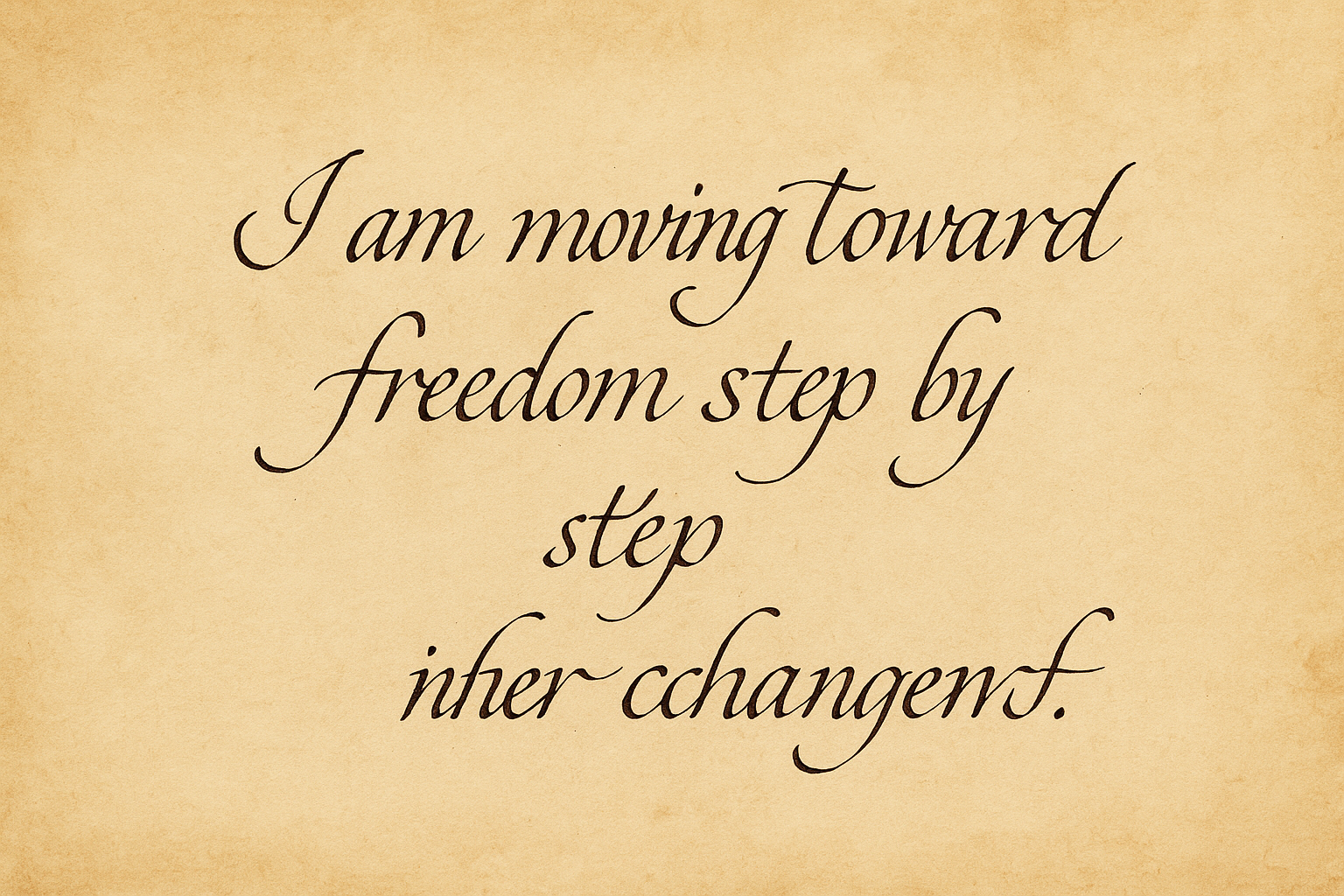
Image Healing: Guided Mandala Viewing - Lesson 217
Choose a mandala with clear spacing and a stable center.
Let your gaze move freely among the elements.
Feel the balance of being close yet not sticking.
Mandala is not about drawing something, but about observing. In observing, you practice autonomy through connection.
The theme of this lesson's mandala is a parallel ring, symbolizing independence and companionship in a relationship.
◉ One gaze is sufficient; no repetition is required.

Lesson 217: My "Connection vs. Dependency" Visual Exercise
Objective: To concretize the two patterns in relationships so that one can more clearly perceive "whether I am connecting or depending".
Steps: Draw two circles on a piece of paper: write "dependence" on the left and "connection" on the right. In the left circle, draw the behaviors you exhibit when dependent (such as clinging, repeated confirmation, fear of loss), and in the right circle, draw the feelings you experience when connected (such as ease, communication, mutual support). Finally, connect the two circles with a soft line, symbolizing that you can move freely within them, rather than being trapped in one place.
Please log in before submitting your drawings and feelings.
○ 217. Log-guided suggestions for dependencies and connections in relationships
① In which situation today did you feel "need for the other person"? Was this dependence or connection?
② Write down your core feelings at the time (fear, loneliness, warmth, being seen).
③ Record body signals (tense/relaxed/accelerated heartbeat/steady breathing).
④ Which thought is more real? "I can't live without you," or "I want to be connected with you"?
⑤ Write down a "stabilizing action" you take for yourself (such as taking a deep breath, expressing your needs, or maintaining boundaries).
⑥ In which relationship moment do you want to practice "reducing dependence and increasing connection" tomorrow? What are the criteria for success?
Please log in to use.
Dependence is about clinging, connection is about getting closer. The better you can distinguish between the two, the freer, more stable, and closer your relationships will be to your true self.
 EN
EN  ZH
ZH  ES
ES  FR
FR  JA
JA