

Lesson 261: Recording and Playback Exercises
Duration:70 minutes
Topic Introduction (Overview):
For many, "hearing their own voice" triggers feelings of tension, shame, avoidance, or judgment. However, recording and playback is one of the most effective training methods for restoring autonomy over one's voice. This lesson will guide you through a very gentle way to practice accepting your own voice—without judgment, without trying to improve it, and without forcing yourself to confront uncomfortable parts. You simply need to allow your voice to be recorded and then listen to it in a safe environment.
When you can listen to your own voice in an environment where there is no supervision or evaluation, you will gradually discover that tension, haste, and weakness in your voice are not flaws, but rather reactions of your emotional system. The purpose of recording practice is not to improve your voice, but to learn to be at peace with your own voice, allowing you to slowly experience:
“"It turns out my voice isn't as scary as I thought; it just needs a little time to be understood."”
Lesson 261: Recording and playback exercises, click to listen to the reading, view the content.
After language gradually recovers and can be used in real life, recording and playback exercises often trigger new tensions. Many people instinctively avoid hearing their own voice, even feeling more uneasy than when they are speaking. This reaction is not narcissism or fault-finding, but rather the brain misinterpreting playback as a re-exposure and evaluation. The goal of recording and playback exercises is not to examine performance, but to re-establish a safe relationship with one's own voice. The first step is to redefine the meaning of recording: it is not evidence, not an achievement, but a process that has ended. The second step is to start with very short recordings, such as a sentence or three words, to ensure the body knows this is not prolonged exposure. The third step is to maintain low expectations while recording; you don't need clarity or naturalness, just authenticity. The fourth step is to set safe playback conditions, such as being alone, wearing headphones, using a low volume, and taking a full breath before playback. The fifth step is to practice neutral listening: when you hear a sound, don't judge it as good or bad, only mark its features, such as "this is too slow," "this is too soft," rather than "I sound terrible." The sixth step is to allow incomplete playback; if you feel uncomfortable halfway through, you can pause at any time to let your body learn that you can interrupt rather than be forced to listen to the whole thing. The seventh step is post-replay integration. After the recording ends, perform a physical action, such as standing up and walking around or drinking water, to help the nervous system distinguish that the recording has ended and you are still safe. It's important to understand that becoming familiar with your own voice is a crucial step in speech recovery. When you can accept your own presence during playback, tension in real-life expression will significantly decrease. The core of recording and playback exercises is not liking your own voice, but allowing it to exist and being accepted by yourself.
▲ AI Interaction: Your voice deserves to be heard by yourself
When people hear their own recordings for the first time, many feel that "something's off."
But that's not a flaw; it's that I've never truly understood my own voice.
When you are willing to listen again, or even just a little more, you are practicing acceptance.
Recording is not about supervision, but about gently reflecting on yourself.
You don't need to change it, just allow it to exist.
Click the button below to analyze the "tension points" and "highlights" in your voice with AI.
○ Sound Stabilization - Gentle Music Playback Method
First, play some calm and gentle music to help your emotions relax and your body relax.
Then listen to only the first 3 seconds of your own recording; you don't need to play the whole thing.
By layering music with your own voice, you'll find it easier to appreciate the texture of your sound.
Repeat this three times, and you will find that the discomfort decreases significantly.
Herbal Tea: Rose and Ophiopogon Soothing Drink
Recommended drinks:Rose + Ophiopogon japonicus
Recommended reasons:Relieve tension and stabilize your chest, so that recording practice no longer causes your heart to race.
practice:Soak 3 roses and 3 grams of Ophiopogon japonicus in hot water for 4 minutes.
○ Ayurvedic Spiced Chicken Breast (ID261)
During the recording and playback practice phase, the body is prone to subtle tension and exhaustion. The warmth of Ayurvedic spices and the stable protein of chicken breast help restore internal support, making it suitable for consumption after practice to help the body return to a resilient state.
Self-acceptance
Stable recovery
Open Recipe
◉ Ayurvedic Spiced Chicken Breast
The chicken breast is marinated with turmeric, black pepper, coriander seeds and a little yogurt, then grilled until golden and juicy.
Low fat and high protein Enhance immunity Spice Care
1. Recommended dishes and reasons
Recommended dishes:Spiced Chicken Breast (ID 189)
Recommended reasons:High protein and low fat combined with mild spices support immunity and muscle repair, refreshing and non-greasy.
2. Recipe and Method
Ingredients (Serves 2–3):
- 2 chicken breasts (about 400 g, patted to an even thickness)
- 2 tablespoons sugar-free yogurt
- 1/2 teaspoon turmeric powder
- 1/2 tsp coriander seed powder
- 1/4 teaspoon black pepper
- 1 tsp minced garlic
- 1 tsp olive oil
- 1/3 teaspoon salt
- 2 lemon wedges (for serving)
- A handful of mixed lettuce (to serve)
practice:
- Combine yogurt, turmeric, coriander seeds, minced garlic, salt, and black pepper, then rub on chicken breasts and marinate for 15–30 minutes.
- Heat a small amount of oil in a frying pan over medium heat and fry for 3–4 minutes on each side until the center reaches 65–70°C; or bake at 200°C for 12–14 minutes.
- Remove from heat and let stand for 3 minutes to absorb juice, then slice and serve with lettuce and lemon juice.
3. Eating rituals
Take two minutes before meals to slow down your pace and breathe deeply.
Serve with a serving of leafy greens and whole grains.
Record your fullness and mental focus.
4. Experience Record
- Physical sensation (refreshing/full/warm).
- Post-meal mental and digestive scores.
- Record portion sizes and daily fruit, vegetable, and whole grain intake.
5. Tutorial Video (approximately 2–5 minutes)
◉ Video Title:Spiced Chicken Breast · Refreshing and High in Protein
6. Precautions
- If you are intolerant to dairy products, you can omit the yogurt and replace it with olive oil + lemon juice.
- Poultry must be fully cooked; not suitable for those allergic to chicken or garlic.
hint:Diet therapy is for daily care and does not replace individualized medical treatment. If you have allergies or chronic diseases, please consult a professional first.
○ Suggestions for Chinese Calligraphy and Seal Carving Practice: Lesson 261: Living with Your Own Voice
The seal carving exercises in this lesson are designed to help you maintain a steady rhythm when facing self-presentation and self-view, allowing your body to learn that even when being seen and heard, you don't have to judge.
- Introduction to the characteristics of seal carving:
Seal carving emphasizes the controllable continuity of force and rhythm. Each stroke is independent yet also part of the whole, corresponding to each sound segment in a recording. - Written words:
Heart She - Psychological Intention:
Through repeated writing, the brain experiences that self-presentation does not need to be perfect, but only consistent and authentic. - Knife skills:
After each cut, pause briefly to ensure your hand is steady before continuing with the next cut. - Emotional transformation:
Transform the avoidance of "I don't want to hear myself" into the sense of acceptance of "I can listen to a short segment slowly".

Image Healing: Guided Mandala Viewing - Lesson 261
Choose a mandala with a stable center and clear outer layers.
First look at the center and then slowly diffuse to the outer layer.
Pause for a moment on each floor to see if you feel the urge to make a judgment.
Mandala is not about drawing something, but about observing what you are doing. In observing, you are practicing peaceful coexistence with your self.
The theme of this mandala is the Heart of Echo, symbolizing your ability to carry your own voice and move forward.
◉ One gaze is sufficient; no repetition is required.
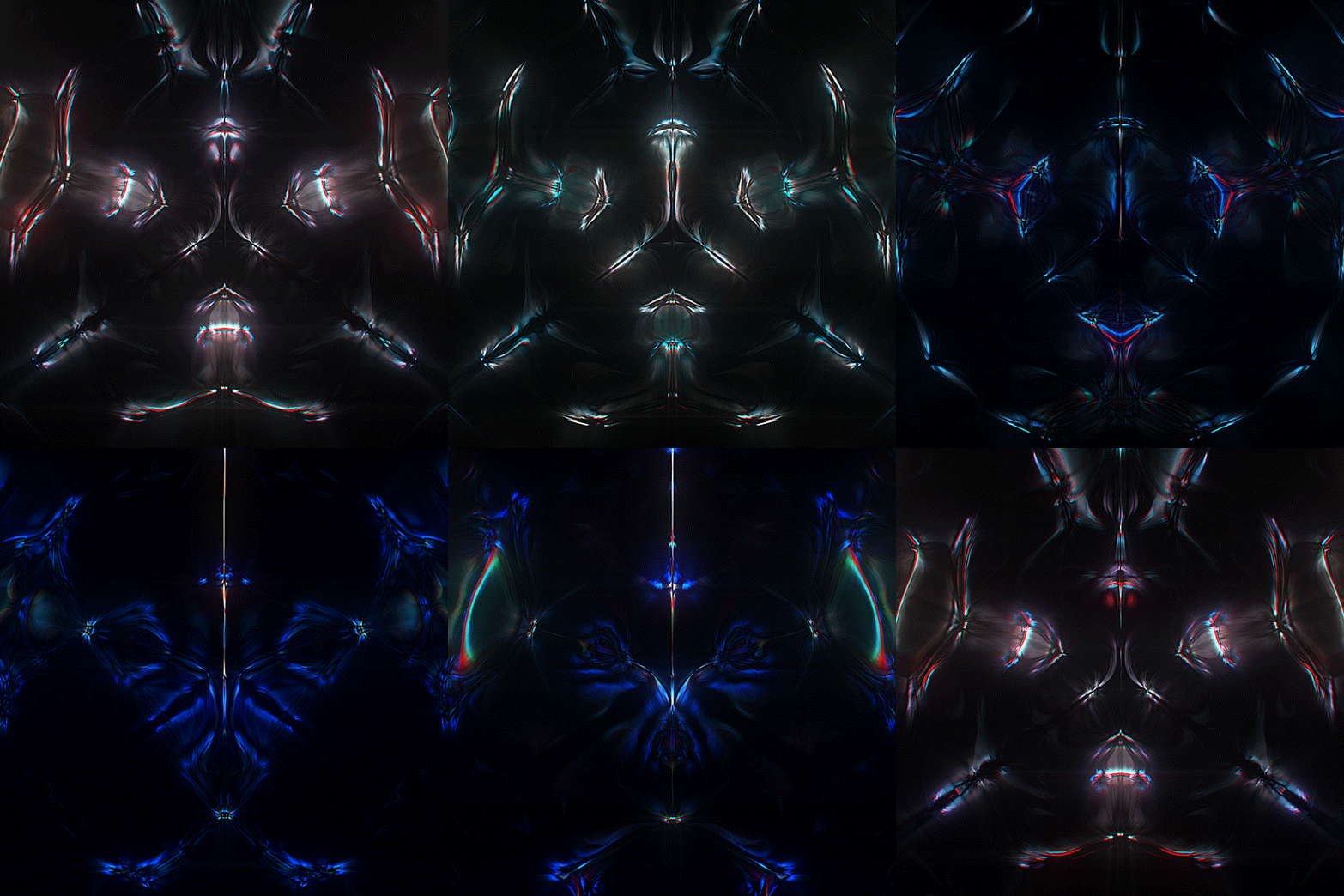
Lesson 261: My "Sound Reception Map"“
Objective: To help you draw your true feelings about your own voice, making it less abstract.
step:
① Draw a color that represents "I feel uncomfortable" (such as gray, blue, or light purple).
② Draw another color to represent "I am willing to keep trying".
③ Let the two colors gradually blend together, symbolizing that your acceptance of the sound is taking place.
④ Write down your feelings after playing back the recording next to the picture.
Please log in before submitting your drawings and feelings.
○ 261. Audio playback · Log guidance
① What was my first feeling when I heard my own voice today?
② Which part made me nervous? Which part I unexpectedly liked?
③ Was the sound stronger, weaker, or more stable than I expected?
④ I'd like to say a word of encouragement to my own voice.
⑤ I'd like to replay it for a few seconds tomorrow? (Even 1 second counts)
⑥ Which type of expression did today's exercise bring me closer to? (Natural/Gentle/Authentic/Stable)
Please log in to use.
The sound won't betray you; it just needs you to hear it again. Each replay is a reconciliation with yourself.
 EN
EN  ZH
ZH  ES
ES  FR
FR  JA
JA