

Lesson 291: How to Cope with Persistent Guilt and Self-Blame
Duration:70 minutes
Topic Introduction (Overview):
In major depressive disorder, guilt and self-blame often shroud daily life like a heavy fog.
These emotions are often disproportionate to reality, yet they repeatedly resurface in the heart, like a constantly looping internal accusation:
“I didn’t do well enough,” “It’s all my fault,” “I let others down,” “I should be stronger.”
The brain in a depressed state magnifies mistakes and minimizes contributions, taking all the blame upon itself, trapping people in a painful cycle of "no matter what they do, it's not enough."
This lesson will help you understand:
Persistent guilt and self-blame are not a character issue, but rather the result of emotional system fatigue, damaged self-worth, old relationship patterns, and negative automatic thoughts working together.
We will learn how to distinguish between "it is all my responsibility" and "the part that belongs to me" and "the part that does not belong to me";
How to stop endless psychological punishment;
How can we gradually loosen our emotions from the heavy burden of guilt and rediscover reality, kindness, and our current efforts?
Lesson 291: How to Cope with Persistent Guilt and Self-Blame (Click to listen to the reading and view the content)
Persistent guilt and self-blame are often not because you actually did anything wrong, but because the brain, under prolonged stress or depression, excessively focuses responsibility on yourself. This internal blame often manifests as repetitive replays and assumptions about what would have happened differently, making it difficult to stop. The first step is to distinguish between responsibility and consequences. You can be responsible for your actions, but not for all outcomes; many things are limited by the circumstances at the time, not by your personal abilities. The second step is to understand the function of guilt. Guilt is originally meant to repair relationships and a sense of worth, but when it loses its outlet, it transforms into persistent self-attack. The third step is to identify the language patterns of self-blame, such as "I shouldn't have," "I'm too bad," or "It's all my fault." These phrases themselves intensify the pain. The fourth step is to shift your focus from judgment to compassion, asking yourself how you would respond if a friend experienced the same thing. The fifth step is to allow imperfection to exist. Human learning inherently includes mistakes; self-blame cannot change the past, it only drains present energy. The sixth step is to recalibrate from a realistic perspective, listing what you did your best in, rather than focusing solely on what you didn't do. The seventh step is to set boundaries for guilt, such as limiting the time for reflection and concluding with physical actions. The eighth step is to understand that letting go of self-blame is not about escaping responsibility, but about stopping ineffective self-punishment. When guilt is transformed into motivation for understanding and healing, your inner space will become breathable again.
▲ AI Interaction: Why do I always feel like "it's all my fault"?
Enter a recent event that made you feel guilty. AI will help you:
① Analyze whether your self-blame is consistent with the facts (disproportion test)
② Identify the old beliefs behind the guilt (people-pleasing, perfectionism, fear of abandonment, etc.)
③ Distinguish between the "responsible part" and the "emotionally amplified part" in an event.“
④ Generate a more realistic "self-dialogue" (not forgiveness, but seeing things as they are).
○ Musical Guidance: Melodies that soothe and ease inner blame
Choose soft, stable music that feels like "slowly letting go of weight" to allow your nervous system to experience a gentle relaxation.
As the melody dips downwards and then slightly rises again, practice a short phrase:
Inhale: This isn't all my responsibility— Exhale: I'm willing to let go a little bit.
○ Western Healing Tea: Lavender & Apple Skin Release Tea
Recommended reasons:Lavender soothes a tense emotional system; the sweetness of apple peel can regulate the "sharpness of excessive self-blame" within.
practice:Add 1g of lavender and a little apple peel, and steep for 6 minutes.
○ Stable Dietary Therapy: Angelica, Red Date, and Black Chicken Soup (ID291)
During a period of prolonged guilt and self-blame that depletes energy, the body needs gentle, supportive nourishment. Angelica and red dates help stabilize Qi and blood, while black-boned chicken provides deep support, making it suitable for helping the body regain strength after a period of low mood.
Self-care
Deep nourishment
Open Recipe
◉ Chinese Medicine Dietary Therapy: Angelica, Red Dates, and Black Chicken Soup
Angelica nourishes and invigorates blood circulation, red dates nourish and soothe the mind, and black-bone chicken nourishes and refreshes. Cooking all three together creates a clear, mellow soup, perfect for daily conditioning for women experiencing blood deficiency, poor complexion, or menstrual irregularities.
Nourishing blood and activating blood circulation Regulate menstruation and nourish the skin Nourishing and refreshing
1. Recommended soups and reasons
Recommended soups:Angelica and Red Date Black Chicken Soup
Recommended reasons:It replenishes blood, invigorates blood circulation, regulates menstruation and nourishes the skin, improves fatigue and dull complexion.
2. Recipe and Method
Recipe (Serves 3–4):
- 1 black-bone chicken (about 1.0–1.2 kg, chopped)
- 8–10 g angelica root (sliced)
- 6–8 red dates (pitted)
- 10 g wolfberry (optional)
- 4 slices of ginger
- 2.5 L of clean water
- a pinch of salt
- 10 ml cooking wine (optional)
practice:
- Blanch the black-bone chicken in cold water to remove the blood foam, then remove and rinse.
- Add water to a casserole, add black-bone chicken, angelica slices, ginger slices (and cooking wine), bring to a boil over high heat, then reduce to low heat and simmer for 80–90 minutes.
- Add red dates and wolfberries and cook for another 8–10 minutes. Season with a small amount of salt.
- Let it sit for 5 minutes, skim off excess fat and drink warm.
3. Small rituals for body and mind
3-7 days after menstruation, drink one bowl of warm water every day or every other day.
Drink the soup first and then eat the meat, served with steamed vegetables.
Record changes in complexion and menstrual regularity.
4. Dietary Therapy Experience Record
- Physical sensation (warmth/relaxation/fullness).
- Mental and emotional (stability/focus).
- Record the ratio of today's soup to other staple foods.
5. Tutorial Video (approximately 5–8 minutes)
◉ Video Title:Angelica, Red Dates and Black Chicken Soup - Regulating Menstruation and Nourishing Skin
6. Precautions
- Those with heavy menstrual flow or bleeding tendency should use angelica with caution.
- If you are pregnant, breastfeeding or have a chronic disease, please follow your doctor's advice.
- Diet therapy does not replace personalized medicine.
hint:Diet therapy is daily care and cannot replace individualized medical treatment. If you have underlying diseases or long-term medication, please consult a doctor first.
○ Modern Calligraphy · Lesson 291 Writing Practice Suggestions
In-depth analysis:
Persistent guilt and self-blame can cause the body to tighten involuntarily, as if repeatedly shrinking its lines inward.
Modern art calligraphy emphasizes not perfection, but...The breathability and sense of space in the lines.
When you allow the lines to extend outward, you are also sending a signal inward:
I can stop punishing myself; I have room to understand and let go.
Writing Skills (Advanced Version):
- Gentle Start:Avoid slamming your pen down too hard, as this symbolizes a gentle attitude towards yourself.
- Flourishing:Add a natural curve at the end to allow the movement to complete without abruptly retracting.
- The concept of leaving blank space:I deliberately leave space between words to remind myself not to cram everything together.
- Flow:Reducing pauses midway corresponds to reducing interruptions caused by repeated self-blame.
- Closure (Stop when finished)Putting down the pen after writing a word symbolizes the end of a cycle of self-blame.
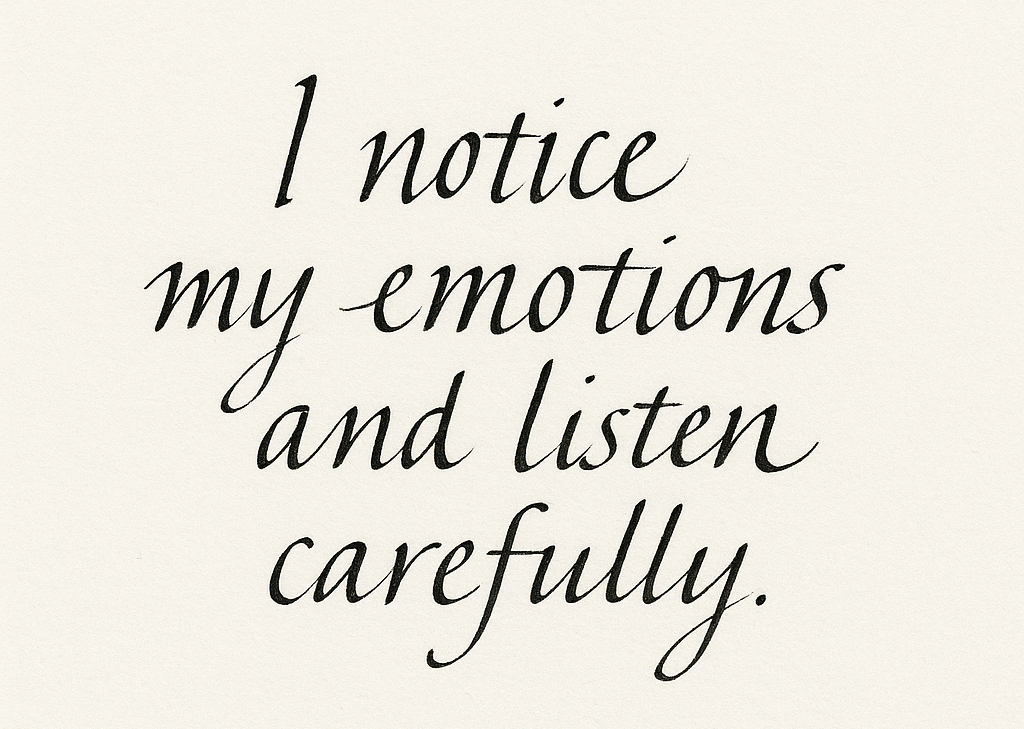
Image Healing: Guided Mandala Viewing - Lesson 291
Choose a mandala with soft lines that spread outwards.
Let your gaze slowly move outward from the center.
Feel how the space gradually becomes more spacious.
Mandala drawing is not about drawing something, but about observing. In observing, you practice letting go of guilt.
The theme of this mandala is self-forgiveness, symbolizing that you are giving yourself space to breathe again.
◉ One gaze is sufficient; no repetition is required.

Lesson 291: Drawing Exercises for Boundary Lines of Responsibility
Purpose:It helps you visually distinguish between "real responsibility" and "emotional responsibility".
step:
① Draw a circle to divide the inside and outside into two layers.
② Write "The part that belongs to me" in the inner circle; write "The part that does not belong to me" in the outer circle.
③ Write down the events you are blaming yourself for in the corresponding location.
④ Use different colors to distinguish between "factual responsibility" and "emotional responsibility".
⑤ Paint the inner circle with a gentle color to help the brain understand that taking responsibility does not require harming oneself.
Please log in before submitting your drawings and feelings.
○ 291. Log Guidance
① What did I feel guilty or remorseful about today?
② In this matter, what are the facts and what are the exaggerated emotions?
③ Does this responsibility really belong entirely to me?
④ If a friend were in the same situation, how would I comfort him?
⑤ Which gentle truth do I choose to keep to myself?
Please log in to use.
Not all the weight belongs to you, but you deserve to be lighter.
 EN
EN  ZH
ZH  ES
ES  FR
FR  JA
JA