

Lesson 561: What is Emotional Coping Disorder?
Duration:70 minutes
Topic Introduction:If you consistently overreact, experience extreme mood swings, persistent anxiety, or avoidant behaviors when faced with stress, loss, or change, you may be experiencing an emotional coping disorder. This course will help you understand its mechanisms, identify the signs, and gradually develop effective coping strategies.
○ Common features of emotional coping disorders
- Excessive emotional reactions:
A small thing can trigger a strong emotional outburst, such as crying, anger, and a sense of collapse. - Avoidant behavior:
Fear of facing stressful events and a tendency to avoid responsibility, conversation, or action. - Self-blame:
When under pressure, people tend to blame themselves for all problems, which damages their self-confidence.
▲ AI interaction: Have you ever experienced "excessive emotions" or "long-term distress" after being stressed?
When major life changes occur, emotions can be thrown into a turbulent state.
You may feel sleepless, weak, or overly tense. This is not your fault; it is a natural reaction of your body and mind.
Please write about a recent change that was difficult for you to adjust to and describe how it made you feel.
Remind yourself: this is a transitional state, not a permanent one.
Conclusion: I allowed myself to adjust slowly, and adaptation takes time and kindness.
Click the button below to work with AI to explore whether you have a "coping with obstacles" pattern and design alternative mechanisms.
○ What is music guidance for emotional coping disorders?
When life changes dramatically, emotions can be like abrupt notes, suddenly losing harmony.
Please play some slow music and let your heart slowly calm down with the melody.
Write about a recent difficult experience you had and observe how it felt in the music.
Remind yourself: this is a transition, not a failure.
The music will accompany you and help you slowly transform the chaos into a beat.
○ Cocoa Healing· Spiced Cocoa Drink
Recommended drinks:Spiced Cocoa Drink
Recommended reasons:It enhances mood-stabilizing neurotransmitters while combining spices to stimulate central awareness and provide warm support.
practice:Mix 200ml hot milk + 1 tbsp cocoa powder + cinnamon powder + cardamom + honey and drink.
○ Cold-pressed juice
Slow cold pressing preserves flavor and nutrients, allowing you to freely combine apples, carrots, celery, and ginger. Refreshing, hydrating, and pure.
Healing Recipes
/home2/lzxwhemy/public_html/arttao_org/wp-content/uploads/cookbook/leng-zha-guo-zhi-cold-pressed-juice.html(Please confirm that the following has been uploaded: leng-zha-guo-zhi-cold-pressed-juice.html)
Mental Healing: Mental Mandala Imagery 32
Use the deep blue of night to outline "awareness." That is seeing the light of thought. Gaze into this blue, letting thoughts arise and then depart. Awareness is not change, but clear seeing. You are now a complete mirror.
Be aware, and let the light return to the center.
Spiritual mandalas are commonly used in religious and spiritual practices, and their patterns and shapes symbolize spiritual growth, awakening, and spiritual connection. By drawing spiritual mandalas, individuals can explore their connection with the universe, divinity, or higher beings, and achieve psychological and spiritual healing.

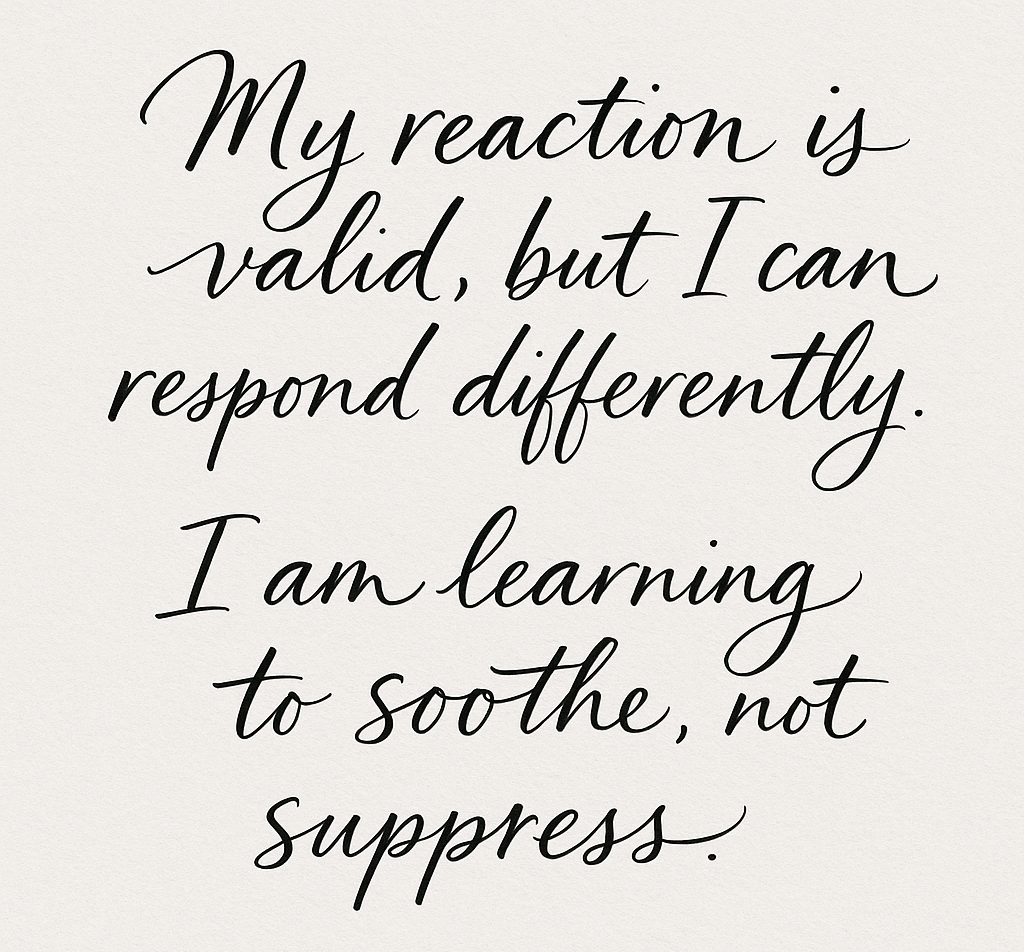
○ Modern art calligraphy practice
You are not "too sensitive," you just haven't learned to respond to yourself in a new way. Write a supportive message to yourself.
Suggested sentences for practice:
"My reaction is valid, but I can respond differently."
"I am learning to soothe, not suppress."
It is recommended to copy it once every morning and put it in your bag or on your mobile phone desktop as a starting point for self-dialogue.
Lesson 561: What is Emotional Coping Disorder?
Objective: To understand that emotional coping disorders are not due to being "too fragile," but rather to an imbalance in the regulatory system when facing stress.
Steps: Draw a forest battered by the wind, with trees leaning yet still firmly rooted. Write "Confusion, Fear, Adaptation" on the ground. Then draw a beam of light piercing through the branches and leaves, symbolizing inner resilience. Write: "I am still learning to live with the wind."“
Please log in before submitting your drawings and feelings.
○ 561. What is emotional coping disorder? · Journaling guidance suggestions
① Use three sentences to review a recent "major change" (moving, changing jobs, separation, etc.), and write down its impact on your rhythm of life and the most intuitive emotional waves.
② Physical and mental radar: Sleep changes, appetite, concentration, and social willingness, each with a score of 0-10. Mark them truthfully and let the data speak for you without blaming yourself.
③ Rewrite the narrative: "I have poor stress tolerance" → "I am facing a new environment, and my system needs time to calibrate." Read it three times and notice if your body relaxes a little.
④ Support Checklist: Three people to contact, two safe places, and one immediate comforting action (hot drink/deep breathing/walk).
⑤ Today’s micro-action: Choose one item from the list and complete it. Record the change in your mood from 0 to 10 points. Acknowledge that even 1 point is progress.
⑥ Conclusion: Adaptation does not happen overnight, so I allow myself to take it slowly.
Please log in to use.
True stability is not “having no emotions”, but your ability to slowly receive, settle and resolve them.
 EN
EN  ZH
ZH  ES
ES  FR
FR  JA
JA