

Lesson 563: The event is not the problem; interpretation is the key.
Duration:70 minutes
Topic Introduction:We often assume that emotions are caused by events, but what truly impacts us is our interpretation of those events. This lesson will help you deconstruct the cognitive pathways of emotional reactions and practice building a more robust interpretation system when faced with stimuli, minimizing misunderstandings, internal friction, and accidental harm.
○ The three-stage path of emotion formation
- Triggering event:
An external event or something someone says or does. - Subjective interpretation:
The meaning you attach to the event (being ignored, offended, rejected). - Emotional results:
The emotional and behavioral responses you have as a result of these interpretations.
▲ AI Interaction: What was the most recent event that made you emotional?
Different interpretations of the same thing will bring completely different feelings.
Please write down an event that made you emotional today and describe the facts in one sentence.
Write down three more possible interpretations and you will find that different choices bring different emotions.
Practice saying to yourself, "The event is neutral; I can choose my perspective."
Conclusion: I have the ability to change the course of the story and thus comfort myself.
Click the button below to work with AI to sort out your "cognitive interpretation path" of events and practice new thinking angles.
○ The event is not the problem, the interpretation is the key music guide
Events are notes, interpretations are arrangements, and different understandings create different melodies.
Please play a quiet piece of music and write down something that has been bothering you recently.
Then, accompanied by the melody, try to rewrite it from another gentle perspective.
You will find that your emotions are gradually relaxed through interpretation.
Music reminds you that the direction of the story can be rewritten by you.
Cocoa Healing Cocoa and Coconut Milk
Recommended drinks:Cocoa and coconut milk
Recommended reasons:Cocoa brings a sense of calmness and balance, while coconut milk nourishes the nerves and is suitable for use during "cognitive reconstruction".
practice:Combine 150ml coconut milk, 100ml milk, and 1 tbsp cocoa powder, stir well over low heat, and add appropriate amount of honey.
Grilled chicken breast with avocado
Marinate chicken breasts with a pinch of salt, black pepper, and olive oil, grill until juicy, slice them, and serve with avocado and lemon juice. This light and refreshing dish, packed with healthy fats, is perfect for a training day meal.
Healing Recipes
/home2/lzxwhemy/public_html/arttao_org/wp-content/uploads/cookbook/kao-ji-xiong-pei-niu-you-guo.html(Please confirm that the following has been uploaded: kao-ji-xiong-pei-niu-you-guo.html)
Mental Healing: Mental Mandala Imagery 34
Adorn the "Flower of Consciousness" with transparent light. It unfolds layer by layer, like a lotus emerging from the mud. Each stroke is a new petal of the soul. You are not creating a shape, but blossoming yourself.
To blossom is the natural state of the soul.
Spiritual mandalas are commonly used in religious and spiritual practices, and their patterns and shapes symbolize spiritual growth, awakening, and spiritual connection. By drawing spiritual mandalas, individuals can explore their connection with the universe, divinity, or higher beings, and achieve psychological and spiritual healing.

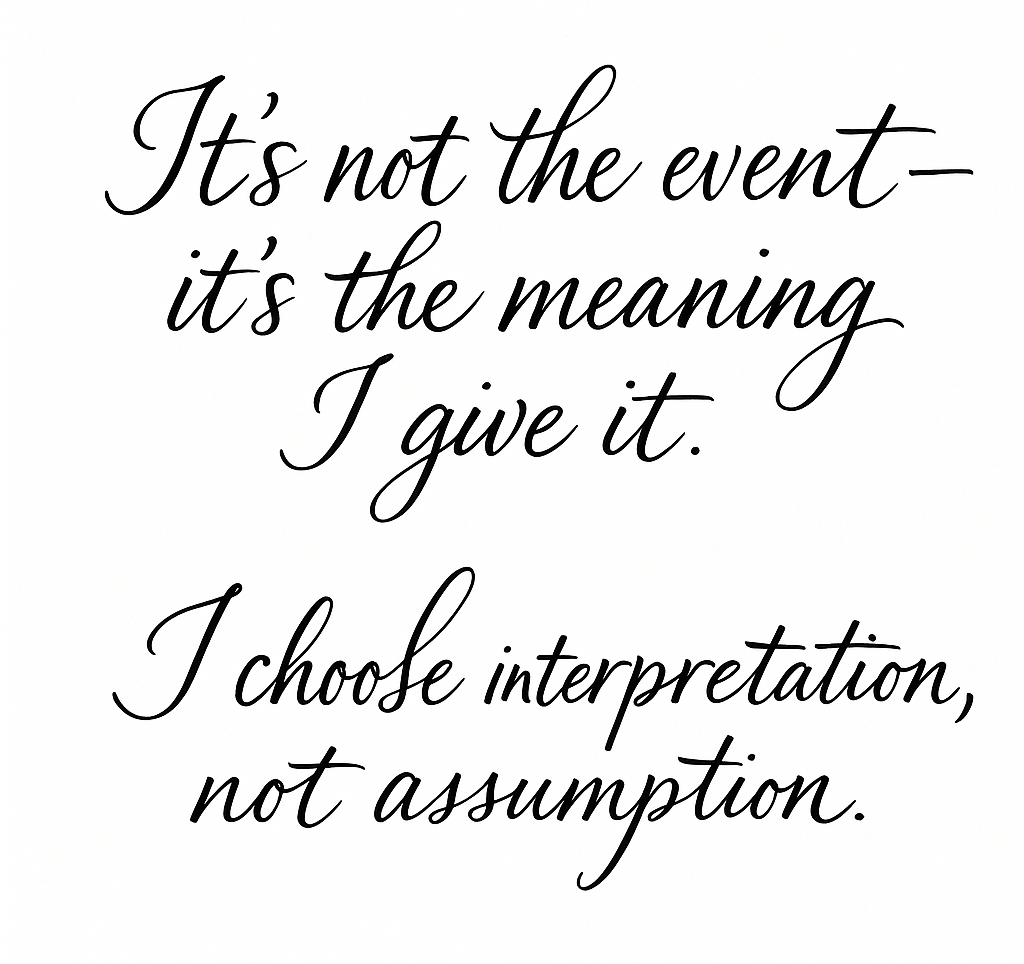
○ Modern art calligraphy practice
Write down a statement that reminds you to "suspend interpretation before judging" in a conflict to help you step away from your first reaction.
Suggested sentences for practice:
"It's not the event — it's the meaning I give it."
"I choose interpretation, not assumption."
Write it down in a space where you often misunderstand or become overly sensitive to others, such as a note on your phone, a conversation journal, or next to a mirror.
Lesson 563: The event is not the problem; interpretation is the key.
Purpose: To help you distinguish between objective events and subjective interpretations.
Steps: Draw a window with the scenery outside remaining constant, but the windowpane painted in different colors. Use colors to represent an "emotional filter." Write: "What I see is not always the truth, but my emotions."“
Please log in before submitting your drawings and feelings.
○ 563. The event itself is not the problem; interpretation is key. · Log guidance suggestions
① Write down an event that made you emotional. Just state the fact that it can be captured by camera without adding any comments.
② List three automatic interpretations (e.g., “He doesn’t value me”) and label them with emotional intensity on a scale of 0–10; then propose an alternative interpretation.
③ Evidence table: Three pieces of evidence each to support/oppose the original interpretation, allowing facts and emotions to go their separate ways.
④ Gentle rewrite: “It must be terrible” → “I’m not sure, but I can ask/clarify/wait.” Read the sentence three times and note any changes in your body.
⑤ Today’s exercise: Choose a situation, use “clarification sentences” instead of imagining, and record the results and feelings.
⑥ Conclusion: When I change my interpretation, more possibilities appear in the world.
Please log in to use.
The world will not become better because you explain it correctly, but you will be freer because you explain it gently.
 EN
EN  ZH
ZH  ES
ES  FR
FR  JA
JA