

Lesson 62: The Fear of Being Photographed, Recorded, or Live-Streamed
Duration:70 minutes
Topic Introduction:
Do you feel nervous the moment the camera is pointed at you?
Stiff when taking photos, video recording freezes, and I'm too afraid to turn on my microphone during live streams...
These reactions are not contrived, nor are they "overly sensitive," but rather the brain perceives the camera as a social threat of "high exposure."
The camera makes you feel like every detail of you is being magnified, recorded, and evaluated.
This lesson will help you understand why the camera triggers such intense anxiety and teach you how to gradually build a "stable presence" in front of the camera.
Why does the camera terrify me?
- The fear of being "frozen in time":The camera makes you feel like your state is being permanently recorded and cannot be corrected.
- Excessive self-monitoring:You'll start to notice every expression, every hair, and whether your posture is stiff.
- To maintain a perfect image:You're afraid the camera will expose the parts that aren't "good enough."
- Past experiences of being photographed poorly:The shame you once felt may resurface in front of the camera, making it hard to relax.
Lesson 62: The Fear of Being Photographed, Videotaped, and Live-Streamed (Click to listen to the reading)
It's not uncommon to experience intense discomfort when being photographed, videotaped, or live-streamed. You might freeze the moment the camera is pointed at you, your expression become unnatural, and the thought "I must look awful" repeatedly flashes through your mind. This fear often doesn't stem from the camera itself, but from the feeling of being permanently recorded and repeatedly watched. You are no longer just a part of the present moment, but transformed into an image that can be preserved, judged, and even disseminated, which quickly puts the brain into a state of high alert. Psychologically, the camera amplifies self-awareness, turning you from an experiencer into an object of observation. You begin to examine yourself from an external perspective; every detail of your posture, expression, and voice is magnified infinitely. This intense self-monitoring severs your connection with your present feeling, rapidly escalating the tension. For some, past experiences of being ridiculed, secretly filmed, or embarrassed in public create a strong association between images and shame and loss of control. Thus, every time you face the camera, it feels like returning to those old, threatening scenarios. What you need to be seen isn't exposure itself, but the loss of control over your self-presentation. The image seems to freeze a fragment, making you worry that this fragment will be misunderstood, labeled, and thus replace your real, multifaceted self. The key to alleviating this fear is not forcing yourself to get used to the camera, but rebuilding your sense of boundaries and choice. You can allow yourself to be imperfect, allow tension to exist in the scene, and set a level of participation for yourself. As you gradually shift your attention from the external image back to what you are doing and saying, your brain will gradually lower its excessive defenses. You are not a scene for others to judge, but a person experiencing the present moment. Being recorded does not equate to being defined; you still have the right to interpret yourself.
▲ AI Interaction: What are you most afraid of happening when the camera is pointed at you?
You're not afraid of the camera, but you're afraid of "being seen too much."
You worry that your facial expressions will be stiff, your movements will be unnatural, your voice will be unpleasant, and the photos will not turn out well.
You're afraid of leaving behind "imperfect evidence".
But the camera doesn't record your flaws, it records your existence.
You can practice making the camera an "observer" rather than a "judge".
Click the button below to practice "stabilization in front of the camera" with AI.
When nervous in front of the camera, breathing automatically becomes shallow.
Music can help the brain loosen up from the feeling of being "in the spotlight".
Let the melody bring you back to your body, not back to the camera.
○ Eastern Healing Tea - Osmanthus Green Tea
Recommended drinks:Osmanthus Green Tea
Recommended reasons:The delicate fragrance of osmanthus can relieve stiffness and tension in front of the camera and help regulate breathing.
practice:Brew with 80℃ hot water; it has a slightly sweet aroma and is perfect for calming the mind before taking photos or videos.
○ Sweet Potato Milk Calming Soup
Camera anxiety is often accompanied by abdominal cramps, dry throat, and rapid heartbeat.
The delicate flavor of sweet potato and the warmth of milk can help the body settle down and reduce the feeling of "floating in front of the camera".
Gentle and smooth, it helps you transition from tension to stability.
Stabilize the body
Gentle soothing
Open Recipe
◉ Warming and Nourishing Food: Refreshing Pumpkin and Brown Rice Porridge (ID 54)
Pumpkin and Brown Rice Porridge is a gentle porridge that combines satiety, comfort, and lightness. Brown rice provides slow-release energy, helping to stabilize blood sugar; the natural sweetness and soft, glutinous texture of pumpkin make the porridge gradually smooth and delicate during cooking. Whether you need a stomach-friendly dinner, a light meal after working overtime, or a warm bowl of porridge for the first thing in the morning, this dish gently treats your body without causing any burden.
Warm and gentle Slow energy Low-fat light meals
I. Recommended Dietary Therapy and Reasons
Recommended dishes:Nourishing Pumpkin and Brown Rice Porridge (ID 46)
Recommended reasons: Pumpkin is rich in beta-carotene and dietary fiber, providing the body with gentle energy and aiding digestion; brown rice has a more complete structure and releases energy slowly, helping to maintain a more stable mental state. For those who don't want to eat greasy food for dinner, those with an upset stomach, or those who want to maintain a light feeling, this porridge can provide the body with nourishment that is "slowly replenished and unhurried."
2. Recipe and Method
Recipe (1–2 servings):
- 150–200 g pumpkin (peeled and cut into small pieces)
- 40–50 g of brown rice (soaking for 1 hour beforehand is best)
- 550–650 ml of clean water
- 1-2 slices of ginger (optional)
- Add a pinch of salt (optional, or add lightly at the end).
- A small handful of goji berries (optional, to enhance moisturizing effect).
practice:
- Soaking brown rice for 1 hour beforehand will make it softer and less glutinous, and shorten the cooking time. If you are short on time, you can use it directly, but you will need to extend the cooking time.
- Peel and cut the pumpkin into chunks; for a smoother texture, cut it into smaller cubes.
- Add water, brown rice, and ginger slices to a pot, bring to a boil over high heat, then reduce to low heat and simmer for 20 minutes.
- Add the pumpkin chunks and continue to simmer over low heat for 18–25 minutes, stirring occasionally to prevent sticking.
- Once the pumpkin is cooked until completely soft, you can gently mash it with the back of a spoon to make the porridge thicker naturally.
- If you prefer a slightly sweet taste, you can add a few goji berries and cook for another 3–5 minutes.
- After turning off the heat, add a little salt to taste as needed, or you can leave it without salt to make a mild and nourishing porridge.
- Let it sit for 3 minutes to allow the porridge to blend better before serving.
3. Small rituals for body and mind
When crushing and softening the pumpkin, you can gently feel the metaphor of "heaviness being softened," allowing the accumulated tension to slowly loosen.
The process of cooking porridge is itself an exercise in slowing down the pace, observing the tiny bubbles in the pot, and allowing the mind to detach from the rapidly flowing information.
As you take your first bite of porridge, silently tell yourself, "I allow myself to go slowly, and I deserve to be so gently settled."“
4. Dietary Therapy Experience Record
- Record the time of consumption, as well as the level of hunger and mental state at that time.
- Observe whether you feel relaxed, unburdened, and have stable energy levels 1–2 hours after consumption.
- If this porridge is eaten for dinner for several consecutive days, changes in sleep, stomach comfort, and mood stability can be recorded.
V. Instructional Videos (approximately 3–5 minutes)
◉ Video Title:Soothing Pumpkin Brown Rice Porridge: A bowl of gentle, slow-burning, heartwarming energy.
6. Precautions
- For those who find brown rice difficult to digest, a 50/50 ratio of brown rice and white rice can be used to make the porridge smoother.
- People with significant blood sugar fluctuations can reduce the amount of pumpkin and extend the cooking time of brown rice porridge to slow down the rate of blood sugar rise.
- For those with weak stomachs, the pumpkin can be completely crushed to make the porridge easier to digest and absorb.
hint:This recipe is a light daily diet option and does not replace professional nutritional advice. If you have chronic stomach discomfort or metabolic issues, please consult a professional to adjust your diet.
○ Gothic script - Lesson 62 Writing Exercises
In-depth analysis:
When facing a camera, we often feel that our souls are being "captured" or frozen in time for judgment.
The Gothic textura, with its dense, black lettering, resembles a sturdy castle.
Writing in this dense, fence-like font is a way of constructing a psychological "barrier." You are not nakedly exposed in front of the camera; you are in a fortress you have built yourself, safe and secluded.
Writing Skills (Advanced Version):
- The Fence effect:
The vertical strokes of Gothic calligraphy are arranged like a tight fence. When writing, imagine these lines blocking the prying eyes of the outside world and protecting your inner true self. - Quadrata (diamond facet):
The rhombus shape at the beginning and end of the stroke symbolizes "rejection." You have the right to refuse uncomfortable stares; your boundaries are as hard as diamonds. - Extremely stable (Stability):
No matter how the outside world (the camera) moves, the center of gravity of a Gothic body always points vertically downwards. Practice this feeling of being "immovable as a mountain" to combat the helplessness of being photographed. - Compactness:
Keep the letters close together. This symbolizes the "inward" control of energy, preventing it from dissipating outward due to fear. - Mechanical repetition:
Repeating the writing with the precision of a printing press, using this sense of order to calm the chaotic heartbeat when facing the camera.

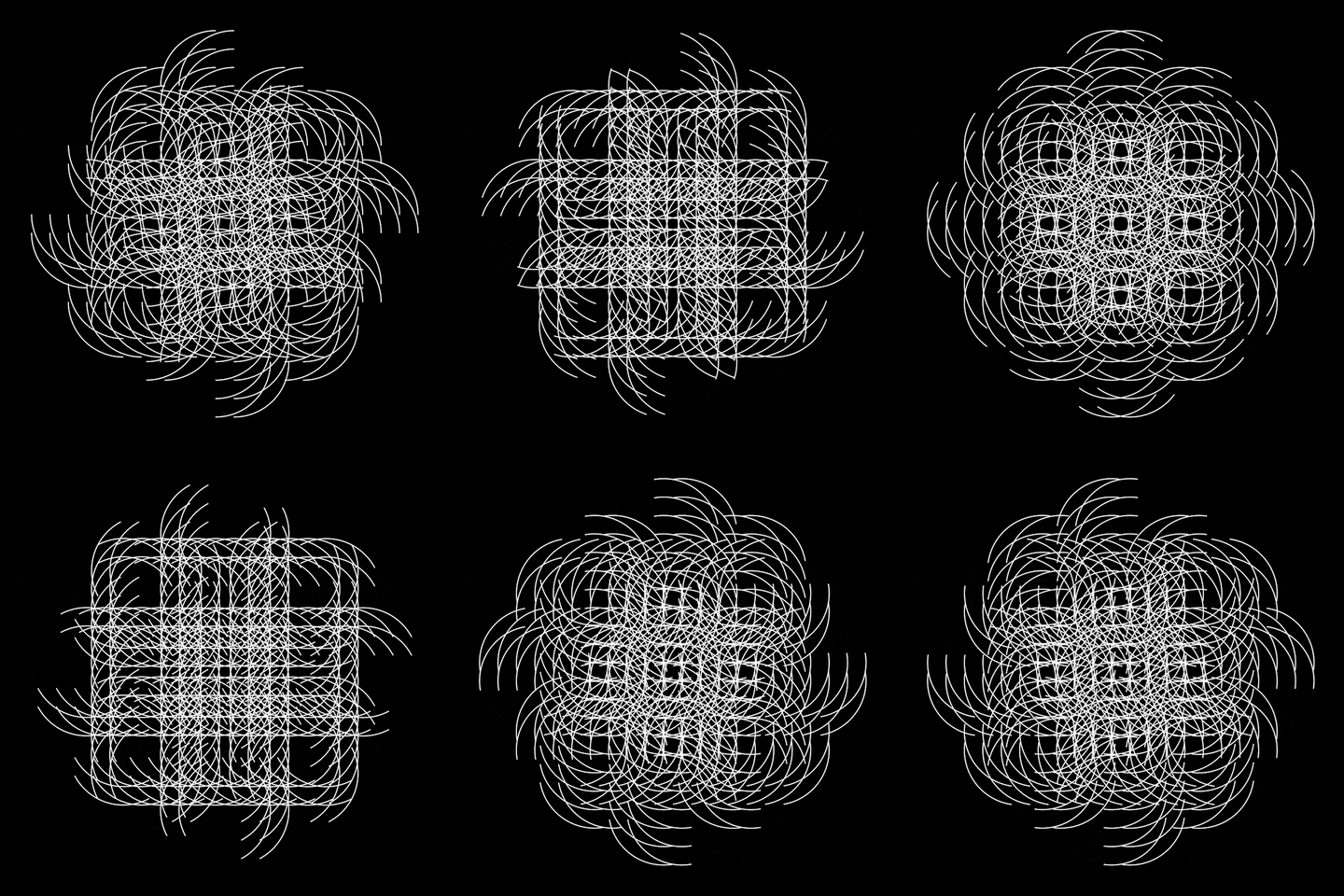
Image Healing: Mandala Stability Guidance 62
Imagine the dark, round hole in the lens; it's merely the outermost ring of the mandala. It's not a prying eye, but a mirror. Light passes through it, not taking your soul, but merely reflecting tones. You remain seated at the center of the mandala, the core of your "true self," which cannot be recorded by film or digital signals. Images are merely fleeting shadows, while you are the eternal source of light.
Traditional mandalas typically feature a harmonious and intricately varied circular structure, symbolizing the wholeness of the universe and the cycle of life. By viewing mandala images, individuals can perceive inner peace and strength, achieving psychological balance.
◉ Gaze at the mandala twice, while taking deep breaths.
▲ AI Interaction: Reconciling with the "Lens"
We are often afraid of the camera because we are afraid of leaving behind a "dark history".
This fear of being "perpetually recorded" makes us freeze instantly when the red dot lights up.
But in reality, not many people analyze your micro-expressions frame by frame.
Try talking to the AI about your most awkward physical reactions when facing the camera (such as a stiff face or not knowing where to put your hands).
We can practice a kind of desensitization thinking together, like "treating the lens as a piece of wood".
Click the button below to simulate a recording rehearsal with AI, where you are "not judged".
Lesson 62: The "Self-Relaxation Map" in Front of the Camera“
Objective: To help you find a stable sense of center in front of the camera through painting.
step:
① Draw a stable dot in the middle to symbolize "me".
② Draw a radiating line on the outer edge, symbolizing the magnification of the lens and external attention.
③ Add a soft protective halo around the dot to symbolize "I can remain natural in front of the camera".
A note was written next to it reminding me: "The camera only records the moment, it doesn't define me."“
Please log in before submitting your drawings and feelings.
○ 62. Camera Anxiety: Log Guidance Suggestions
① What situation am I most afraid of in front of the camera? Taking photos/recording videos/live streaming?
② Do my facial expressions or movements appear stiff in front of the camera? What are the reasons?
③ Was there a moment today that made me feel "the camera isn't so scary after all"?
④ Use a scale of 0–10 to assess the intensity of your camera anxiety today.
⑤ In front of the camera, which part of my body tenses up first? (Face, shoulders, throat...)
⑥ Tomorrow's practice: Record a 5-second short video, don't check the effect, just focus on your breathing in the present moment.
Please log in to use.
The camera cannot define you; it can only record you. But your authentic existence is always more powerful than any image.
 EN
EN  ZH
ZH  ES
ES  FR
FR  JA
JA