

Lesson 63: Avoidance Behaviors in Social Situations (Silence, Leaving, Not Showing Up)
Duration:70 minutes
Topic Introduction:
When faced with social situations, do you unconsciously fall silent, leave early, or simply not show up at all?
These behaviors are not laziness or "unsociability," but rather the brain's way of protecting you from "potential harm."
Avoidance is an instinctive defense mechanism that tries to distance you from the possibility of embarrassment, judgment, tension, misunderstanding, or failure.
This lesson will help you understand the psychological logic behind avoidance and learn how to gradually regain a sense of stability that "I can stay here".
Why did I choose to avoid it?
- Fear of being observed or misunderstood:Silence and leaving can reduce the feeling of being exposed.
- Hypervigilance:Your brain scans for danger in advance, making you want to avoid any "potentially wrong" situations.
- Low self-esteem:They think, "I'm not important," and "I wouldn't be welcome if I were there."
- The body reacts before consciousness:A rapid heartbeat, a tight stomach, and a constricted neck and shoulders make you instinctively want to escape.
Lesson 63: Avoidance Behavior in Social Situations (Click to listen to the reading)
Choosing to remain silent or not show up at all in social situations is often misinterpreted as coldness, aloofness, or indifference. However, for the person involved, it's a coping mechanism for self-protection. You might try to speak as little as possible at a party, shrink into a corner, and isolate yourself with your phone, or leave early when you feel increasingly nervous, or even cancel an event before it starts. These avoidance behaviors are not arbitrary choices but rather automatic defense strategies activated by the brain when it perceives a threat. Psychologically, when a social environment is interpreted as uncontrollable or high-risk, the nervous system prioritizes reducing exposure to minimize the possibility of being judged, rejected, or humiliated. Silence can prevent saying the wrong thing, leaving can end discomfort, and not showing up eliminates the risk at its source. In the short term, avoidance can indeed quickly relieve anxiety, but in the long term, it doesn't correct fear but rather reinforces it, causing your social circle to shrink further. You might then feel more guilty, thinking you're always running away while ignoring the strong safety signals behind these behaviors. It needs to be understood that avoidance is not a sign of failure but a temporarily effective but costly form of self-protection. The key to alleviating avoidance behavior is not forcing yourself to stop running away completely but gradually expanding your safe zone. You can practice lingering a few minutes longer when tension arises or develop a controlled way to exit instead of disappearing completely. As the brain learns that social situations don't necessarily lead to disaster, its risk assessment gradually adjusts. You have the right to protect yourself and the ability to gradually increase the scope of your interactions. Remaining silent and absent doesn't define you; it simply means you're learning how to be safer within relationships.
▲ AI Interaction: When was the last time you socially avoided someone?
Silence is not indifference, but tension.
Leaving is not rude, but a means of survival.
His absence wasn't due to laziness, but rather fear of being unable to handle the situation.
It's not that you don't want to connect, it's that you want to avoid getting hurt.
We can start practicing a new experience on a small scale: I can be present, but I don't have to be perfect.
Click the button below to practice methods for "reducing avoidance drive" with AI.
When you want to escape a social situation, music can help you calm your body down first.
Let the melody guide you from "wanting to leave" to "I can sit down for a bit."
When the body is stable, the urge to avoid will naturally decrease.
○ Oriental Healing Tea - Jasmine Dragon Pearl Tea
Recommended drinks:Jasmine Dragon Pearl Tea
Recommended reasons:A pleasant fragrance can relieve the mental "stiffness" during social interactions, allowing tension to flow again.
practice:Brew with 85°C water, gently inhale the aroma, and help the brain return from "escape mode" to "present mode".
○ Stable Dietary Therapy - Yam and Honey Warm Drink (ID 63)
When you feel that tightness in your chest, dry throat, or empty stomach before or after a social interaction, your body is actually searching for a sense of certainty. The smooth and gentle texture of yam can pull your scattered nerves back to your abdomen, making it easier to breathe. The sweetness of honey acts like a protective film, helping you take a step back from self-examination and tense alertness. This warm drink is perfect as a closing ritual, ten minutes before leaving the house or after returning home, allowing you to slowly shift your attention from external evaluations back to a sense of physical comfort and being cared for.
Warming the spleen and stomach
Soothe anxiety
Open Recipe
◉ Stable Dietary Therapy - Yam and Honey Warm Drink (ID 63)
Yam and Honey Warm Drink is a gentle dish that falls somewhere between a beverage and a light meal. Finely mashed yam provides a slightly smooth texture, which is then thickened with warm water or milk to a suitable consistency. The honey slowly infuses the drink at a low temperature, resulting in a rounded, subtle sweetness. Upon tasting, you experience the comforting and comforting flavor of yam combined with the gentle caress of honey. It's especially suitable for when you have a poor appetite, in the cool mornings or evenings, or when you don't want too many strong flavors; a cup of this understated warmth can gradually calm your body.
Warm and refreshing drinks Nourishing the stomach and calming the nerves Light sweetness
I. Recommended Dietary Therapy and Reasons
Recommended dishes:Yam and Honey Warm Drink (ID 63)
Recommended reasons: Yam, with its delicate texture and mild flavor, is ideal as a gentle stomach-soothing ingredient. When blended into a smooth paste, it doesn't feel heavy like a rich soup, yet it provides a sense of fullness and comfort. Adding honey at a moderate temperature preserves some of its aroma and gentle sweetness, transforming the "plain paste" into a more palatable and palatable warm drink. Perfect for busy evenings, mornings when you want to start your day slowly, or when you're feeling restless but don't want to eat too much—a small, comforting warmth that doesn't require much chewing.
2. Recipe and Method
Recipe (1–2 servings):
- 80–100 g of fresh yam (peeled and sliced)
- 200–250 ml of warm water or warm milk
- Add 1–2 teaspoons of honey (adjust to taste).
- A little ginger juice or ginger slices (optional, to increase the warming sensation).
- A small amount of cinnamon powder or crushed osmanthus flowers (optional, for garnish).
practice:
- After peeling the yam, slice it and rinse it quickly to prevent oxidation and discoloration. If you are sensitive to the yam's mucus, you can wear gloves when handling it.
- Place the yam slices in a small pot, add enough water to cover the yam, bring to a boil, then simmer over low heat for about 8–10 minutes, until the yam softens.
- Pour the cooked yam, along with a small amount of the cooking liquid, into a blender. Add some warm water or warm milk and blend until smooth and creamy.
- Pour the yam paste back into the small pot, add a small amount of warm water or warm milk according to your preference, adjust to your desired consistency, and heat over low heat until it just starts to steam, avoiding boiling.
- After removing from heat, let it sit for 1–2 minutes to allow the temperature to drop to a comfortable temperature (around 40–50℃), then add honey and stir gently until completely melted.
- If you prefer a stronger warming sensation, you can add a small amount of ginger juice at this point or remove and discard the ginger slices used when cooking the yam earlier, leaving only a faint ginger aroma.
- Pour into a glass, sprinkle with a little cinnamon powder or garnish with a few dried osmanthus flowers, and drink slowly.
3. Small rituals for body and mind
When making yam paste, you can deliberately slow down the process and watch the solid gradually become smooth, as if you are practicing "breaking up today's blockage little by little".
While waiting for the temperature to drop to a comfortable level for adding honey, refrain from using your phone and simply hold the cup quietly, feeling the temperature change and drawing your attention away from the clutter of information.
When you take your first sip of the warm yam and honey drink, you can silently recite a short sentence in your mind, such as "I can be kinder to myself today," making this warm drink a concrete and perceptible response.
4. Dietary Therapy Experience Record
- Record the time of drinking (early morning, afternoon, before bed) and your mental state at the time (tired, anxious, tense or depressed).
- Observe the changes in stomach comfort, body warmth, and mood relaxation within 20–30 minutes after drinking.
- If consumed before bed, you can record whether it helps with falling asleep faster, sleep continuity, and how you feel when you wake up the next morning.
V. Instructional Videos (approximately 3–5 minutes)
◉ Video Title:Yam and Honey Warm Drink: A cup of gentle sweetness that slowly soothes and calms you down.
6. Precautions
- Honey should not be added at excessively high temperatures, as this may destroy its aroma and some of its nutrients. It is recommended to stir it in after the warm drink has cooled down slightly.
- This product is not suitable for people who are allergic to honey or yam. You should check your allergy history before drinking it.
- People who need to manage their blood sugar can reduce or omit the amount of honey and simply make a basic warm drink with yam and warm milk/water.
hint:This warming drink is intended as a reference for daily dietary therapy and mental well-being, and is not a substitute for professional medical diagnosis and treatment. If you have chronic illnesses or special dietary restrictions, please prioritize following the advice of your doctor and nutritionist.
○ Gothic script - Lesson 63 Writing Exercises
In-depth analysis:
Avoidance (silence, leaving early, absence) is the body's most instinctive "escape" response to anxiety.
But each escape reinforced the false message that "social interaction is dangerous."
Gothic (Blackletter) script, each stroke is like a heavy...锚.
Writing in this weighty font trains the body's "steadiness": I am here, as steady as a rock, unmoved by anxiety.
Writing Skills (Advanced Version):
- A heavy stroke of the pen (Weight):
Gothic vertical strokes require a strong initial stroke. When writing, feel the weight of the pen tip on the paper; this symbolizes your "presence" in this social setting—it's real, not superficial. - Tight Connection:
The letters are tightly connected, with almost no gaps. Practice this sense of connection to fight against the instinct to avoid contact with people or to keep your distance. - Grounded feet:
The bottom of each letter rests firmly on the baseline. Imagine your feet are also firmly rooted to the ground, and no force can easily push you away. - Slowness:
Gothic script cannot be written quickly. Forcing your hand to slow down is like forcing your restless heartbeat, which wants to escape, to slow down. - Complete closure:
Write each word down before raising your hand. This symbolizes "even if you're uncomfortable, you must continue this conversation/gathering to the end."

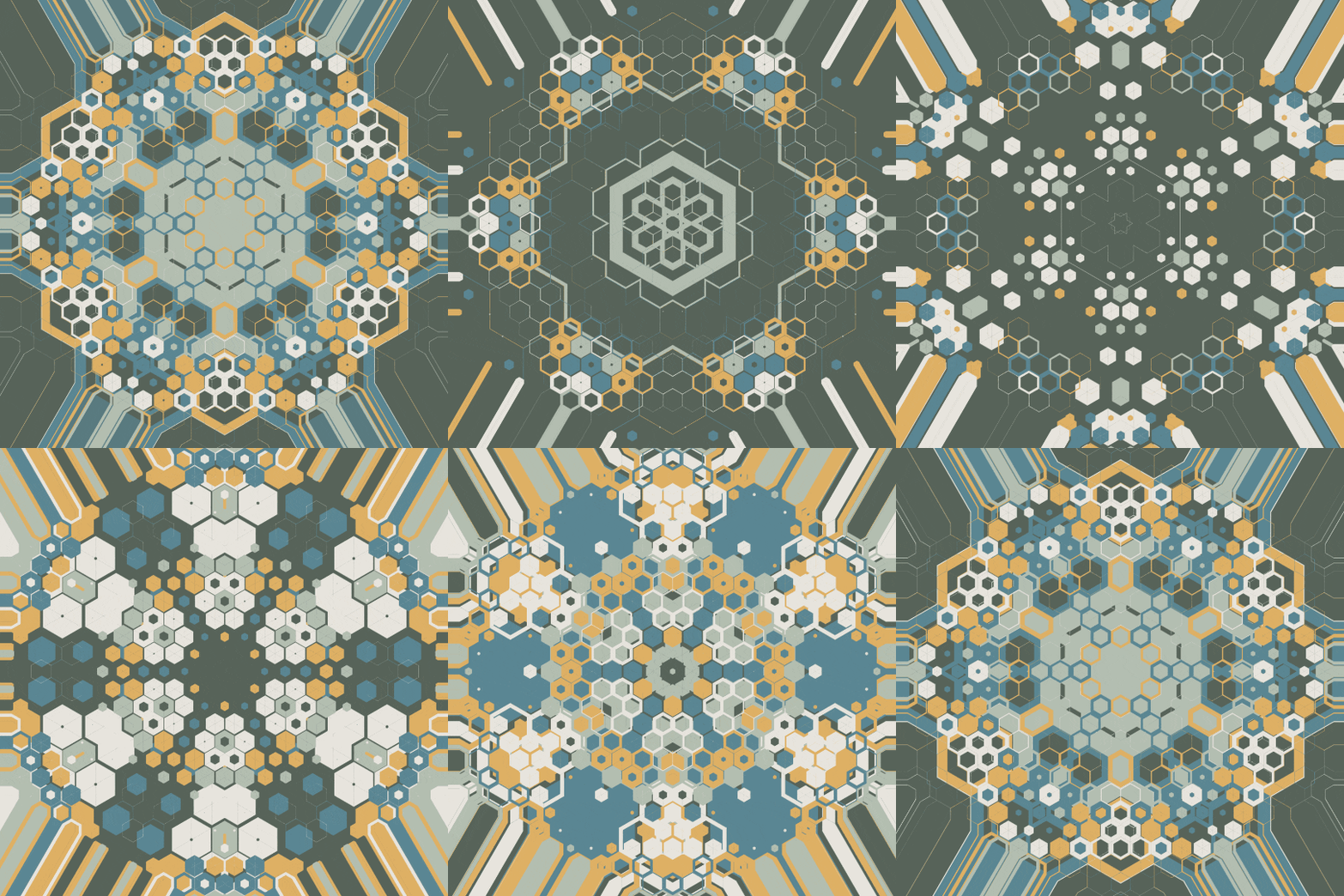
Image Healing: Mandala Stability Guidance 63
When you want to escape, your energy is centrifugal and dissipates. Now, look at the center of the mandala. Imagine it as a giant magnet, or tree roots deep in the ground. The wind outside (social pressure) may rustle the leaves, but it can't uproot the roots. You don't need to control the wind; you just need to feel the roots. With each deep breath, let the roots sink a little deeper. Stay here, and the wind will eventually stop.
Traditional mandalas typically feature a harmonious and intricately varied circular structure, symbolizing the wholeness of the universe and the cycle of life. By viewing mandala images, individuals can perceive inner peace and strength, achieving psychological balance.
◉ Gaze at the mandala twice, while taking deep breaths.
Lesson 63: Exercise Diagram on "Presence"
Objective: To establish an experience of "I can stop" and "I can exist" through painting.
step:
① Draw a stable, solid circle in the center of the picture to represent "yourself in the picture".
② Draw some arrow symbols that indicate an attempt to escape around the area, symbolizing the urge to avoid.
③ Draw a gentle protective layer outside the central circle to indicate that "even if I want to escape, I can still stop for a while."
Write a reminder next to it: "Not being in a hurry to leave is a kind of strength."“
Please log in before submitting your drawings and feelings.
○ 63. Avoidance Behavior: Log Guidance Suggestions
① In which scenario did I exhibit avoidance today? (Silence/Leaving/Absence)
② What was I afraid would happen at that time?
③ After avoiding it, do I feel relaxed, regretful, or more tense?
④ Use 0–10 to assess the intensity of your avoidance impulse today.
⑤ Was there a moment when I thought, "I could have stayed a little longer"?
⑥ Tomorrow's practice: Choose a small scene, practice staying there for 10 seconds before making a decision.
Please log in to use.
Avoidance is not failure; it's your way of protecting yourself. And you are learning a new kind of strength: choosing to stay instead of running away.
 EN
EN  ZH
ZH  ES
ES  FR
FR  JA
JA