

Lesson 74: What is true self-confidence?
Duration:70 minutes
Topic Introduction:
Many people think that "confidence" means daring to speak, daring to express oneself, and being able to move around in a crowd with ease.
But true confidence is not about being outgoing, assertive, or fearless;
Rather, it is **the willingness to be true to oneself even when one is vulnerable, nervous, and afraid**.
Confidence is not "I will never fail", but "even if I fail, I am still willing to continue and still believe that I deserve respect".
This course will guide you through understanding the essence of confidence and help you build a stable, gentle, and sustainable inner strength.
True confidence is not an outward expression, but an inner state.
- Confidence is not about being perfect, but about allowing yourself to be imperfect.
- Confidence is not the absence of fear, but the ability to act even when fear is present.
- Confidence is not about pleasing others, but about respecting your own boundaries.
- Confidence is not about being domineering, but about maintaining one's own stance.
- Confidence is not about suppressing vulnerability, but about acknowledging vulnerability and still being willing to move forward.
Lesson 74: What is True Confidence? Click to listen to the reading.
Many people believe confidence is an outward state—speaking confidently and without nervousness, expressing oneself calmly in any situation. However, this understanding often leads to greater anxiety because nervousness makes one feel insecure. True confidence isn't the absence of fear, but rather knowing who you are and allowing yourself to exist even when fear arises. Confidence isn't an emotion, but a relationship—a relationship with yourself. Psychologically, false confidence is often built on control, suppressing vulnerability to gain security through perfect performance. True confidence, on the other hand, is built on stability. You don't need constant proof or continuous defense. You can be nervous, hesitant, or uncertain, but these states won't shake your fundamental sense of self-worth. True confidence stems from understanding your own boundaries. You know what your responsibilities are and what they aren't; you know when to advance and when to retreat, and you know that even when criticized, you remain whole. It allows you to say, "I don't know, I need time, I can't do it now," without feeling ashamed. From a neurological perspective, confidence means the body is in a relatively safe zone. You don't need to be constantly on guard or maintain your position through appeasement or confrontation. Internal stability gradually forms when you stop using external reactions as the sole basis for self-judgment. Confidence isn't about being loud or always right; it's about standing on your own side when the world fluctuates. This kind of confidence is not ostentatious but hard to break because it comes not from showing off but from allowing your true self to exist.
▲ AI Interaction: Where do you usually feel "insecure"?
It's not that you lack confidence, but rather that your confidence is hidden behind a protective layer.
True confidence is not "I can definitely do it", but "I am willing to try".
You are already on the path to learning self-confidence—because you are becoming aware, exploring, and changing.
Click the button to explore with AI where your "true confidence" lies.
When you feel you're "not good enough," music can soften the internal criticism.
Melody can help you return to your body, rather than getting lost in evaluation and comparison.
Put aside judgment and let the music tell you: "You've had enough."“
○ Eastern Healing Tea: Osmanthus Pu-erh
Recommended reasons:The soothing aroma of osmanthus can enhance self-acceptance, while the calming effect of Pu-erh tea helps you to settle down.
practice:Brew with hot water at 90–95℃, allowing the aroma to become the gateway to "inner strength".
○ Stable Dietary Therapy: Lotus Root and Yam Nourishing Soup (ID74)
In the process of rediscovering self-confidence, the body needs a nourishing approach that is both gentle and supportive. The refreshing sweetness of lotus root and the rich texture of yam provide both fluidity and stability, helping the body maintain a sense of balance while relaxing. This soothing soup is suitable for consumption after emotional ups and downs or self-doubt, allowing the body to slowly return to a grounded and relaxed state. It symbolizes not impulsiveness but the strength to stand firmly, reminding you that you can have your place without effort.
Gentle support
Soothe self-doubt
Open Recipe
◉ Stable Dietary Therapy: Lotus Seed and Yam Warm Soup (ID 74)
Lotus seed and yam warm soup is a gentle soup that leans towards a "quiet" approach: the lotus seeds become soft and tender after slow cooking, with a subtle bean aroma, while the yam provides a delicate, slightly sticky texture, giving the whole bowl of soup a gentle, comforting feeling on the tongue and in the stomach. The soup is clear and milky white, neither heavy nor spicy, making it suitable for when you are physically and mentally exhausted, during seasonal changes, or when you want to "repair and nourish" yourself without eating greasy or overly nutritious soups. It allows you to slowly calm down with a bowl of simple, warm soup.
Gentle nourishment Soft texture Lightly nourishing and not greasy
I. Recommended Dietary Therapy and Reasons
Recommended dishes:Lotus Seed and Yam Warming Soup (ID 73)
Recommended reasons: Lotus seeds, after stewing, become soft and delicate, possessing a quiet and understated flavor. Combined with the smoothness and slight stickiness of yam, this creates a slow and steady sensation in the mouth. Compared to meat broths with higher fat content, this soup is lighter and less heavy on the stomach, yet offers a gentle and nourishing experience, making it suitable for daily warming during periods of high work stress, recovery, or seasonal changes. For those who don't want a major undertaking and simply want to pamper themselves a little more at dinner, this is a perfect "simple and warming soup."
2. Recipe and Method
Recipe (1–2 servings):
- 20–25 g of dried lotus seeds (with the core removed and soaked in advance).
- 80–100 g of yam (peeled and cut into chunks; fresh yam can be used).
- 3-4 red dates (optional, to enhance aroma and flavor)
- 800–1000 ml of clean water
- A few goji berries (optional, add at the end)
- Add very little salt or none at all (adjust as needed).
practice:
- Soak dried lotus seeds in water for at least 1 hour beforehand. If they have a bitter core, remove the core beforehand.
- After peeling the yam, cut it into small pieces. You can wear disposable gloves to reduce the irritation of the mucus on your skin.
- After washing the red dates, you can remove the pits or make slits in them to help release their aroma during stewing (this step can be omitted if you don't like them too sweet).
- Place the soaked lotus seeds, red dates, and water into a pot, bring to a boil over high heat, then reduce to a simmer and cook slowly.
- After simmering for about 20 minutes, add the yam chunks and continue to simmer over low heat for 15–20 minutes, until the lotus seeds are soft and the yam is tender.
- If using goji berries, add them 3–5 minutes before the soup is done to lightly enhance its color and aroma.
- No salt needs to be added during the entire process, allowing the natural flavor of the ingredients to shine through; if necessary, a very small amount of salt can be added for light seasoning before removing the dish from the heat.
3. Small rituals for body and mind
When washing lotus seeds and peeling yams, there's no need to rush. You can treat it like a quiet little task and allow yourself to focus on doing this simple thing.
While the soup is simmering over low heat, I occasionally glance at the boiling water and the slowly swelling and softening lotus seeds in the pot, taking it as a reminder that "the pace of today is slowing down."
When you take the first sip of the lotus seed and yam warm soup, you can say to yourself, "This soup is a little time for me to recover." Let this feeling and warmth settle into your chest and stomach.
4. Dietary Therapy Experience Record
- Record the time of consumption (noon, after dinner, before bed, etc.) and the mental and physical state at the time.
- Observe the changes in body warmth, stomach comfort, and mood stability within 20–40 minutes after drinking.
- If consumed multiple times during a period of physical and mental fatigue or recovery, the subjective impact of this soup on sleep quality and fatigue can be recorded.
5. Tutorial Video (approximately 4–6 minutes)
◉ Video Title:Lotus Seed and Yam Warm Soup: A bowl of quiet nourishment slowly simmered.
6. Precautions
- Lotus seeds should be stewed until soft before eating to avoid them being difficult to digest; those with weak digestive function can extend the stewing time appropriately.
- Yam is prone to oxidation and discoloration after being cut into pieces, so it is best to cut it and cook it immediately, or soak it briefly in water before use.
- If you need to control the sugar content or avoid it being too sweet, you can omit the red dates or reduce the amount used, and do not add sugar at all, just retain the natural sweetness of the ingredients.
hint:This soup recipe is for daily dietary guidance and mental well-being, and does not replace any medical diagnosis or treatment. If you have chronic illnesses or special dietary needs, please follow the professional advice of your doctor or nutritionist.
○ Modern Calligraphy · Lesson 74 Writing Practice Suggestions
In-depth analysis:
Many people with social anxiety mistakenly believe that "confidence" equals "never being nervous" or "performing perfectly".
But this is actually "arrogance" or "pretense".
True self-confidence is having the courage to be an imperfect person.
The beauty of modern art calligraphy lies precisely in its rejection of the rigidity of standard fonts. It allows letters to bounce and lines to vary in thickness.
Confidence is not about eliminating fear, but about carrying your fear and still writing your own chapter in the story.
Writing Skills (Advanced Version):
- Bounce Style:Intentionally let the bottoms of the letters fall on or below the lines. Practice the freedom of "breaking the rules," and you'll find that breaking the rules doesn't bring disaster, but rather style.
- Embrace thickness (Contrast):Confidence has two sides: strength (bold strokes) and vulnerability (fine strokes). When writing, do not try to hide the trembling of the fine strokes; it is genuine vitality.
- Flow:Even if you're not satisfied with what you've written, keep the pen flowing until you finish the word. Confidence is about "what happened doesn't matter, what matters is that I kept going."
- Authenticity:Don't try to imitate every pixel of a calligraphy model. Find the way you feel most comfortable writing; your handwriting is your signature, no need to change its shape to please others.
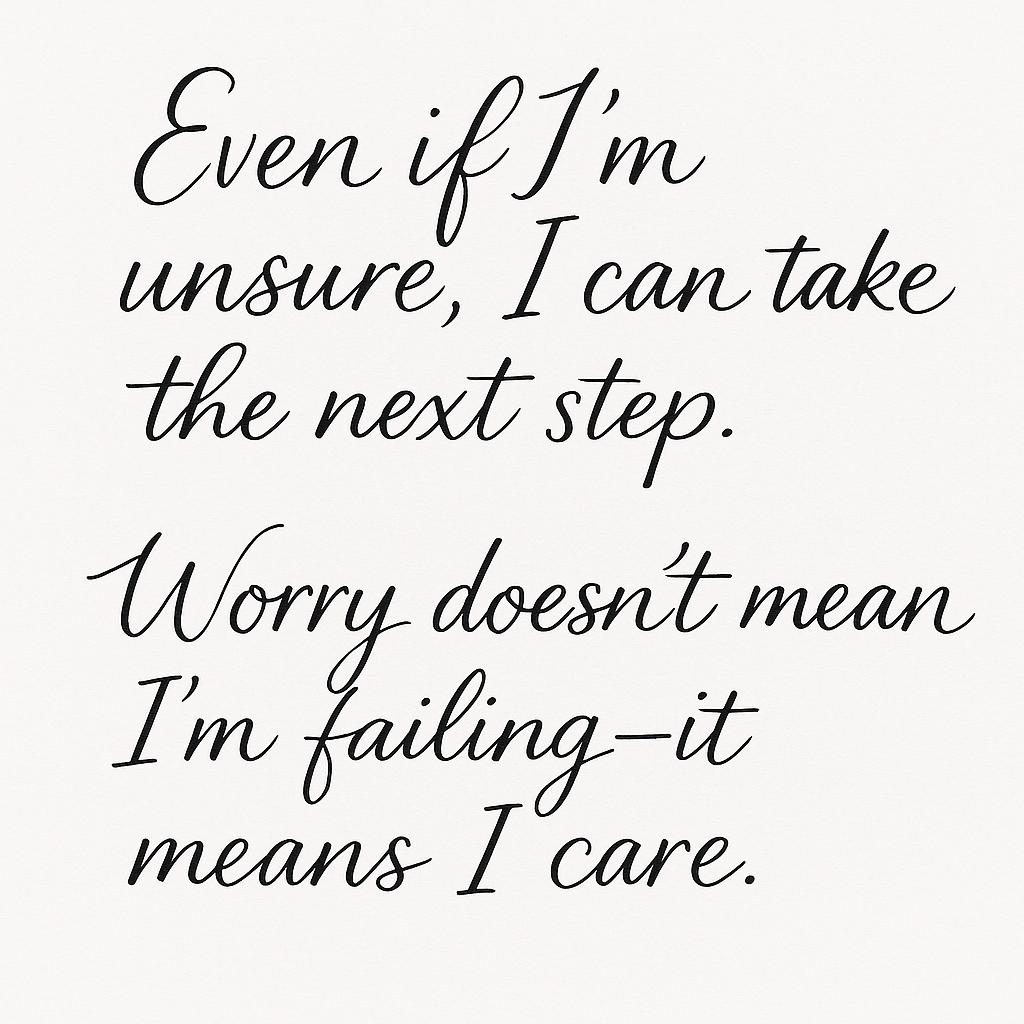
Image Healing: Mandala Stability Guidance 74
We often seek confidence externally, trying to adorn the outer circle of a mandala with applause, praise, or perfect performance. But true confidence originates from the center. Gaze at that very center point. It needs to do nothing, needs to shine, needs to rotate; it simply "exists" there. No matter how complex or ever-changing the outer circle's design, the center remains steadfast. Confidence is this abiding in of inherent completeness—you don't need to become better to deserve love; you are already a complete circle as you are.
Traditional mandalas typically feature a harmonious and intricately varied circular structure, symbolizing the wholeness of the universe and the cycle of life. By viewing mandala images, individuals can perceive inner peace and strength, achieving psychological balance.
◉ Gaze at the mandala twice, while taking deep breaths.

Lesson 74: Drawing the "Core of Inner Confidence"“
Objective: To help you connect with the essence of self-confidence through images.
step:
① Draw a warm circle in the center of the paper (representing your true self).
② Draw a soft gradient light around the outer edge, symbolizing your willingness to be seen.
③ Write a sentence in the center of the circle: "I deserve to be respected."“
④ Write down three qualities or strengths you possess on the edge (patience, kindness, diligence, sensitivity, etc.).
This image can remind you when anxiety strikes: confidence is not an external adornment, but an inner stability.
Please log in before submitting your drawings and feelings.
○ 74. The Essence of Confidence: Suggestions for Journaling
① What situation made me feel "lacking in confidence" today?
② At that time, was I really afraid of "performing poorly" or "being evaluated"?
③ If I don't strive for perfection, what would I do?
④ What qualities of mine deserve recognition? (Write 3)
⑤ If I allow myself to come with imperfections, will I feel more relaxed today?
⑥ Tomorrow's practice: Practice "appearing nervous" in a small scenario.
Please log in to use.
True confidence isn't about "becoming stronger," but about allowing yourself the right to exist in any situation. You are already more resilient, more authentic, and more deserving than you imagine.
 EN
EN  ZH
ZH  ES
ES  FR
FR  JA
JA