

Lesson 75: How to transition from social anxiety to social confidence
Duration:70 minutes
Topic Introduction:
Social anxiety is not a lack of ability, but a lack of security.
Social confidence is not about being bold, outgoing, or talkative, but about being able to maintain your own pace in front of others.
This lesson will explore in depth how to gradually move from the fear of being judged by others to a confident state where you allow yourself to express yourself naturally.
○ Core Knowledge: The Three Stages from Anxiety to Confidence
- ① Consciousness stage: Seeing your own automatic fear patterns.
Most anxious people are not "insecure", but rather they are used to focusing on "how others see me".
Once you become aware of these concerns about automation, you've already taken the first step towards unlocking it. - ② Experience phase: Allow tension to exist, but do not avoid it.
Confidence is not about being free from nervousness, but about being able to speak even when nervous.
When you can tolerate mild discomfort without rushing to avoid it, your brain will gradually form a new memory of "I can do it". - ③ Internalization stage: Establishing internal stability and rhythm.
Confidence naturally arises when you focus on conveying content rather than showcasing yourself.
Confidence isn't something you can train for; it's accumulated through repeated successful experiences at your own pace. - You don't need to become an extrovert.
You just need to go from "being afraid to be seen" to "allowing to be seen".
This is the essence of social confidence.
Lesson 75: How to Transition from Social Anxiety to Social Confidence (Click to listen to the reading and view the content)
The transition from social anxiety to social confidence is not a leap, but a gradual process of loosening constraints. Many people mistakenly believe that confidence means no longer being nervous, no longer being afraid, and no longer caring about others' opinions. Therefore, when anxiety recurs, they become disappointed in themselves and even feel that they can never change. But the true transition is not about eliminating anxiety, but about changing your relationship with it. Social anxiety often persists because you are constantly in a state of self-monitoring and self-denial, treating every interaction as a test of your worth, thus keeping your body in a state of high alert. The first step in the transition is to stop seeing tension as failure and instead see it as a signal that your body is still learning for safety. When you allow tension to exist without immediately fleeing or suppressing it, your nervous system has the opportunity to update its experience. The second step is to gradually build predictable experiences of success—not by performing perfectly, but by lingering longer and expressing yourself more authentically. When you discover in interactions that even imperfect relationships don't collapse, confidence begins to build. The third step is to shift your focus from how you are perceived to whether you respect your own rhythm and boundaries. Social confidence is not about being extroverted, but about internal permission—you can participate or withdraw, express yourself or remain silent without self-blame. From a neurological perspective, confidence means that the body no longer equates social interaction with a threat but rather sees it as a modifiable experience. This transformation requires time, repetition, and gentle guidance, not coercion. When you stop demanding of yourself to immediately become someone else and instead allow yourself to gradually expand your sphere of action based on your existing foundation, anxiety will naturally recede from its central position. Social confidence is not a state but a path; you are on that path, and that in itself is the beginning of confidence.
▲ AI Interaction: What makes it hard for you to be confident in front of others?
It's not that you're not good enough, you've just experienced too much pressure to "not make mistakes".
Confidence isn't something you can force; it arises naturally when you stop focusing all your attention on what others think.
Let's see together: you are already more powerful than you think.
Click the button below to analyze a social difficulty you encountered today with AI and find your own path to confidence.
Music can help you shift your focus from "external perspectives" back to your own body.
While listening, try to follow the rise and fall of the melody and feel how your chest, throat, shoulders, and neck relax little by little.
When the body is relaxed, confidence naturally emerges.
○ Eastern Healing Tea - Tieguanyin
Recommended drinks:Tieguanyin
Recommended reasons:
Tieguanyin tea has a rich aroma and a lingering sweet aftertaste, which can help stabilize breathing and enhance awareness.
Suitable for drinking before social events, it helps the nervous system relax from tension.
practice:
Take 5 grams of tea leaves and brew with 95℃ hot water. Use the first brew to quickly awaken the tea leaves.
For the second and third infusions, steep for 15–25 seconds. You can add water multiple times. The aroma is stable and long-lasting.
○ Stable Dietary Therapy - Sweet Potato and Nut Warm Bowl (ID75)
In the process of moving from tension to stability, the body needs nourishment that provides both energy and a sense of security. The natural sweetness of sweet potatoes brings a sense of groundedness and satisfaction, while nuts provide continuous and stable support, preventing the body from being depleted. This warm bowl is perfect for eating after practicing social skills or when emotionally drained, helping you slowly replenish your energy. It symbolizes gradual accumulation, reminding you not to rush to prove yourself but to take steady steps forward.
Stable energy
gentle transition
Open Recipe
◉ Stable Nutrition - Sweet Potato and Nut Heartwarming Bowl (ID 75)
The Sweet Potato and Nut Heartwarming Bowl is a light main dish that offers both warmth and support. The steamed sweet potato, naturally sweet and soft, is paired with a touch of crunch and oil from the nuts, creating a balanced texture of softness and crispness, and a balanced yet not overwhelming energy intake. It's perfect for breakfast, a midday recovery meal, or a simple yet comforting bowl of warmth to help you regain a sense of stability and groundedness when you're feeling a little tired.
Heartwarming staple food Light sweet fiber Stable energy
I. Recommended Dietary Therapy and Reasons
Recommended dishes:Sweet Potato and Nut Warm Bowl (ID 75)
Recommended reasons: Sweet potatoes are a mild type of complex carbohydrate, providing stable energy without causing a heavy burden; nuts, on the other hand, provide satiety with natural lipids and plant protein. The combination is perfect for times of mental and physical fatigue: it provides energy and warmth, but without the sluggishness that heavy, oily, or salty foods can cause. Whether you need a gentle start in the morning or a little "stabilizing" boost in the afternoon, this comforting dish can accompany you steadily and gently.
2. Recipe and Method
Recipe (1–2 servings):
- 180–220 g sweet potato (peeled and cut into chunks)
- Mixed nuts 20–25 g (cashews, almonds, walnuts are all acceptable)
- 30–50 ml of warm milk or plant-based milk (concentration can be adjusted).
- A pinch of cinnamon (optional)
- 1 teaspoon of honey or maple syrup (optional, to add sweetness)
- A small amount of raisins or dried cranberries (optional, to add flavor).
practice:
- Cut the sweet potatoes into chunks and put them in a steamer. Steam over high heat for 12–15 minutes until they are completely soft.
- Place the steamed sweet potato in a bowl and mash it with a fork; for a smoother texture, you can add a little warm milk or plant-based milk.
- Roughly chop the nuts and sprinkle them on the surface of the sweet potato puree to create a contrast between soft and crunchy textures.
- You can add cinnamon powder, raisins, or a small amount of honey to gently enhance the aroma and sweetness.
- When eating, mix gently, or you can eat it while mixing to enjoy the layered texture.
3. Small rituals for body and mind
Feel the sweet potato mash as it transforms from a blocky mass into a soft texture, as if you're gradually breaking down the stiffness of today.
The moment nuts are added, the crunchy sound becomes a reminder: the body has strength, but also allows for gentleness.
When you take your first bite, pay attention to how the temperature of the sweet potato slowly travels from your mouth to your stomach, letting your body know that "I am nourishing myself."
4. Dietary Therapy Experience Record
- Record your physical and emotional state before consumption: such as fatigue, tension, and appetite.
- Observe whether there is a warming sensation and a feeling of fullness without heaviness after eating.
- When trying this dish during a period of fatigue for several consecutive days, you can record whether it improves concentration or stabilizes mood.
V. Instructional video (approximately 3–4 minutes)
◉ Video Title:Sweet potato and nut warm bowl - lightweight yet provides stable energy.
6. Precautions
- Nuts should be consumed in moderation, not excessively, to avoid increasing digestive burden.
- If you are allergic to nuts, you can substitute pumpkin seeds or sunflower seeds.
- If you need to control total energy intake, you can reduce the amount of honey and dried fruit.
hint:This recipe is for daily dietary guidance and does not replace any medical advice. Please consult a professional in case of special circumstances.
○ Modern Calligraphy · Lesson 75 Writing Practice Suggestions
In-depth analysis:
The transition from social anxiety to social confidence often doesn't require "changing your personality," but simply "being more relaxed."
In modern art calligraphy, the most fascinating transition lies in“"Flourishing"”—That is, the elegant curve drawn at the beginning or end of a letter.
Anxiety makes us want to pull our hands back, while confidence allows us to extend the lines and occupy more blank space.
Practicing this extension is telling your subconscious: This space is safe, and I can stretch freely.
Writing Skills (Advanced Version):
- Momentum (inertial guidance):Anxiety often leads to sluggish pen strokes. Practice writing a little faster, using momentum to smooth out those shaky corners. Speed brings physical stability and also a sense of psychological fluidity.
- Boldly extend (Extension):At the end of a word, try elongating the final stroke, drawing a relaxed wave or circle. This symbolizes leaving behind a lingering impression rather than hastily escaping at the end of a social interaction.
- Light Entrance:Don't slam your pen down (that's a sign of nervousness). Practice landing your pen as lightly as an airplane taking off. A confident opening statement is often like that: light and non-aggressive.
- Muscle memory:Confidence is not an emotion, but a skill. By repeatedly practicing the same elegant arc, you allow your arm to remember this "smooth feeling," and this physical memory, in turn, leads to mental relaxation.

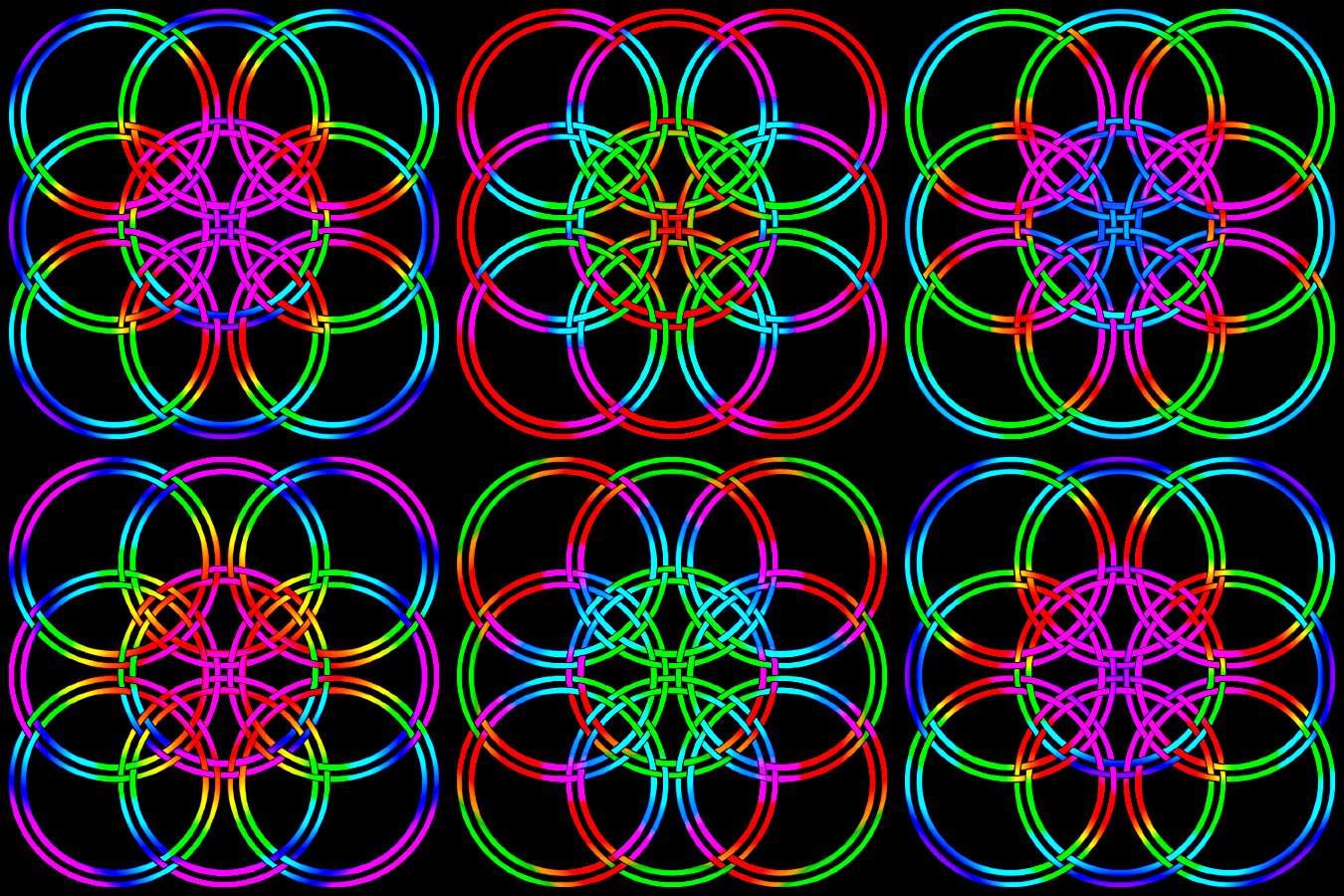
Image Healing: Mandala Stability Guidance 75
Anxiety often resembles a shrinking black dot, taut and heavy. Confidence, on the other hand, is an outward-expanding spiral. Gaze upon the lines in a mandala that radiate from the center to the edges. They are not straight lines, but rather spiraling and dancing outwards. Imagine yourself as the center; with each breath, your energy circle expands outwards a little. It doesn't require instantaneous progress; simply, like these lines, gently and continuously extend outwards until you fill the space you are meant to occupy.
Traditional mandalas typically feature a harmonious and intricately varied circular structure, symbolizing the wholeness of the universe and the cycle of life. By viewing mandala images, individuals can perceive inner peace and strength, achieving psychological balance.
◉ Gaze at the mandala twice, while taking deep breaths.
Lesson 75: Guided Drawing - Finding Your "Inner Stability"“
Purpose:
Experience the inner power of “my center is stable, therefore I can express myself naturally” through painting.
① In the center of the image, depict a "stable core" with gentle blocks of color or circular lines.
It doesn't need to be clear or symmetrical; it symbolizes your truest center.
② Draw lines that gradually brighten, soften, and create a rhythmic effect, expanding outwards from the core.
It symbolizes self-confidence as extending outward like light, not through effort, but naturally emerging.
Please log in before submitting your drawings and feelings.
○ 75. Log-based guidance suggestions
① What scenario today made you realize that "I am actually more capable than I thought"? Please describe it in detail.
② Write down a social situation that you were particularly afraid of in the past. Looking back now, is it no longer so scary? What has changed?
③ Tomorrow's "confidence exercise": In a small scenario (such as a greeting or a brief response), allow yourself to maintain a natural pace and write down your feelings.
Confidence isn't innate; it's built up through countless moments of "I did it." May you begin today to gradually experience the power that belongs to you.
 EN
EN  ZH
ZH  ES
ES  FR
FR  JA
JA