

Lesson 9: Breathing Anxiety and Tachycardia – “Am I about to stop breathing?”
Duration:85 minutes
Topic Introduction:Anxious individuals often experience physical sensations such as "chest tightness, rapid breathing, and a racing heart." This is not a problem with the organs, but rather a "false alarm" state of the nervous system. This course will help you understand the physiological mechanisms of anxiety-induced breathing, master balanced breathing training, chest-abdominal resonance relaxation techniques, and how to transform the panic of "not being able to breathe" into "I can still control my breathing rhythm."
○ Mechanisms of anxiety-induced breathing and tachycardia
- When anxious, the sympathetic nervous system is activated, and the brain sends a "fight or flight" signal to the body.
- Breathing becomes shallow and rapid, occurring only in the chest, causing a drop in carbon dioxide levels and creating the illusion of suffocation.
- An increased heart rate is the body "preparing to escape," not a heart attack.
You're not actually lacking oxygen. On the contrary, it's because you're breathing too fast, causing excessive carbon dioxide to be expelled from your body. Your brain then perceives this as a closer danger, creating a vicious cycle.
Lesson 9: Nervousness, Rapid Heartbeat, Shortness of Breath: How to Soothe Them Immediately 🎧 Click to watch/listen to the reading
Breathing anxiety often strikes without warning. You might be walking, in a meeting, or simply sitting quietly when you suddenly realize your breathing has become labored, your chest feels constricted, and your heart starts racing. Within seconds, your brain throws out a powerful question: "Am I about to stop breathing?" At this moment, the fear doesn't come from the body itself, but from misinterpreting its reactions. In fact, in a state of anxiety, the body easily enters a "fight or flight" mode. A surge of adrenaline causes shallow, rapid breathing, a racing heart, and muscle tension. These changes are meant to increase the chances of survival in dangerous situations, but when there is no danger, the brain interprets these normal physiological responses as "signals of trouble." Attention becomes fixated on breathing and heartbeat, and the more you focus, the more uneasy you feel. A typical cycle of breathing anxiety is: **abnormal sensation → fear of suffocation or heart problems → increased tension → further amplification of symptoms**. You start frequently checking if you've taken enough air, deliberately inhaling forcefully, which disrupts your natural breathing rhythm. Your body isn't actually lacking oxygen, but your brain has entered a mental scenario of "I can't hold on any longer." Recognizing this is crucial. You can remind yourself that the breathing discomfort at this moment is more caused by tension than by functional disorder. A helpful approach is to replace "I need to breathe properly" with "Let breathing happen naturally." You don't need to control it; just allow it to exist. Deliberate control often exacerbates the feeling of being out of control. During an episode, try focusing your attention on **exhalation**, rather than inhalation. Gently prolong the exhalation, for example, mentally count to four, then inhale naturally. Prolonging the exhalation sends a signal to the nervous system: there's no need to run away now. Your heart rate will gradually slow down. At the same time, reducing the constant confirmation of your heart rate is also key. A rapid heartbeat doesn't equal danger; it's just the body responding to tension. When you stop treating every heartbeat as an alarm, the fuel for fear diminishes. Through repeated practice, you'll gradually develop a new experience: even with imperfect breathing and a rapid heartbeat, you are still safe. Anxiety may arise, but it won't take you away. You learn to coexist with these bodily sensations, rather than fight them. At that moment, the question, "Am I about to run out of breath?" will gradually lose its original power.
▲ AI Interaction: How to Instantly Soothe the Body
When tension arises, the body often reacts before the mind does.
My heart suddenly raced, my chest tightened, and my breathing became shallow, as if my body was sending out an alarm.
These reactions are not dangerous; they are simply the nervous system trying to "protect you."
What truly perpetuates discomfort is often not the symptoms themselves, but your fear of those symptoms.
When you start to observe these sensations instead of rushing to suppress them, your body will gradually loosen up.
The goal of reassuring is not to make the symptoms disappear immediately, but to let the body know that it is safe now.
Click the button below to practice "instant body soothing" with AI, gradually slowing your breathing and rebuilding trust in your body's responses.
○ Audio Exercise: Balanced Breathing Technique
Play the audio track and follow the instructions to complete one cycle of the "4-4-6 breathing": Inhale for 4 counts → Hold for 4 counts → Exhale for 6 counts. While exhaling, softly say "let go." After three rounds, feel if your heart rate has slowed slightly.
○ Eastern Tea Therapy: Lily and Ophiopogon Tea for Calming the Mind
Recommended reasons:Lily bulbs moisten the lungs and relieve coughs, while ophiopogon japonicus calms the mind and soothes the nerves, thus alleviating respiratory anxiety and insomnia. Suitable for those prone to chest tightness and easily startled.
practice:Steep 5 grams of lily bulbs and 5 grams of Ophiopogon japonicus in boiling water for 10 minutes, then drink while lukewarm.
○ Dietary Recommendation: Lotus Seed and White Fungus Soup
Anxiety-related breathing is often accompanied by dry mouth and a tight throat. White fungus nourishes yin and moistens the lungs, while lotus seeds calm the nerves, helping to regulate the "excessive tension" in the respiratory system.
Healing Recipes
/home2/lzxwhemy/public_html/arttao_org/wp-content/uploads/cookbook/lotus-soup.html(Please confirm that lotus-soup.html has been uploaded)Lesson 9: Chinese Calligraphy - Regular Script - Patience and Process Awareness
The value of regular script calligraphy training lies not in the number of works completed, but in maintaining respect for the process. This lesson trains patience and sustained focus.
Writing Instructions:
Treat each character as an independent practice, and do not let a mistake in one character affect your writing of the next. Maintain a steady writing speed, and do not speed up or slow down due to emotional fluctuations.
Written words:
Free and harmonious
Motivational words:
Taking the time not to write well makes it easier to go further.
Writing Tips:
When you encounter a character whose shape you are clearly not satisfied with, do not erase or repeat it; move directly to the next character.
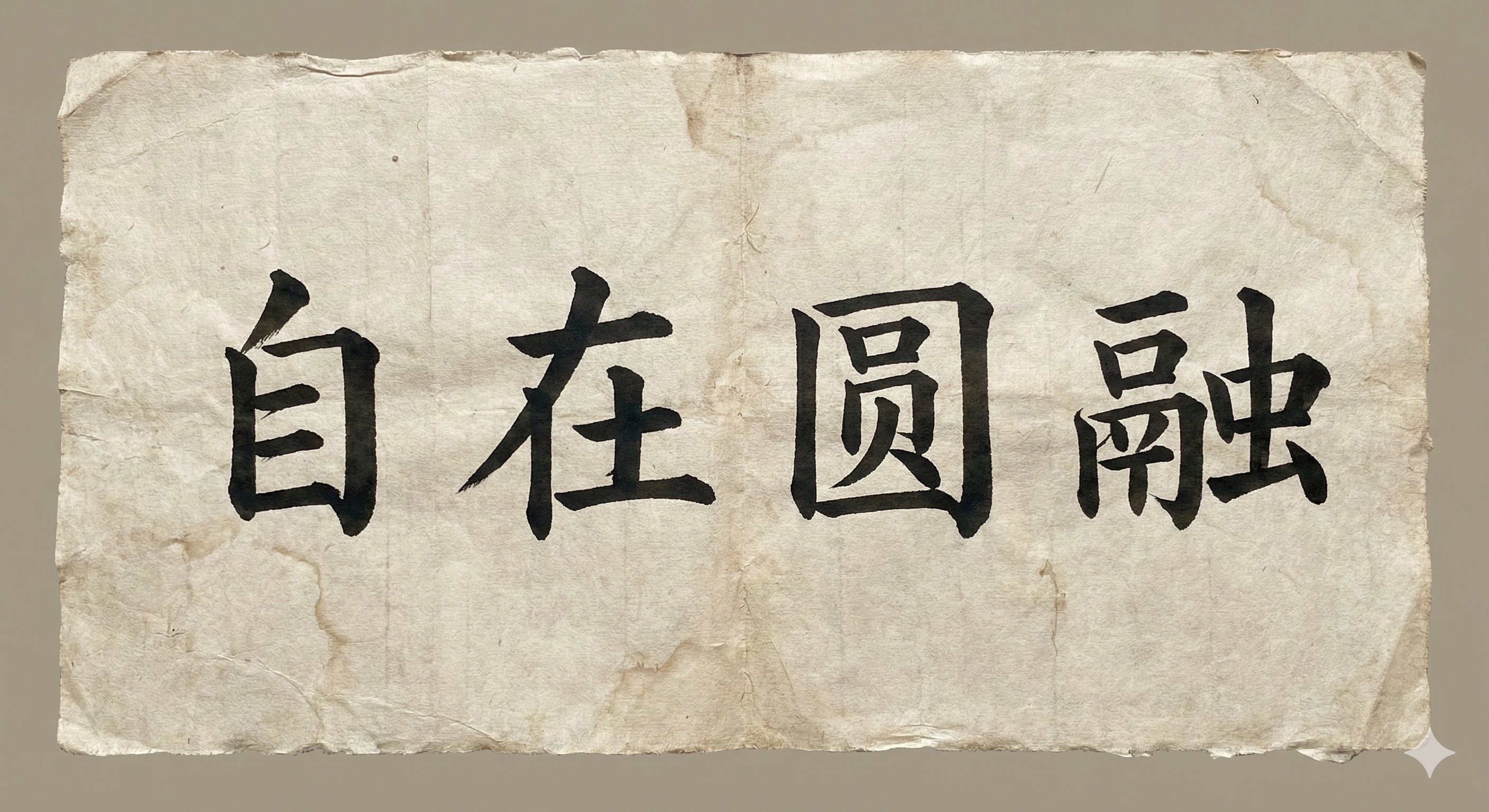
Image Healing: Traditional Mandala Imagery 09 · Echoes of Emptiness
Look at the blank space in the image. That blankness is not a lack, but a pause in breathing. You will find that emptiness gives form an echo, and also gives you the ability to hear.
Every symmetrical line tells the same story: "I am here, I have not lost my center." Place your hands on your lap and feel the weight of the ground. In this geometric tranquility, you become the center of the world once more. Steady your body, and your heart will follow.
Emptiness is the soul of form.

Lesson 9: Body Rhythm
Objective: To find a soothing rhythm through bodily awareness to help manage heart rate, breathing, and muscle tension.
Steps: Draw a pulsating line to represent the rhythm of your heartbeat, using variations in height to express emotional fluctuations. Write the triggering event (e.g., meeting, message, thought) next to each peak, and label each trough with a calming action (e.g., deep breathing, stretching, drinking water). Finally, use a soft color to write the sentence on the background: "I can slow down with my body."“
Please log in before submitting your drawings and feelings.
○ 9. Suggestions for a Breathing Anxiety Diary
① What are some recent scenarios in which I have experienced shortness of breath or rapid heartbeat?
② What was I thinking at that time? (e.g., "Am I sick?" "I'm going to faint")
③ What was my body actually doing at that time? (Shallow breathing/shaking hands/warm chest)
④ Write down one case of "I was nervous but got through it safely".
⑤ Today, my most effective way to soothe someone is (breathing/washing face/walking slowly/stretching).
⑥ Tomorrow's practice goal: Use the "4-4-6 breathing" for 3 consecutive rounds.
Please log in to use.
You don't need to "control your breathing," you just need to allow your breathing to belong to you again.
 EN
EN  ZH
ZH  ES
ES  FR
FR  JA
JA