

Lesson 968: Coordinating Responses to Team or Group Incidents
Duration:75 minutes
Topic Introduction (Overview):
When unexpected events occur within a team, class, workplace, or community, individual stress responses intertwine: some become overly busy, some remain extremely silent, some angrily question, and some repeatedly recount the details of the event; emotions, information, and responsibility flow rapidly within the group, easily leading to secondary harm such as mutual blame, escalating misunderstandings, and organizational disorder. This lesson will help you understand the basic dynamics of "group stress": who is taking on too much, who is constantly withdrawing, and who is being ignored; and recognize that these reactions are not simply personality issues, but rather an instinctive manifestation of the collective trying to process immense uncertainty.
We will learn three main directions: First, clarify and simplify information to avoid rumors and repeated panic; second, distinguish between "emotional expression space" and "task execution space" to ensure every role has a place; and third, establish a reliable rhythm within the team—regular meetings, brief checks, and shift supervision, rather than relying on a few individuals to carry the load. You will see that when everyone takes a step back, slows down, and clarifies things, the group has a chance to recover together. The mandala is not about drawing something, but about observation—observing the texture of the team under stress, the tension in relationships, and the gradual emergence of order and support after coordination.
▲ AI Interaction: Seeing the "Role Distribution" within a Group“
Recall a sudden event that your team or group experienced together: Who are you? What happened? What were your typical reactions afterward?
Try naming the roles of several key figures: Overburdened Person, Silent Bystander, Emotional Outburst Activist, Coordinator, Information Amplifier...
AI will help you analyze: What was your location at that time? What kind of pressure and protection did that location bring you?
Click the button below to work with AI to create a "team stress map" and find a gentler way to coordinate.
○ Group Rhythm Music Therapy
Choose a calm, non-intrusive background music for your team or group and play it at a low volume during short meetings or group reassurance sessions.
The purpose of music is not to cover up problems, but to help everyone slow down from the extreme "tense rhythm" and give them a couple of seconds of breathing space between sentences.
You can also listen to this music again on your own after the meeting and recall the conversation, and feel again: can these words be understood more gently at a slower tempo?
🍵 Chinese Black Tea: From "Over-Investment" to Moderation
Recommended drinks:Qimen black tea.
In mass incidents, some people instinctively rush to the front lines, constantly contacting, arranging, and reassuring others, until they are completely exhausted. The delicate aroma and mellow flavor of Qimen black tea help to "step back from the over-involved front lines," allowing you to rediscover your own boundaries and needs while still caring for others. You are not neglecting your duty; rather, you are conserving your energy for "long-term support."
usage:Take 3 grams of Qimen black tea and brew it with hot water at 85–90℃. Let it steep for a moment to observe the change in tea color before slowly sipping. With each sip, ask yourself: "How much can I still handle right now? What part can I relinquish to the team?"“
○ Chinese Food Therapy: Longan and Millet Warming Porridge
In team-based situations, many people skip meals and rest amidst the chaos, leaving their bodies in a prolonged state of "only focusing on functioning, neglecting replenishment." Longan nourishes the blood and calms the mind, while millet strengthens the spleen and harmonizes the body. When cooked into a soft and warm longan-millet porridge, it can provide individuals with a small sense of "being cared for" during the lull after the group's stress. Only when energy is slightly replenished can coordination and communication cease to be merely a forced effort.
Healing Recipes
/home2/lzxwhemy/public_html/arttao_org/wp-content/uploads/cookbook/guiyuan-xiaomi-zhou(Alternatively, you could try relaxed="1" or use an existing filename.)
🎨 Mandala Stable Viewing · Mi Xiangwen 968 · Multiple Links
Look at the mandala, not at yourself as the sole center, but at each intersection as a person, a message, or a source of support. You will find that not all the lines originate from you, nor do all the lines point to you.
A mandala is not about drawing something, but about observing—observing how connections transform from "single-line carrying" to "multi-point distribution," observing how responsibility and power are shared within the image. When you find your own little segment in the diagram, you may be able to allow yourself to no longer carry the entire pattern alone, but to become a stable link within it.

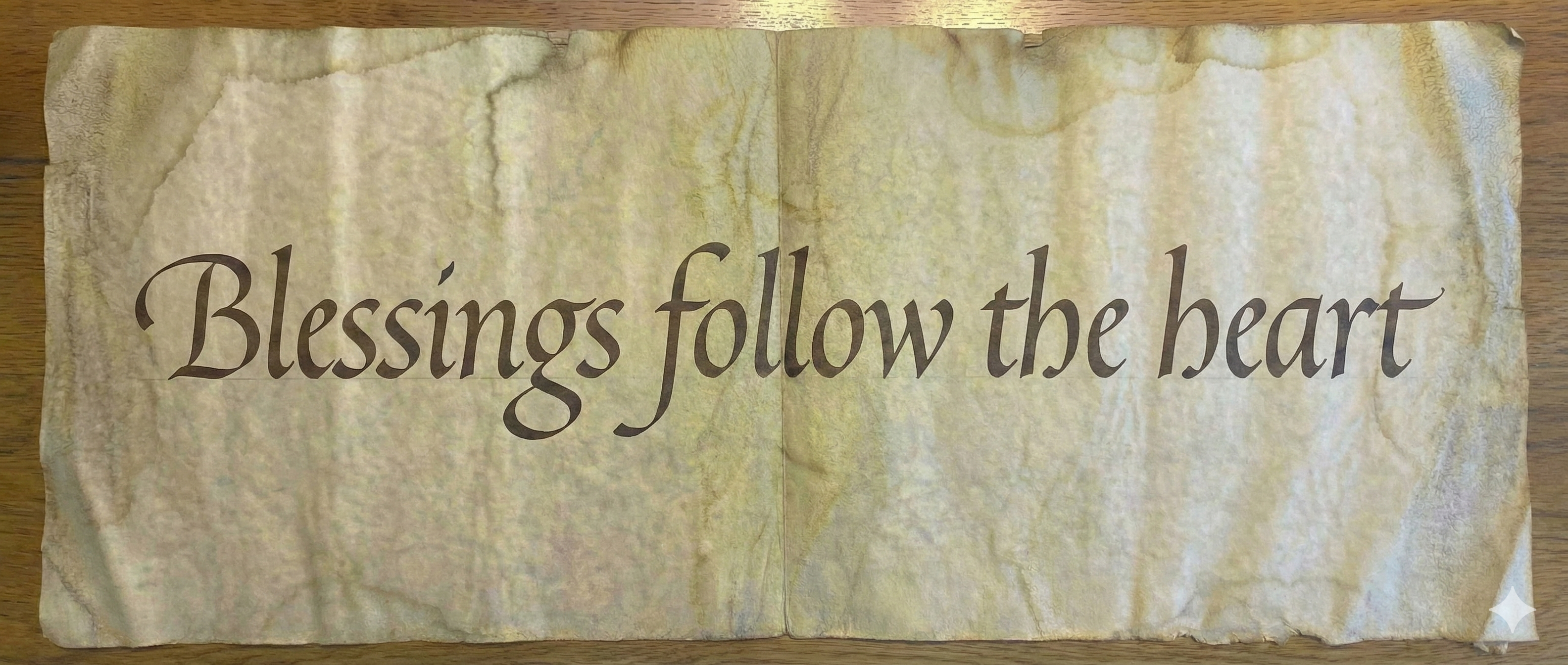
○ Italian Renaissance Humanist Script: A Writing Exercise for Coordination and Communication
Write sentences:I listen, I speak, and we share the weight together.
When writing Humanist script, leave clear spaces between each word, just like the space needed between team members: someone to speak, someone to listen, and someone to take a break. When writing "together," slow down a little and feel the stability of your wrist and the fluidity of your pen tip—you are practicing a new posture: not fighting alone, but "coordinating together."
Lesson 968: Team or Group Event Coordination - Guided Drawing
Objective: To externalize "who is taking responsibility, who is backing down, and who is coordinating" into a visible image.
Steps: Draw a circle on a piece of paper to represent the entire team. Mark several points on the edge of the circle and connect them with lines of varying thicknesses: thick lines represent those who take on more responsibility, thin lines represent members who temporarily step back, wavy lines represent individuals with stronger emotions, and stable straight lines represent the coordinator. After finishing, write next to the drawing: How would you adjust the lines to make them slightly more balanced? Let this diagram be your starting point for observing group dynamics and learning about allocation and coordination.
Please log in before submitting your drawings and feelings.
○ 968. Team or Group Incident Response Coordination: Log Guidance Suggestions
① Write down the most recent "team stress event" you participated in (it can be big or small), and describe the situation and role distribution at that time.
② What role did you naturally play in this? Was there ever a moment when you felt "a bit too much" or "a bit neglected"?
③ If you could do it all over again, what coordination action would you like to add for yourself and your team? (For example: one more confirmation, one less accusation, one more shift arrangement)
④ Write down a small list of things you can prepare for similar events in the future: three things that can help the team coordinate better while protecting yourself.
⑤ Suggested concluding statement: In the event of an emergency, I am not the only fulcrum; we can adjust our positions and recover together.
Please log in to use.
When a team learns to coordinate, share responsibilities, and look after each other during stress, recovery is no longer the task of one person, but a process completed by the entire group.
 EN
EN  ZH
ZH  ES
ES  FR
FR  JA
JA