

Lesson 989: How to Distinguish Between Adjustment Disorders and Depression
Duration:75 minutes
Topic Introduction (Overview):
Adjustment disorders and depression often appear very similar: low mood, lethargy, decreased attention, frequent crying, loss of motivation... but their core mechanisms differ. Adjustment disorders primarily occur "after a major change," representing a stress response to an event, with a clear starting point and a close connection to the triggering event; while depression can persist even without a specific event, with deeper and more persistent low mood, accompanied by significant loss of interest, self-doubt, and disruption of circadian rhythms. This lesson will guide you through a clear structure to distinguish between the two, preventing you from falling into the panic of "Am I already depressed?"
In comparing the two, you'll find that adjustment disorder is more like a "temporary imbalance after a sudden increase in workload," and symptoms often improve significantly as the stressful event subsides or a support system is established. Depression, on the other hand, involves a deeper emotional state that isn't entirely synchronized with life's events. The purpose of learning to differentiate isn't labeling, but rather enabling you to choose care methods more accurately. Mandala drawing isn't about drawing something, but about observation—observing the origin of emotions, observing the connection between stress and events, and observing which psychological path you are experiencing, thus making treatment and self-care more precise and gentle.
▲ AI Interaction: Distinguishing Between "Event-Driven" and "Intrinsic Settlement"“
Please write down your most recent period of significant mood swings and recall whether it was related to a certain event: change, conflict, stress, loss, increased responsibility... anything is acceptable.
Ask yourself three questions: ① Did my emotions begin shortly after the event? ② Did my emotions improve as the event subsided or I received support? ③ Did I retain any interest or motivation?
These are key clues to adjustment disorders, rather than typical symptoms of depression.
In an AI conversation, try writing out your "trigger chain": event → increased workload → emotional change → physical reaction.
Click the button below to analyze your emotional journey with AI and find out what the real core issue is.
○ Emotional Differentiation & Music Therapy
Choose a piece of music that gradually transitions from slow to slightly brighter as a tool for practicing "emotional layering".
Close your eyes and imagine the somber opening section symbolizing the deep emotions of depression: like dark waters at the bottom of a lake; while the gradually brightening melody in the middle section symbolizes the "adjustable part" of psychological adjustment disorder.
As the music transitions into a certain section, ask yourself: "Am I currently emotionally aligned with an event, or am I completely detached from it, as if enveloped by a shadow?"“
You don't need an immediate answer; just follow the music and divide your emotions into different levels—this is the first step in discerning them.
🍵 Chinese Green Tea Healing: Clearing the Mind and Refining Discernment
Recommended drinks:Lightly brewed green tea (Longjing or Biluochun).
The light and refreshing aroma of green tea makes it suitable for drinking when your thoughts are confused or unclear, helping to reduce excessive fatigue and keep your mind on a clear line of observation.
Usage: Brew lightly and sip slowly. Take a deep breath with each sip of tea, bringing your attention back to the present moment of "observation" rather than self-criticism.
○ Chinese Food Therapy: Longan and Lotus Seed Porridge (Calming and Soothing)
During periods of emotional confusion, the body often feels more fatigued. Longan and lotus seed porridge can nourish the heart and spleen, and calm emotions, preventing you from overexerting yourself when trying to understand "what I am going through." The warming and nourishing properties of longan combined with the calming effects of lotus seeds can help you keep your thoughts grounded at night, leaving a soft window for your mind.
The process of distinguishing between adjustment disorder and depression is not logical reasoning, but rather a restoration of bodily sensation. The rhythm of cooking porridge, the slow bubbling of soup, are like the unfolding of a mandala—a mandala is not about drawing something, but about observation: observing how your mind and body slowly find a stable center from chaos.
Healing Recipes
/home2/lzxwhemy/public_html/arttao_org/wp-content/uploads/cookbook/gui-yuan-lian-zi-zhou(Alternatively, you could try relaxed="1" or use an existing filename.)
🎨 Dream Mandala Healing · Mi Xiangwen 989 · Two Rivers of Emotion
You dream that you are standing at the confluence of two rivers. One is turbulent, with everyday fragments floating on its surface: work orders, chat logs, schedules, names, locations—every wave is closely connected to an event; the other is deep and slow, like a shadow with no clear origin, where you can only see your own shadow swaying with the current.
As you approach, you see two rivers converging to form a giant circle—like a spreading mandala. You don't need to separate the waters; simply observe: which river's sound resonates more with you at this moment? Which river makes you feel deep, stagnant, and captivated? And which one makes you feel weary yet still directional? A mandala isn't about drawing something; it's about observation—observing the source and depth of emotions, allowing you to find your own outlet.

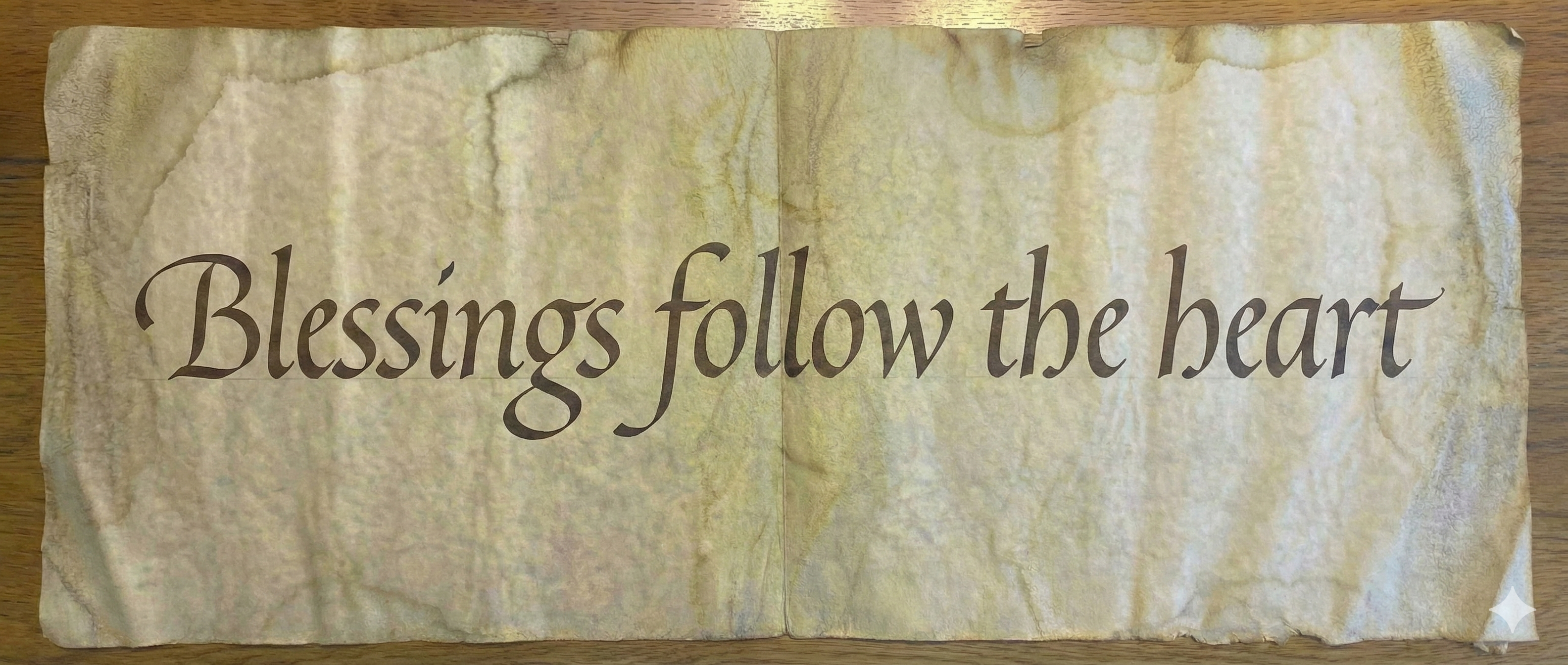
○ Italian Renaissance Humanist Script: Gentle Writing Exercises
Write sentences:I see where my feelings come from.
When writing this sentence, please make the spacing between letters wider so that your eyes can "see" the independent existence of each letter, just as you are learning to distinguish the source of emotions. The structure of Humanist Script is gentle, rounded, and rhythmically balanced, making it suitable as a vehicle for "discrimination exercises"—allowing your hand to write with a sense of unhurried clarity.
After each time you finish writing, pause for a second, look at the sentence on the paper, and ask yourself: Does my emotion come from the event itself, or from a deeper inner state? This kind of observation is practice.
Lesson 989: Identifying the Sources of Emotions - Drawing Guidance
Purpose: To visually separate "event triggering" from "inner settling" so that you no longer get confused.
Steps: Draw two concentric circles on the paper. The outer circle symbolizes the pressure of an event and can be represented with sharper, more varied lines; the inner circle symbolizes deeper emotions and can be depicted with more even, slower, and darker lines. As you begin to draw, focus your attention on observing: Which circle is closer to your current state? The fluctuations of the outer circle? Or the heaviness of the inner circle?
Finally, a soft transition line is added between the two circles to symbolize "distinguishing"—not forcibly cutting them apart, but seeing their differences more clearly.
Please log in before submitting your drawings and feelings.
○ 989. Adjustment Disorders vs. Depression: Journaling Guidance Suggestions
① Write down the starting point of your most recent low mood: Did it occur at the same time as something else?
② List your physical reactions at the time: heaviness, fatigue, tightness, shortness of breath, wanting to cry, heavy head... anything is fine.
③ If the situation improves, does your mood improve as well? If not, please write down why.
④ Describe your core feelings right now in one sentence: Exhausted? Hopeless? Confused? Numb?
⑤ Write a new inner dialogue for yourself to replace the panic-driven thought, "Am I depressed?"
⑥ Conclusion: Discrimination is not about labeling, but about understanding yourself more gently. Seeing the source is the beginning.
Please log in to use.
When you identify the source of your emotions, your heart gains the power to choose. Not all low moods equate to depression; some are simply life adjusting its pace.
 EN
EN  ZH
ZH  ES
ES  FR
FR  JA
JA