

Lesson 93: Creating an Anxiety Hierarchy Chart
Duration:70 minutes
Topic Introduction:
Anxiety Hierarchy is the most essential tool in exposure training.
It helps you break down "huge and vague fears" into small, practiceable steps, and makes the exposure process safe, controlled, and prevents you from breaking down.
This course will guide you step-by-step through creating your own anxiety level assessment path.
How to create an anxiety level chart that suits you?
- 1. List all the situations that cause you anxiety:From the mildest to the most intense, be as specific as possible, such as "speaking in front of guests".
- 2. Anxiety intensity rating: 0–10Rate your fear from 0 (completely fearless) to 10 (extreme fear) using your intuition.
- 3. Sort by score:Start practicing with mild scenarios of 2–4, and then gradually increase the difficulty level.
- 4. Preserve a way out:There should be a pause between each level, rather than jumping straight into the highest intensity.
Lesson 93: Creating an Anxiety Hierarchy Chart (Click to listen to the reading, view the content)
An anxiety hierarchy isn't a list to force yourself to be anxious; it's a map that helps the body reinterpret the intensity of fear. Many people, when faced with anxiety, only feel a general sense of fear, causing the brain to label all related situations as dangerous, thus losing room for adjustment. The purpose of the hierarchy is to break down this vague and overwhelming fear into distinct, comparable, and progressively approachable levels. Psychologically, when fear is concretized, the nervous system is no longer in an all-or-nothing alert state but begins to enter an evaluation mode. The first step in creating the hierarchy is to list all the specific situations that trigger anxiety; no ranking is needed, just complete and accurate information. The second step is to label the subjective anxiety intensity of each situation, usually measured from zero to ten. The important thing is not the accuracy of the number, but your intuitive feeling of the intensity. The third step is to rearrange the situations according to intensity from low to high, forming a progressive path. This process itself reduces fear because you begin to see that not all situations are equally dangerous. The core of the anxiety hierarchy isn't the highest level but the lowest level; it provides an entry point. By practicing from low intensity levels, the body gradually accumulates successful experiences, and the nervous system is more willing to continue exploring upwards. It's important to understand that the hierarchy is dynamic; it adjusts with experience and progress, rather than being a static standard. You don't need to complete the entire list at once, nor do you need to improve every day. What truly matters is maintaining direction while respecting the pace. When you replace vague fear with a hierarchy, action is no longer blindly forcing your way forward but structured learning. The anxiety hierarchy isn't meant to prove how brave you are, but to protect you from overexertion during the process of change. When fear is broken down and the path is seen, the body is more willing to cooperate.
▲ AI Interaction: What is your anxiety level?
You can enter several social or fearful scenarios that make you anxious.
AI will help you sort them by intensity to create your personal hierarchy table.
It will help you determine which ones are suitable to practice first and which ones need to be approached more gently.
Hierarchical charts can reduce fear, but the body may still be tense.
A gentle melody can help you breathe easily while planning your exposure route.
It is recommended to play background music for a few minutes while drawing the hierarchy table to maintain a smooth flow.
○ Eastern Healing Tea - Genmaicha (Brown Rice Tea)
Recommended drinks:Japanese Genmaicha
Recommended reasons:The aroma of roasted rice can soothe tense emotions and help you stay clear-headed when arranging hierarchical structures.
practice:Brewing with hot water at 80–85℃ maintains a stable aroma and helps reduce heart palpitations.
○ Stable Dietary Therapy: Ginger and Carrot Warm Soup (ID93)
During the phase of developing a hierarchy and beginning systematic practice, the body needs a nourishing balance that provides both warmth and direction. The natural sweetness of carrots brings a sense of groundedness and comfort, while the gentle warmth of ginger helps dispel tension and sluggishness, allowing the body to maintain adequate dynamism. This warm soup is suitable for consumption after planning a practice session or completing an exposure, helping the body translate thought into a sense of stability in action. It symbolizes steady progress along a clear path.
Warmth Action
Support Practice
Open Recipe
◉ Stable Dietary Therapy: Warm Ginger and Carrot Soup (ID 93)
Warm Ginger and Carrot Soup is a mildly spicy yet very gentle warming soup. The carrots release their natural sweetness as they simmer, which combines with the warm, spicy aroma of ginger, creating a comforting sensation that spreads from the stomach outwards. Unlike heavy, thick soups, it's not heavy and is more suitable as a daily soothing soup for when you feel tired, have cold hands and feet, or are feeling down, allowing your body to gradually warm up in the warm, orange broth.
Warming ginger aroma Refreshing Light Soup Friendly during a low mood
I. Recommended Dietary Therapy and Reasons
Recommended dishes:Warm Ginger and Carrot Soup (ID 93)
Recommended reasons: Carrots are rich in beta-carotene and have a natural sweetness, making them easily absorbed by the body; ginger, with its warming properties, is considered a helpful "body-awakening" agent in many culinary traditions. When combined into a refreshing soup, they provide gentle energy without burdening the digestive system. For those who sit for long periods, experience cold hands and feet, experience stress leading to tension, or feel depressed, this soup is a simple, safe, and easy-to-eat "warming dish."
2. Recipe and Method
Recipe (1–2 servings):
- 120–150 g carrots (peeled, sliced or diced)
- 20–30 g onion (chopped, optional)
- 4–6 slices of ginger (adjust according to tolerance)
- 600–700 ml of water or vegetable broth
- 1 tablespoon olive oil (optional)
- salt to taste
- A pinch of white pepper (optional, to enhance the warming sensation).
- A little chopped cilantro or parsley (garnish, optional)
practice:
- Wash and peel the carrots, then cut them into thin slices or small pieces; chop the onion and slice the ginger.
- Add a little olive oil to a pot and sauté the chopped onions over low heat until slightly translucent (this step can be omitted if you do not want to use oil and you can directly cook the soup).
- Add ginger slices and stir-fry briefly to release the aroma.
- Add the carrot chunks and toss them a few times to coat them with the aroma of ginger and onion.
- Pour in water or vegetable broth, bring to a boil over high heat, then reduce to low heat, cover and simmer for about 15–20 minutes, or until the carrots are tender.
- If you prefer a smoother texture, you can blend some of the soup and carrots into a puree using a food processor, then pour it back into the pot and mix. If you prefer a clear soup with the ingredients, you can eat it directly.
- Add salt and a pinch of white pepper to taste, and gently stir well.
- Pour into a bowl, and sprinkle with a little chopped cilantro or parsley as a garnish. Drink while hot.
3. Small rituals for body and mind
When cutting carrots, focus on the rhythm of the knife's contact with the cutting board, turning cutting vegetables into a quiet "paced action" rather than a hurried chore.
While the soup is simmering, when you smell the aroma of ginger and carrots, you can silently tell yourself, "I'm telling my body how hard it's worked."“
When you take your first sip of soup, pay attention to the path of warmth from your mouth to your throat, then to your chest and abdomen, as if you are slowly turning on a small light inside your body.
4. Dietary Therapy Experience Record
- Record the time of drinking (morning, afternoon, evening) and your physical condition at the time (cold, tired, tense, etc.).
- Observe changes in hand and foot temperature, stomach comfort, and overall relaxation within 20–40 minutes after drinking.
- If you drink this soup regularly over a period of time, you can record its effects on sleep quality, mood stability, and digestion.
V. Instructional Videos (approximately 3–5 minutes)
◉ Video Title:Warm Ginger and Carrot Soup - A bowl of light soup that warms you from your throat to your toes
6. Precautions
- The amount of ginger slices can be adjusted according to individual constitution and preference. Those who are sensitive to spiciness can reduce the amount or slice it thinner.
- If you have a sensitive stomach, you can extend the stewing time to make the ginger flavor milder and the carrots softer.
- Those who need to control the amount of oil can omit the olive oil and cook it directly into a clear soup version.
hint:This soup recipe is for daily dietary reference only and does not replace medical advice. If you have stomach ulcers, severe gastritis, or other digestive system diseases, please adjust your consumption method under the guidance of a professional physician.
○ Gothic script - Lesson 93 Writing Exercises
The topic of this lesson:Creating an Anxiety Hierarchy Chart—Building a Ladder to Freedom
In-depth analysis:
When faced with a huge fear (such as "social" or "flying"), we often feel helpless because it is like a high wall.
The purpose of the anxiety hierarchy chart is to carve steps into this wall.
The process of writing in Gothic script (Textura Quadrata) is a perfect demonstration of this psychological technique.
A complex Gothic word is not written in one stroke, but rather consists of countless short, independent...Vertical lines (Minims)It is stacked like bricks.
The significance of writing practice lies in the fact that by focusing on writing each short vertical line well, it tells the brain that a huge task (fear) can be broken down into countless small, safe, and controllable actions.
Writing Skills (Advanced Version):
- Deconstruction of strokes:
When writing words (such as "Ladder" or "Step"), don't think of it as a whole. Mentally break it down into "ladder". Pause after writing each letter. This symbolizes processing one level of anxiety in a hierarchy, taking a short break, and then moving on to the next level. - The Ladder:
Gothic script contains many soaring, upward-reaching strokes (such as l, h, k). When practicing, feel the pen tip slowly rising from the baseline. This is like stepping steadily up a ladder on a staircase. - The Base:
Ensure that the quadrata at the bottom of each stroke lands smoothly on the baseline. When creating a hierarchy, this means that each level should be built upon the previous level, which has become solid through repeated practice. Do not force advancement if the foundation is not solid. - Even Spacing:
Ensure that the white space between strokes is completely equal. This means that the difficulty range of the hierarchy should be even. Avoid setting too large a jump in difficulty between level 1 and level 2; maintain a steady pace. - Ink accumulation:
Imagine the black lines gradually thickening on the paper as your "courage savings account." Each stroke is a small victory.
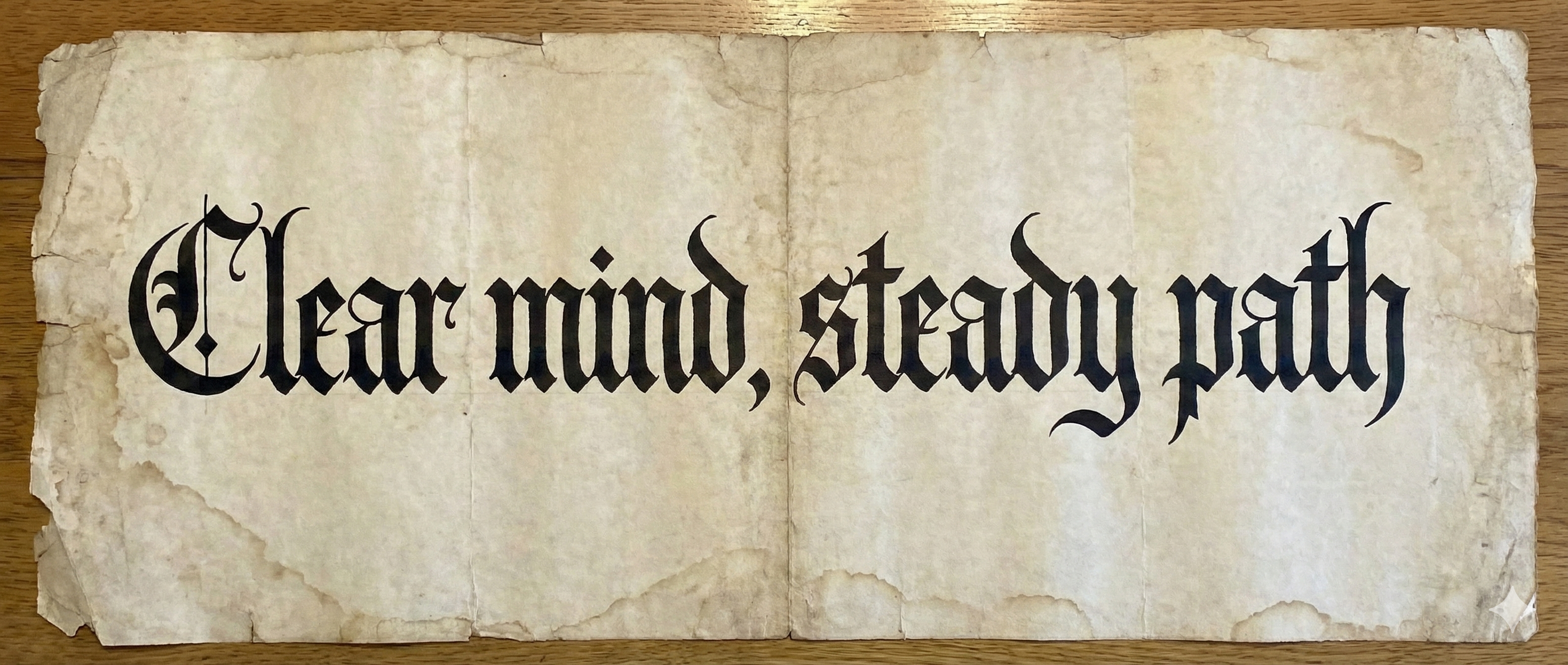
Image Healing: Mandala Stability Guidance 93
Imagine the mandala as a "step pyramid" or a "multi-tiered cake" viewed from above. The innermost layer is the ground (the absolute safe zone, anxiety score 0). Each concentric circle radiating outwards represents the next step on the anxiety hierarchy (anxiety score 10, 20, etc.).
Now, focus your gaze on the very center. Don't rush to the outermost circle. Try mentally taking a small step and standing on the first circle of patterns. Breathe in this position and feel the simplicity and friendliness of the design. Only when you feel completely comfortable on this circle should you expand your gaze outwards to the next. You built this pyramid yourself, and you have the right to decide your own pace.
Traditional mandalas typically feature a harmonious and intricately varied circular structure, symbolizing the wholeness of the universe and the cycle of life. By viewing mandala images, individuals can perceive inner peace and strength, achieving psychological balance.
◉ Gaze at the mandala twice, while taking deep breaths.
Lesson 93: My Anxiety Layering Chart (Guided Drawing)
① Guiding drawing actions:Draw three concentric circles to represent the "mild", "moderate", and "severe" conditions, and color them with a gradient from dark to light or from warm to cool.
② Guiding drawing actions:Write down a small scenario you'd like to practice on each level, such as "saying thank you to a stranger" or "1 minute of eye contact."
Please log in before submitting your drawings and feelings.
○ 93. Develop an anxiety hierarchy chart and use journaling as a guide.
① What are the fear scenarios I listed today? What are their respective ratings?
② Which one is most suitable as the "Level 1 Exercise"? Why?
③ What is my biggest concern about the hierarchical table? Is it possible to break it down into smaller parts?
④ After finishing today, how tense was my body (0-10)? Did it decrease?
Please log in to use.
The hierarchy is not a task list, but a cushion that allows you to "steadily approach" your fears.