

Lesson 102: Avoiding Secondary Harm from "Too Rapid Exposure"
Duration:70 minutes
Topic Introduction:
Exposure training can reduce fear, but "over-promotion" and "challenging high difficulty levels too early" can cause secondary harm.
When your nervous system is not ready but is forced to face strong stimuli, the brain will relabel fear as "dangerous," even more intensely than before.
This lesson helps you understand the importance of "appropriate difficulty" and learn how to identify if you have entered a state of "exposure overload".
What is "rapid exposure"? Why does it cause secondary harm?
- Beyond the emotional tolerance window:When the difficulty of exposure exceeds your stability zone, the brain enters "freeze or run" mode.
- The experience of being forced:Entering a peak situation directly without gradual training can mislead the brain into thinking, "I really can't take it anymore."
- Lack of recovery phase:If there is no adjustment after exposure, the fear will remain in the body and form negative memories.
Lesson 102: Avoiding Secondary Harm from Too Rapid Exposure (Click to listen to the reading, view the content)
When faced with fear, many people unconsciously develop an urgent desire to resolve the issue quickly, choosing an overly rapid and intense exposure method, as if everything would end as soon as they overcome it. However, overly rapid exposure is often not a shortcut but a new risk; it can lead to so-called secondary harm, making the fear not lessen but more ingrained. Secondary harm doesn't refer to the fear itself, but rather to the body experiencing a sense of loss of control, helplessness, or being forced to endure something before it's ready. Psychologically, when the intensity of exposure far exceeds the body's current capacity, the amygdala records the experience as new evidence of danger, thus deepening the original fear memory. The brain doesn't understand your motivation; it only remembers that "I was overwhelmed again." Many people experience stronger avoidance, deeper self-blame, and even fear of exposure itself after overly rapid exposure. This isn't a sign of weak willpower but rather the system's self-protection mechanism. The key to avoiding secondary harm is respecting the rhythm, not pursuing speed. Truly effective exposure needs to be built within safe boundaries, allowing fear to arise but not to spiral out of control. You need to learn to distinguish between challenging tension and overwhelming panic. The former, while uncomfortable, can still be managed; the latter will cause the body to enter a frozen or dissociated state. Too rapid exposure is often accompanied by internal compulsions, such as "I must succeed, I cannot back down," and this mentality itself increases pressure. Slowing down is not a regression, but a prerequisite for true learning to happen. You can protect the system by reducing intensity, shortening duration, or adding recovery steps. Trust is rebuilt only when the body repeatedly experiences that it can approach without being hurt again. Avoiding too rapid exposure is not about escaping fear, but about avoiding deepening fear in the wrong way. True courage is not about taking a one-time leap, but about being willing to accompany the body steadily and consistently throughout the learning process.
▲ AI Interaction: Have you recently shown signs of "overexposure"?
Tell the AI which exercises you felt were “too fast,” “too strong,” or “too difficult to handle.”
AI will help you determine if you've entered a state of emotional overload, allowing you to find a safer rhythm.
Exposure is not about stubbornly enduring, but rather about gently expanding the tolerance.
When exposure is too intense, the body retains residual tension. Soft music can help the nervous system return to a balanced state from the "fight/flight" state.
Music can be used as a "bridge to recovery" before and after exposure exercises.
○ Eastern Healing Tea - Pu-erh Ripe Tea
Recommended drinks:Pu-erh ripe tea
Recommended reasons:It is warm, stable, and has a "sinking" sense of stability, making it particularly suitable for recovery after exposure training.
practice:Brew with boiling water and drink slowly, allowing the temperature to help your body return from tension to calm.
○ An Ding Food Nourishment - Roasted Mushroom and Sesame Rice (ID102)
During the phase of adjusting rhythm and preventing secondary injuries, the body needs a rich and stable nourishment. The warmth of shiitake mushrooms and the nourishment of sesame seeds help replenish over-consumed energy, while rice provides a solid foundation. This fragrant roasted rice is suitable for consumption after practice or when feeling physically and mentally exhausted, helping the body rebuild safety and trust. It symbolizes the stable support one gives oneself when slowing down.
Repair consumption
Prevent overload
Open Recipe
◉ Stable Diet - Roasted Mushroom Sesame Rice (ID 102)
Roasted mushroom and sesame rice is a comforting staple food that falls somewhere between "simple and homely" and "slightly sophisticated." The roasted mushrooms have a slightly charred aroma and a concentrated mushroom fragrance. When mixed with rice, each bite carries a subtle smoky flavor and the aroma of sesame. It's low in oil but very satisfying. It's perfect for when you're looking for a "stable, clean, and not overly seasoned" meal, allowing your stomach and mind to settle down comfortably.
Heartwarming staple food Refreshing and non-greasy mushroom aroma
I. Recommended Dietary Therapy and Reasons
Recommended dishes:Roasted mushroom and sesame rice (ID 102)
Recommended reasons: During roasting, shiitake mushrooms are slightly dehydrated and their aroma is concentrated. When combined with the grain aroma of white or brown rice, this makes a simple bowl of rice more substantial. Sesame seeds, with their nutty aroma and oil, add a rounder texture without being greasy. The overall flavor is mild and mellow, making it perfect for those who are tired of strong flavors and want to use a simple staple food to slowly calm their emotions and body.
2. Recipe and Method
Recipe (1–2 servings):
- One bowl of cooked rice (about 180–220 g, some brown rice or mixed grains can be used).
- 4–6 fresh shiitake mushrooms (or about 70–90 g of sliced shiitake mushrooms)
- 1–1.5 tablespoons of roasted white or black sesame seeds
- 1 tablespoon of olive oil or sesame oil
- 1–1.5 teaspoons of light soy sauce (adjust as needed)
- Add a pinch of salt (adjust according to the saltiness of the soy sauce).
- A small amount of black pepper (optional)
- Add a little chopped green onion or parsley (garnish, optional)
practice:
- Wash the shiitake mushrooms, remove the stems, and cut them into thick slices or small pieces. Gently pat the surface dry with kitchen paper.
- Preheat oven to 180–190°C. Mix shiitake mushrooms with a little olive oil, a pinch of salt and black pepper, and spread them evenly on a baking sheet.
- Bake in the oven for about 10–15 minutes, turning once during baking, until the shiitake mushrooms shrink slightly and the edges are lightly browned.
- Once the cooked rice is ready, keep it lukewarm or reheat it in the microwave until it is loose and soft.
- Take a large bowl, add rice, roasted shiitake mushrooms, toasted sesame seeds, light soy sauce and a little sesame oil, and gently mix well.
- Try adjusting the saltiness; add a small amount of salt if needed to adjust the overall flavor.
- After serving in a bowl, you can sprinkle it with chopped green onions or parsley for garnish. It can be enjoyed as a main dish for one person or paired with a light soup.
3. Small rituals for body and mind
When handling shiitake mushrooms, observe their texture and cap shape, allowing yourself to briefly escape your thoughts and return to a state of "just looking at this small thing in front of you".
As the mushrooms are roasting, a warm aroma will slowly fill the kitchen. You can treat these few minutes as a "mini-break" for today, doing nothing but enjoying the smell.
When mixing rice, deliberately slow down the speed to make the stirring a steady rhythm, as if you are mixing and smoothing out your own mood little by little.
4. Dietary Therapy Experience Record
- Record your emotional state (anxiety, fatigue, irritability, calmness, etc.) before and after eating roasted mushroom and sesame rice.
- Observe the feeling of fullness, stomach comfort, and the speed at which warmth spreads throughout the body from a bowl of rice.
- If you repeatedly choose this type of "simple but somewhat sophisticated" staple food during a stressful period, you can record its impact on your eating rhythm and emotional stability.
V. Instructional Videos (approximately 3–5 minutes)
◉ Video Title:Roasted mushroom and sesame rice – a simple yet comforting staple food.
6. Precautions
- Shiitake mushrooms should not be baked for too long to avoid drying them out and affecting their texture. You can adjust the time according to your own oven.
- If you need to control the salt content, you can reduce the amount of soy sauce and focus on the aroma of shiitake mushrooms and sesame seeds.
- For those with sensitive stomachs, rice can be replaced with porridge or softer brown rice to reduce the burden of chewing.
hint:This recipe is for daily dietary guidance and does not replace any medical advice. If you have any special health conditions, please adjust the dosage and combination according to the advice of a professional medical practitioner or nutritionist.
○ · Suggestions for practicing running script in Chinese calligraphy
The topic of this lesson:Avoid "exposing too quickly"—speed must serve control.
Many students, eager to overcome anxiety, take too big a step in exposure exercises (such as directly entering highly fearful scenarios), resulting in panic attacks and exacerbating their trauma. In calligraphy, this is called "moving from running script to cursive script, losing the rules because of being too hasty." Although running script emphasizes speed, its essence is "a slow connection." Only when one can slow down and calm down can one truly master the art.
Writing Instructions:
In running script, one must avoid being "slick". If the brush tip glides too quickly across the paper, the lines will float on the surface and lack the strength to penetrate deeply; this is called "floating".
During practice, please consciously feel it.“"Awkwardness"”Imagine that the paper is resisting the pen tip, and you are going against the wind.
Although the strokes are connected, each turn should be a slight pause, like braking. This pause is the "safety check" in exposure therapy: stop for a moment, confirm that your heart rate is stable, and then proceed to the next step.
Written words:
Virtue enriches life
Motivational words:
Speed doesn't equate to quality; stability signifies strength. Don't lose your spirit in the rush to get there, and don't exhaust your courage in the pursuit of healing.
Writing Tips:
When writing the character "行" (xíng), the two strokes of the double-person radical (彳) should be short and forceful, like solid footsteps; the base of the right-hand "亍" (chù) should be stable. Feel the pen tip "biting" the paper, rather than floating past it. Only by biting the paper can the ink penetrate; only by calming the mind can healing occur.
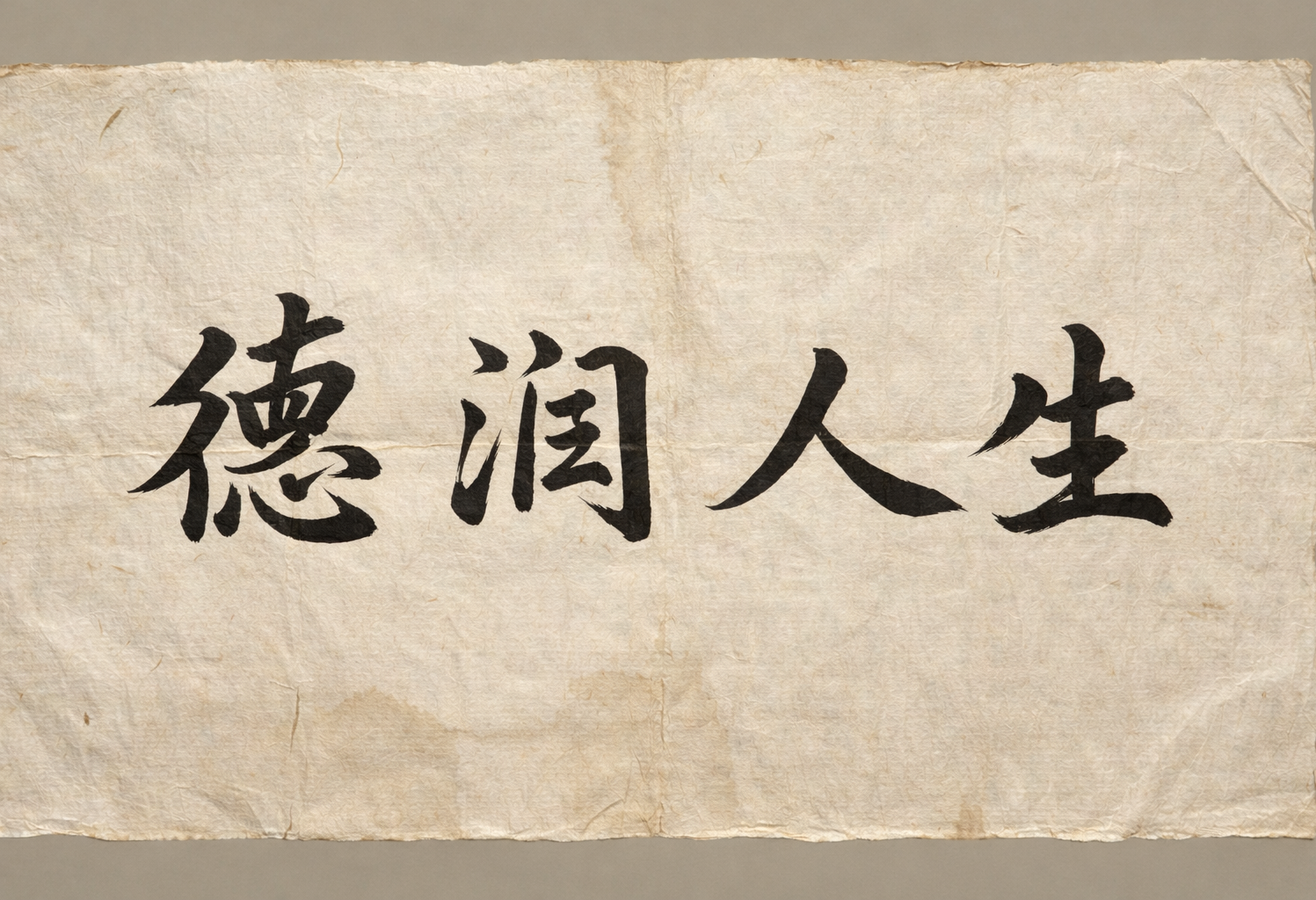
Image Healing: Mandala Stability Guidance 102
Please observe this mandala, which resembles tree rings. A tree's growth never skips steps; it expands outwards only one ring each year. If the inner rings haven't fully developed before the outer rings, the trunk will become hollow and break. Examine your mandala; are each layer of lines completely closed? If not, retreat to the inner rings and carefully trace and repair them with your eyes. Don't rush to the outermost layer; the winds are strong there. Only when the inner rings are strong enough can you safely support the larger expanse of life.
Traditional mandalas typically feature a harmonious and intricately varied circular structure, symbolizing the wholeness of the universe and the cycle of life. By viewing mandala images, individuals can perceive inner peace and strength, achieving psychological balance.
◉ Gaze at the mandala twice, while taking deep breaths.

Lesson 102: The Rhythm of Safe Exposure (Guided Drawing)
① Action guidance:Draw a small, dark center to symbolize your safe zone; the lines should be firm and not scattered.
② Action guidance:Draw a lighter-colored ring around the center to represent "a light level of exposure that can be tried".
③ Action guidance:The third layer of color blocks remains lighter and looser, symbolizing the more challenging areas that will be reached in the future, allowing oneself to see "I can take it slow".
Please log in before submitting your drawings and feelings.
○ 102. Security Exposure • Log-Guided Recommendations
① Which part of today's exposure was too fast or too intense for me?
② Did I skip the "mild exposure" level and go straight to the higher difficulty level? Why?
③ What signals does my body give me after exposure to alert me to "overload"?
④ To what extent can I lower the exposure difficulty tomorrow? (Be specific)
Please log in to use.
A gentle rhythm is the true path to healing. Exposure is not a sprint, but a gradual expansion of courage.