

Lesson 104: Language Reconstruction – Changing the Inner Self-Dialogue
Duration:70 minutes
Topic Introduction:
Fear comes not only from images, but also from language.
When we repeatedly tell ourselves "I can't do it," "They'll laugh at me," and "I'm sure I'll fail," our brains interpret these words as real commands, triggering tension, avoidance, and hypervigilance.
This course will guide you on how to rebuild your internal language system: shifting from "automatic criticism" to "supportive language," allowing your brain to stop triggering false alarms.
Why is the language of fear so powerful?
- Language is the brain's "interpreter":The words you use define the world you see.
- Self-criticism is an automatic habit of highly sensitive individuals.The more you try to avoid mistakes, the more you amplify the danger.
- Supportive language can retrain the nervous system:When you soften your tone, your body will relax more.
Lesson 104: Language Reconstruction: Changing Inner Self-Dialogue (Click to listen to the reading, watch the content)
Inner self-dialogue is not an insignificant psychological background noise, but a vital force that continuously influences emotions and behaviors. Many fears and anxieties recur not because the external situation is dangerous, but because you are constantly repeating highly threatening language internally. For example, phrases like "I can't handle this," "I will definitely fail," and "Others will definitely look down on me" may seem like mere thoughts, but the brain processes them as factual information, directly activating the fear response. The goal of language reengineering is not to force yourself to be positive, but to shift your inner dialogue from aggression and catastrophism to more authentic and bearable expressions. Psychologically, the brain doesn't distinguish between external and internal language; as long as the statement contains strong negativity or dangerous implications, the amygdala will activate its alarm system. Therefore, changing your inner self-dialogue is equivalent to changing the source of fear input. The first step in language reengineering is to become aware of the words you most often say to yourself when you're fearful, rather than immediately refuting them. The second step is to identify the absolute and predictive elements in these words, such as "definitely," "always," or "completely unbearable." The third step is to transform them into more realistic expressions, such as "I'm very nervous now, but I can take it slow," or "This is difficult, but it doesn't mean I can't cope." This transformation is not self-deception, but rather providing the brain with more accurate information. When the aggression of inner language decreases, the body's defensive responses also weaken. Language reconstruction requires repeated practice because old dialogues have often been in place for years. You're not trying to eliminate negative voices, but rather to prevent them from dominating the conversation. When you begin to talk to yourself using supportive rather than punitive language, fear gradually loses its fuel. Changing your inner language won't make you weak; instead, it will make you more stable when facing difficulties. You are creating a safer psychological environment for your body with a new language.
▲ AI Interaction: What is the sentence you say to yourself most often?
Tell the AI: "Automated self-talk" is the phrase you've been repeating most often in your mind lately.
AI will help you decipher the fear logic behind this statement.
It will guide you to convert it into a more stable and authentic language version.
The first step in language reconstruction is to free the body from the "tight language pattern".
Soft, gentle music can help you be more gentle and open when practicing language substitution.
○ Oriental Healing Tea - Osmanthus Oolong
Recommended drinks:Osmanthus Oolong
Recommended reasons:The fragrance of osmanthus has a "lightening effect on emotions," making it suitable for softening the mind before practicing inner language.
practice:Brew with 90℃ water to allow the aroma to slowly diffuse, helping you enter a state of "gentle self-dialogue".
○ Stable Dietary Therapy: Ginger, Mushroom, and Chicken Warm Soup (ID104)
During the process of rebuilding inner language, the body needs nourishment that is both powerful and gentle. Chicken provides stable and mild energy, the soothing texture of mushrooms helps calm the nervous system, and the warmth of ginger dispels inner tension. This warm soup is suitable for consumption after deep practice of self-dialogue or emotional fluctuations, helping the body transform new linguistic experiences into a sense of groundedness. It symbolizes supporting inner change in a warm way.
Warm support
Enhance load-bearing capacity
Open Recipe
◉ Stable Dietary Therapy - Warm Ginger and Mushroom Chicken Soup (ID 104)
Warm Ginger and Mushroom Chicken Soup is a refreshing chicken soup with a subtle mushroom aroma and a warming ginger scent. The chicken provides substantial protein, the mushrooms release their delicate umami flavor during slow cooking, and the ginger adds a gentle warmth without being overly spicy. It's perfect for a soothing evening when the weather is getting cooler, you're feeling tired, slightly chilled, or simply want to treat yourself. This soup will soothe your stomach and chest.
Warming and calming Mushroom and Chicken Soup Refreshing and non-greasy
I. Recommended Dietary Therapy and Reasons
Recommended dishes:Warm Ginger and Mushroom Chicken Soup (ID 104)
Recommended reasons: Bone-in chicken releases its delicate umami flavor as it simmers over low heat, providing the body with stable protein and a feeling of fullness; the savory aroma of shiitake mushrooms makes the soup delicious enough without needing much seasoning; and a touch of ginger gently warms the body without irritating the stomach. The overall soup is clear, light, and not heavy or greasy, making it suitable as a soothing main soup during recovery, stressful periods, or in the evening, helping to transition from a tense state to a state where you can "slow down."
2. Recipe and Method
Recipe (Serves 2):
- 250–300 g of bone-in chicken thighs or pieces
- 5–7 fresh shiitake mushrooms (washed and sliced or halved)
- 4–6 slices of ginger (adjust according to tolerance)
- 1 small piece of scallion (crushed, optional)
- 900–1100 ml of clean water
- Add salt to taste (it's recommended to add a small amount of seasoning later).
- A pinch of white pepper (optional)
- A small amount of chopped scallions or parsley (garnish, optional)
practice:
- Rinse the chicken pieces with clean water. You can put them in cold water and heat them to a simmer. Skim off the foam, then remove them and rinse them with warm water. (The blanching step can be omitted, but the soup will be slightly cloudy.)
- Add water, chicken pieces, ginger slices, and scallion segments to a pot, bring to a boil over high heat, then reduce to low heat.
- Skim off the foam gently to make the soup clearer, then keep it simmering over low heat.
- Add the prepared shiitake mushroom slices or chunks and continue to simmer over low heat for about 35–45 minutes to make the chicken tender and the shiitake mushrooms fully infused with flavor.
- Before turning off the heat, remove the scallion segments, add salt and a little white pepper to taste, and gently stir well.
- Serve in a bowl, garnish with a little chopped scallions or parsley, and enjoy.
3. Small rituals for body and mind
While the soup is simmering, you can deliberately avoid doing other tasks and only occasionally look at the small bubbles slowly rising on the surface of the soup, treating this time as "a blank space for yourself today".
When ladling soup into a bowl, pay attention to the weight of the spoon and the temperature of the steam brushing against your cheeks, bringing your attention back from your chaotic thoughts to the physical sensations of the present moment.
As you take your first sip, tell yourself, "Today has been good enough, I can take it slow." Let this bowl of soup be a gentle signal.
4. Dietary Therapy Experience Record
- Record the time you drink soup (after get off work, weekend dinner, nights when you're feeling down, etc.) and your physical and mental state at the time.
- Observe the changes in body warmth, stomach comfort, and mood relaxation within 30–60 minutes after drinking.
- If you regularly add this kind of refreshing chicken soup during a period of stress or recovery, you can record changes in your sense of physical recovery, sleep quality, and mood stability.
5. Tutorial Video (approximately 4–6 minutes)
◉ Video Title:Warm Ginger and Mushroom Chicken Soup: A bowl of warming and calming soup with the aroma of mushrooms.
6. Precautions
- If you cannot tolerate the spiciness of ginger, you can reduce the number of ginger slices, or remove some of the ginger slices after stewing, just to retain the aroma.
- When you need to control your fat intake, you can skim off the solidified oil on the surface of the soup after it has completely cooled down, and then reheat it before drinking.
- For individuals with high uric acid, gout, or severe hyperlipidemia, the intake of chicken soup and mushrooms should be adjusted appropriately based on professional medical advice.
hint:This chicken soup recipe is for daily dietary and mental well-being reference only and does not replace any medical diagnosis or treatment. If you have chronic illnesses or special dietary restrictions, please consult your doctor or nutritionist first.
○ · Chinese Calligraphy · Running Script · Lesson 104 Writing Practice
The topic of this lesson:Language Reconstruction – Changing the Inner Self-Dialogue
In-depth analysis:
People with social anxiety often have harsh self-talk: "I'm so stupid," "I messed up again." These words are like broken, sharp nails.
The soul of running script lies in“"The brush may break, but the meaning remains."”The end of one stroke must be the beginning of the next.
Practicing cursive script is like rewriting your inner script. When you get used to using smooth lines to connect each stroke, you also subconsciously learn to use a gentle "It's okay, I'll do better next time" to accept the thought of "I messed up".
Writing Instructions:
This lesson focuses on“"Ligatures"”.
Don't break down the components of a character into isolated islands. For example, when writing the character "念" (niàn), the last stroke of "今" (jīn) should flow smoothly towards the first stroke of "心" (xīn).
This connection represents a shift in thinking.
When you find yourself blaming yourself (with a heavy beginning stroke), don't stop there. Try turning your wrist (the rounded turns of running script) to transform that blame into encouragement (a light ending stroke).
If you teach your pen to "turn corners," your emotions will learn to "change their perspective."
Written words:
Stable progress brings peace of mind
Motivational words:
A change of heart can alter one's state of mind and perspective. Don't fight against yourself; follow the flow of your thoughts and offer yourself a kind word.
Writing Tips:
When writing the character "转" (zhuǎn), the "车" (chē) radical should be written compactly and dynamically, while the "专" (zhuān) radical on the right should be extended. As you write that rotating stroke, silently recite a new belief you want to instill (such as "I am safe"). Infuse the energy of this statement into the rotating line with the ink.
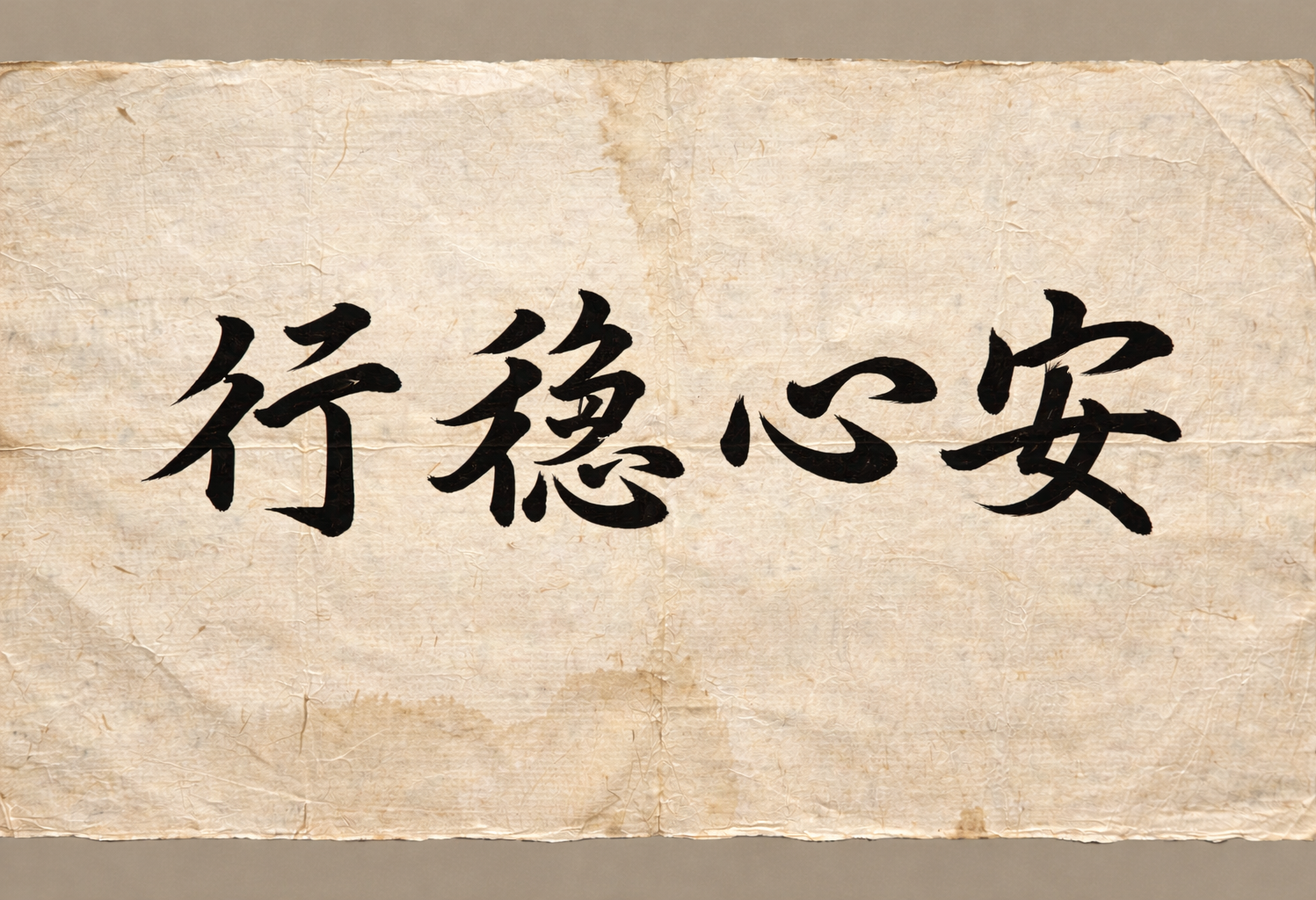
Image Healing: Mandala Stability Guidance 104
Imagine this mandala as a "soundwave map" of your inner voice. If your self-dialogue is sharp and accusatory, the ripples will be jagged; if it's gentle and accepting, the ripples will be smooth. Look at the center of the mandala and imagine you're saying the gentlest words to yourself. Watch as this sentence is like a pebble thrown into water, creating smooth, perfect, and harmonious ripples that spread outwards, smoothing out the original roughness.
Traditional mandalas typically feature a harmonious and intricately varied circular structure, symbolizing the wholeness of the universe and the cycle of life. By viewing mandala images, individuals can perceive inner peace and strength, achieving psychological balance.
◉ Gaze at the mandala twice, while taking deep breaths.

Lesson 104: The "Loosening Exercise" of Inner Language (Guided by Drawing)
① Action guidance:Write the "old language" in a darker color (e.g., I can't), and then write the new version next to it in lighter lines (I'm practicing).
② Action guidance:Draw taut lines on the left side of the image and softer lines on the right side to symbolize the transformation of language.
③ Action guidance:Adding a "slow arc" to the center of the image symbolizes that you are learning a softer inner tone.
Please log in before submitting your drawings and feelings.
○ 104. Language Reconstruction: Log-Guided Suggestions
① What is the "automatic self-criticism language" that I use most often lately?
② If I were to soften this sentence slightly, which word would I be willing to change?
③ How does the new sentence make my body feel? (Relaxed/Neutral/Still tense)
④ What is a new "supportive self-language" that I'm willing to practice tomorrow?
Please log in to use.
Language can hurt us, but it can also heal us. Changing our own dialogue means becoming our own ally again.