

Lesson 106: Cross-Scenario Transfer – How to Maintain Progress in Different Environments
Duration:70 minutes
Topic Introduction:
Many people can remain stable in a "familiar environment," but when they switch to a new setting (office, family gathering, online meeting, public place), they are brought back to square one by anxiety.
This doesn't mean you've regressed; rather, it means your nervous system has different "alert levels" for different environments.
This course will help you take the healing results out of the classroom and transfer them to various real-life scenarios, so that the sense of stability is no longer limited to a certain space.
Why do different scenarios trigger different anxieties?
- Different scene memories:The brain assigns different "safe/dangerous labels" to places based on past experiences.
- Different social roles:At home, in the workplace, and in close relationships, the roles you play and the expectations you receive differ, and so do the sources of stress.
- Different attention distributions:Unfamiliar environments cause the brain to scan for threats rather than maintain internal stability.
Lesson 106: How to Maintain Progress Across Different Environments Through Cross-Scene Transfer (Click to listen to the reading and view the content)
When you've become relatively stable in facing fear in certain situations, a new challenge often arises—that's why you might feel tense again in one environment than in another. This isn't regression, but a natural stage in the incomplete process of cross-scenario transfer. Cross-scenario transfer refers to bringing learned regulatory abilities from familiar situations into new environments, allowing the body to understand that safety doesn't exist in a single condition. From a neurological perspective, learning is highly context-dependent; the brain often binds safety memories to specific places, people, times, or processes. Once conditions change, old alertness may be reactivated. Therefore, continuous progress isn't about constantly repeating the same scenario, but about consciously expanding the boundaries of learning. The first step in transfer is identifying which core abilities you already possess, such as breathing regulation, breath control, or self-talk—these are resources that can be transferred. The second step is to lower your starting point in the new environment; don't demand that you reach your previous level, but start again at a lower intensity, allowing the body to gradually build connections. The third step is to maintain structural consistency, such as using the same preparatory rituals, anchor points, or recovery methods, so that the nervous system feels familiar with the changes. Failure in cross-scenario transfer often stems from overly high expectations. When you demand that you immediately behave the same way in a new environment as in the old one, the body will re-enter a state of stress. Truly effective transfer allows for unfamiliarity while maintaining direction. It's important to understand that progress isn't linear but rather a process of cascading expansion. What you're doing isn't replicating performance, but expanding your safety map. As different environments are gradually incorporated into the same map, the range of fear triggers shrinks, while trust increases. The core of cross-scene migration isn't proving you're cured, but rather allowing your body to learn to gradually stabilize wherever you are. When you're willing to patiently accompany this expanding progress, it will happen naturally.
▲ AI Interaction: Which scenario is most likely to make you lose stability?
Tell the AI in which scenarios you are most likely to feel nervous or withdraw.
AI will help you break down the trigger points and design migration strategies for each scenario.
You can also practice a "small-scale cross-scene stabilization plan".
The most important aspect of cross-scene migration is maintaining an "internal rhythm" in different spaces.
Allow the music to establish a stable state within your body beforehand, so that you are not pulled away by external rhythms when entering a new situation.
○ Oriental Healing Tea - Oolong Tea (Light Roast)
Recommended drinks:Fragrant Oolong
Recommended reasons:Clear and light, it won't cause any extra burden and is suitable as a cue ritual for "entering a new situation".
practice:A short brew with 95℃ water allows the aroma of tea to become a "stable signal" for you to transition from one scene to the next.
○ Stable Diet Therapy - Herb, Lemon, and Vegetable Warmer (ID106)
During the period of adapting to a new environment and practicing skill transfer, the body needs a refreshing and non-irritating nourishment. The light flavor of vegetables provides a stable foundation, the slight acidity of lemon brings a sense of clarity, and the aroma of vanilla enhances the feeling of familiarity and security. This warm cup is suitable for drinking before and after entering a new scene, helping the body maintain balance during changes. It symbolizes entering a new space with familiar support.
Stable migration
Mild expansion
Open Recipe
◉ Stable Diet Therapy - Herb, Lemon, and Vegetable Bowl (ID 106)
Herb and Lemon Vegetable Cups are a brightly colored and refreshing roasted vegetable dish. Using common vegetables such as carrots, broccoli, and cherry tomatoes as the main ingredients, they are tossed with lemon juice and delicate herbs, then lightly drizzled with olive oil before being baked in the oven, allowing the vegetables to achieve a balance between slightly charred and soft. When they come out of the oven, they have a subtle aroma of lemon and herbs, offering a refreshing and invigorating experience without being overly stimulating to the taste buds. It's a perfect dish for when you're feeling down and need something "clear but not overwhelming."
Fresh herbs Lemon flavor Light Vegetable Dishes
I. Recommended Dietary Therapy and Reasons
Recommended dishes:Herb, Lemon, and Vegetable Bowl (ID 106)
Recommended reasons: Roasting a variety of colorful vegetables together creates a rich flavor and nutritional profile without adding too much oil or seasoning. The addition of lemon juice and herbs gives the dish a "gentle awakening" effect, making it suitable as a small main course or side dish when you've lost your appetite or feel tired of greasy food. Serving the vegetables in small bowls also naturally creates a "ritualistic" dining experience, helping your mind and body slowly transition from chaos and busyness to a steady and rhythmic state.
2. Recipe and Method
Recipe (1–2 servings):
- 40–50 g of carrots (diced or sliced thinly)
- 50–60 g of small broccoli florets
- 30–40 g of bell peppers (yellow or red) (cut into small pieces)
- 4–6 cherry tomatoes (cut in half)
- 1–1.5 tablespoons olive oil
- 1–1.5 tablespoons lemon juice
- A small amount of dried thyme or rosemary (fresh herbs are also acceptable).
- salt to taste
- A pinch of black pepper (optional)
- A small amount of lemon zest (optional, to enhance aroma).
practice:
- Preheat oven to 180–190°C.
- Cut carrots into small cubes or thin slices; break broccoli into small florets and blanch them briefly for 1–2 minutes, then drain; cut bell peppers into small pieces and halve cherry tomatoes.
- Place all the vegetables in a large bowl, add olive oil, lemon juice, herbs, salt, and black pepper, and gently toss to coat the vegetables evenly with the seasonings.
- Divide the mixed vegetables evenly into heat-resistant mortars or small baking dishes, piling them up slightly.
- Place in a preheated oven and bake for about 15–20 minutes, until the edges of the vegetables are slightly browned and the inside is soft but still retains a bit of texture.
- Once removed from the heat, sprinkle with a small amount of lemon zest or additional herbs for garnish before serving.
3. Small rituals for body and mind
When cutting vegetables, consciously observe their different colors and shapes to temporarily distract yourself from your chaotic thoughts and focus solely on the ingredients in front of you.
The process of portioning vegetables into small bowls can be seen as a symbol of "organization": putting the scattered day back into manageable small portions.
After baking, don't rush to eat it. Take a few seconds to smell the lemon and vanilla aroma, like giving yourself a deep breath, and then slowly put it in your mouth.
4. Dietary Therapy Experience Record
- Record your mood changes before and after eating this vegetable soup (e.g., irritability, fatigue, calmness, etc.).
- Observe whether crisp, roasted vegetables help improve appetite or make the body feel lighter.
- If you eat these kinds of "ritualistic small-portion vegetable dishes" several times in a row during periods of high stress or low mood, you can record the impact on your eating rhythm and sense of self-care.
V. Instructional Videos (approximately 3–5 minutes)
◉ Video Title:Herb, lemon, and vegetable bowl: A refreshing and heartwarming little dish with a touch of ritual.
6. Precautions
- The amount of lemon juice can be adjusted according to individual tolerance for acidity. For first-timers, start with a smaller amount and then increase according to taste.
- If you have a sensitive stomach, you can reduce the amount of lemon juice and vanilla used to make the flavor milder.
- The types of vegetables can be changed according to the season and available ingredients, but try to keep the combination of "multiple colors" to maintain a rich visual and nutritional experience.
hint:This recipe is for daily dietary reference only and does not replace any medical diagnosis or treatment. For special dietary needs or medical conditions, please adjust according to the advice of a professional medical practitioner or nutritionist.
○ · Chinese Calligraphy · Running Script · Lesson 106 Writing Practice
The topic of this lesson:Cross-scene migration—the environment changes, but the central axis remains the same.
In-depth analysis:
Many students write very well on lined paper, but become helpless and their handwriting becomes crooked when faced with blank paper. This is like how we feel relaxed in a familiar environment (home) but anxious in a new environment (social occasion).
The highest level of running script is "breaking the rules".
In this lesson, we will practice writing without using the grid lines. On a blank sheet of paper without guide lines, you need your own "central axis." Regardless of whether the paper (environment) is wide or narrow, as long as your writing always revolves around this internal axis, you will not lose your way.
Writing Instructions:
Try writing the same word on paper of different materials and sizes.
You'll find that rough paper requires more forceful strokes, while smooth paper requires more agile control.
This is the wisdom of "transfer": don't use the same rigid set of actions to deal with all environments, but fine-tune your intensity according to the feedback from the environment.
Preserve the skeleton of the word (core self), adjust the flesh and skin (social expression), that is adaptation.
Written words:
Safe and orderly
Motivational words:
Water takes the shape of the cup when poured into it, and the shape of the bowl when poured into it, but water is still water. May you find peace and contentment in any container.
Writing Tips:
When writing the character "随" (suí), the left side, the "耳刀" (ěr dāo), should be written tall, and the right side, the "有" (yǒu) and "辶" (chuò), should complement its shape. Imagine you are taking a walk in an unfamiliar place; no matter how big or small your steps are, as long as your center of gravity is stable, anywhere can be a path.
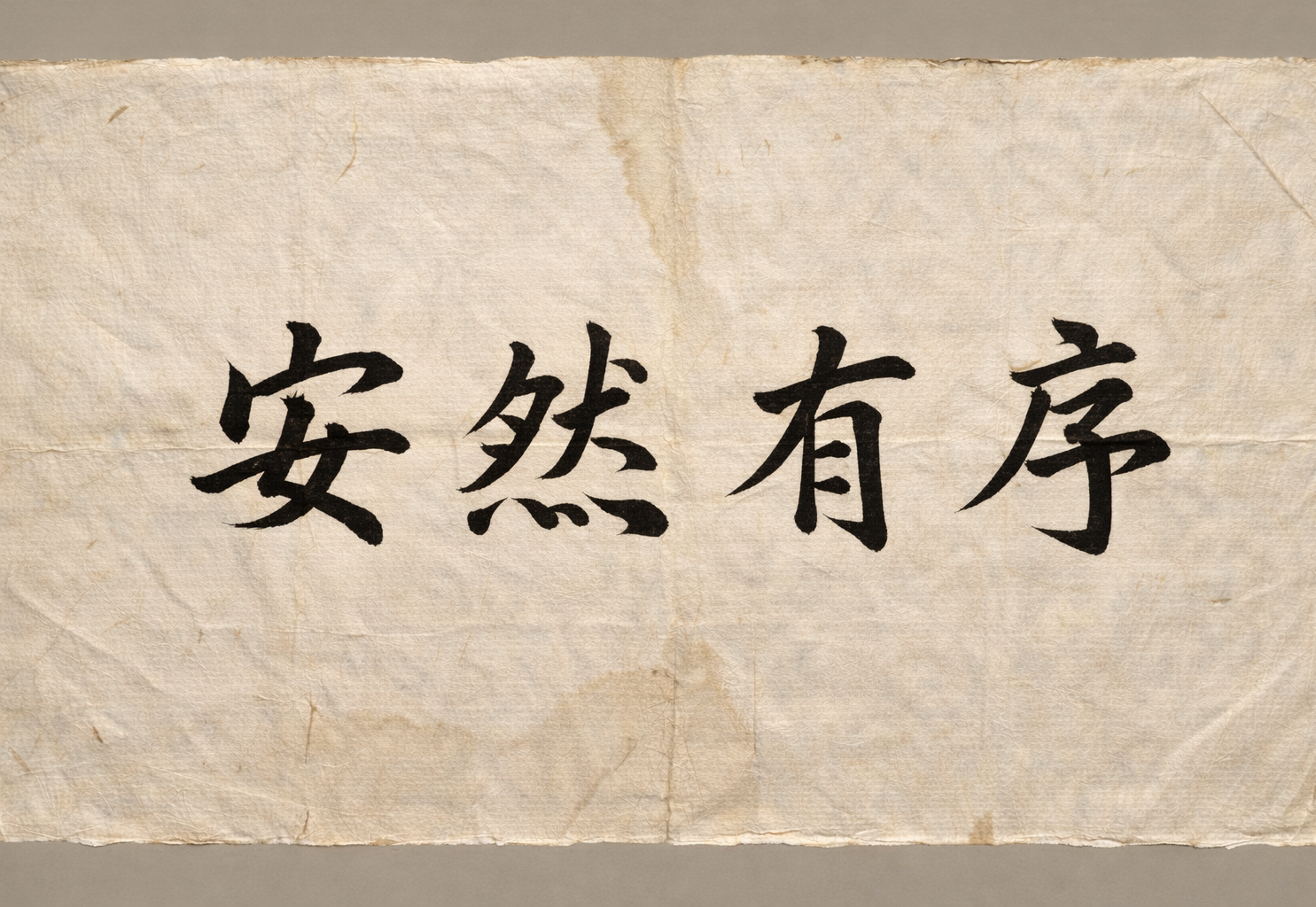
Image Healing: Mandala Stability Guidance 106
Please look at this mandala. Its central motif is a fixed golden geometric shape (representing your core self). Now, imagine the mandala's background color constantly shifting: from a tranquil blue (home), to a bustling red (shopping mall), and then to a somber gray (office). No matter how the background color flickers and dances, that golden center remains suspended there, clear, bright, and unaffected by the background. Take this golden center with you wherever you wish to go.
Traditional mandalas typically feature a harmonious and intricately varied circular structure, symbolizing the wholeness of the universe and the cycle of life. By viewing mandala images, individuals can perceive inner peace and strength, achieving psychological balance.
◉ Gaze at the mandala twice, while taking deep breaths.

Lesson 106: Cross-Scene Stability Practice (Drawing Guidance)
① Action guidance:Draw a stable center point to symbolize "no matter where I am, my core remains unchanged".
② Action guidance:Draw three concentric circles of different colors outwards, symbolizing different scenes, while maintaining steady breathing.
③ Action guidance:Write a reaffirmation phrase in the corner, such as "Different scenarios, but I remain calm," and write it three times to form a memory.
Please log in before submitting your drawings and feelings.
○ 106. Cross-Scenario Log Guidance Suggestions
① Which two scenarios differed the most for me? What did they each trigger?
② In which situation did I manage to remain somewhat stable today? What helped me?
③ Which anchor point (breathing/action/image) is most likely to draw me into a new scene?
④ In which specific scenario am I willing to try "migrating a little bit" tomorrow?
Please log in to use.
Cross-scene migration isn't about being perfect everywhere, but about taking a bit of stability and moving towards a bigger world.