

Lesson 362: How to identify your "emotional rhythm"?
Duration:70 minutes
Topic Introduction:Your emotional rhythm is the natural ebb and flow of your inner emotions throughout the day, week, or month. Understanding your emotional rhythm can help you develop strategies for living, reduce self-criticism, and be more compassionate about your state.
○ Three ways to perceive emotional rhythms
- Intraday volatility records:Observe your peaks and troughs throughout the day and note your thoughts and actions during those times.
- Emotional Mapping:Create an "emotional climate map" each week, using colors and symbols to represent different states.
- Monthly Cycle Tracking:Especially for marking emotional patterns during the premenstrual period, seasonal changes, and late stages of social fatigue.
▲ AI interaction: When do you often reach your “emotional lows”?
Your emotions are like rhythmic music, with ups and downs that are not without trace.
Take a few minutes to review your emotions this week and briefly write down the highs and lows.
Try to identify influencing factors, such as sleep, stress, or diet.
Share it with people you trust, they can help you become more aware.
When the rhythm is seen, you are better able to work with your emotions.
Click the button below to build your own "emotional rhythm calendar" with AI.
○ How to identify your "emotional rhythm"? · Music guide
The soundtrack to your week: morning music, work music, and ending music.
Spend 30 seconds in the morning and evening listening and scoring your emotional energy to make the rhythm visible.
Use music to remind you to “slow down” when there are sudden changes in speed, sleep, or social interaction.
Share your beat sheet with people you trust to get external syncing.
When you can hear the beat, you're better able to negotiate with your emotions.
○ Herbal Healing Tea
Recommended drinks:Citrus flower tea
Recommended reasons:It harmonizes your mood, refreshes your spirits, and helps you regain vitality when your rhythm is low.
usage:Take 2g each of orange blossom and honeysuckle, brew with hot water for 5 minutes, suitable for both morning and evening.
○ Oatmeal and Berry Porridge
Simmer oatmeal until soft, then add blueberries, strawberries, and a little honey. Rich in dietary fiber and polyphenols, this oatmeal is a great breakfast option that's filling and filling.
Healing Recipes
/home2/lzxwhemy/public_html/arttao_org/wp-content/uploads/cookbook/yan-mai-jiang-guo-zhou.html(Please confirm that the following has been uploaded: yan-mai-jiang-guo-zhou.html)
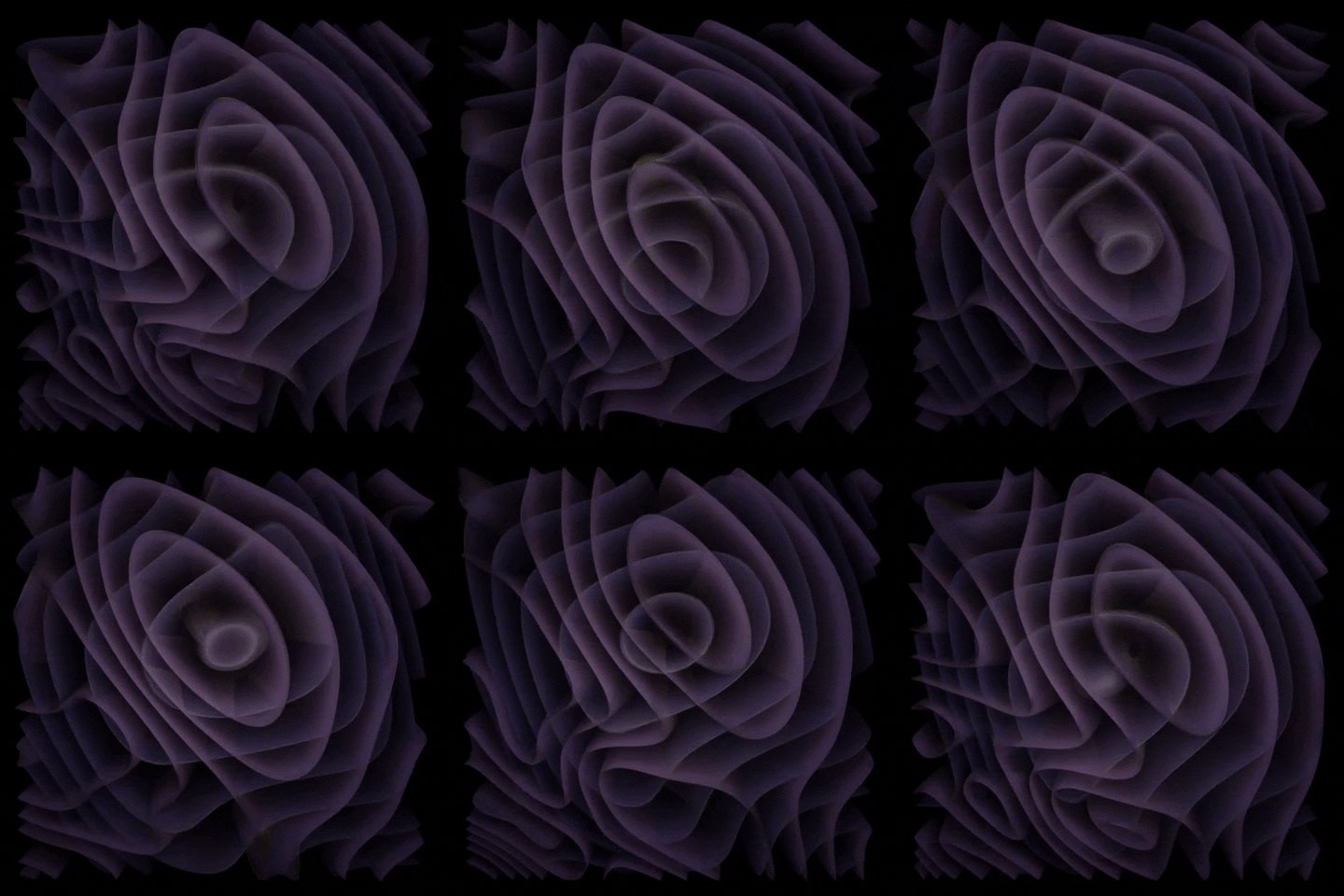
Mental Healing: Mental Mandala Meditation 07
Use golden hues to paint the halo of "compassion." It is gentle, yet it can melt away hard boundaries. Compassion is not pity, but understanding. Let the gold spread, and let yourself be enveloped in gentleness.
Compassion is the form of divinity in the heart.
Spiritual mandalas are commonly used in religious and spiritual practices, and their patterns and shapes symbolize spiritual growth, awakening, and spiritual connection. By drawing spiritual mandalas, individuals can explore their connection with the universe, divinity, or higher beings, and achieve psychological and spiritual healing.
○ Ancient Roman Script · Western Calligraphy Practice
Use writing exercises to help you recognize that emotional fluctuations are part of your natural rhythm, not a failure.
Suggested sentences for practice:
"My emotions have seasons — I'm learning their rhythm."
"I don't need to be constant to be whole."
Choose a sentence and practice writing it with light music and slow breathing to establish a "text anchor point" in the rhythm.
Lesson 362: How to identify your "emotional rhythm"?
Purpose: To help you become aware of the cyclical patterns of your own emotions, find the patterns of energy fluctuations, and thus deal with them in advance.
Steps: Draw a circular timeline, divided into morning, day, night, or seven days of the week. Use different hues to represent different emotional states: gray-blue for low mood, orange-yellow for high mood, and green for balance. Record your emotions over the past few days on the timeline; you will see a pattern of "rhythm" appearing. Drawing is a form of emotional self-monitoring.
Please log in before submitting your drawings and feelings.
○ 362. How to identify your "emotional rhythm"? Journaling guidance suggestions
① Create a weekly "Mood-Sleep-Activity" tracking chart, recording your mood and energy levels on a 0-10 scale in the morning and evening.
② Label the triggers: season, stress, caffeine, sleep changes, social rhythm changes, and find the three most relevant ones.
③ Identify precursor signals: speaking speed, impulsive spending, social withdrawal, slow thinking, and list each once.
④ Create an “early response card” for each type of precursor, list three steps, and stick it on your phone and desk.
⑤ Share your rhythm chart with trusted people to make reminders and support more timely.
⑥ Conclusion: Only by seeing the rhythm can we negotiate with it.
Please log in to use.
You are not unstable, you just have your own rhythm, and you are learning to dance with it.