

Lesson 1284: Diagnosis and Assessment of Disruptive Mood Disorders
Duration:75 minutes
Topic Introduction:This course introduces the diagnosis and assessment of Disruptive Mood Dysregulation Disorder (DMDD). Participants will learn how to identify the clinical manifestations of the disorder, use standardized assessment tools for diagnosis, and understand the different assessment dimensions of the disorder, including physiological, psychological, and social factors.
○ Diagnosis and assessment of disruptive mood disorders
- Clinical manifestations:Disruptive mood dysregulation disorder is characterized by severe emotional outbursts and frequent bouts of irritability and anger. Symptoms often interfere with daily life, school, or work and last for a long time (at least 12 months).
- Diagnostic criteria:When making a diagnosis, it is necessary to refer to the criteria of the Diagnostic and Statistical Manual of Mental Disorders, Fifth Edition (DSM-5) to confirm the degree and duration of mood swings and rule out other possible mental health disorders.
- Assessment Tools:The disorder is comprehensively judged using standardized scales and clinical interviews, combined with physiological assessments (such as anxiety levels, sleep quality, etc.) and psychological assessments (emotional control, impulse control, etc.).
▲ AI Interaction: How to Assess Disruptive Mood Disorders
The process of diagnosis and assessment is like a physical examination of a child's mind. It makes the problem clearer and helps parents get more appropriate guidance.
Please record the frequency, duration, and scope of your child's emotional outbursts over the past three months.
Write down the specific impacts these outbreaks have had on school learning, relationships, and family atmosphere.
Conclusion: Assessment is not a label, but the first step towards help and understanding.
Click the button below to discuss with AI how to assess disruptive mood disorders and learn diagnostic methods and their applications.
○ Diagnosis and Assessment of Disruptive Mood Disorders · Music Therapy
Evaluation is like tuning; the goal is to bring the parts back into harmony. Play a steady, constant-speed melody to accompany you as you complete the recording.
Write down the frequency, duration, and scope of impact of the outbreaks in the past three months, like marking strength and weakness on a score.
Record effective noise reduction methods, such as reducing light, sound, and attention. Compile a list of these "useful tracks" and submit it to a professional for reference.
Prepare three questions to ask: hypotheses about causes, training focus, and family cooperation. This will help focus the conversation.
Conclusion: Evaluation is not labeling, but tuning before ensemble.
🍵 Licorice and wolfberry tea
Recommended reasons:Licorice and Goji Berry Tea combines the nourishing properties of licorice with the tonic benefits of goji berries. Licorice helps balance the effects of other herbs and relieve stress, while goji berries boost immunity and aid in restorative energy.
usage:Place five goji berries and one teaspoon of liquorice in hot water and let it soak for 5-10 minutes before drinking. This drink can be taken once daily to relieve physical discomfort caused by stress and anxiety.
○ Turmeric honey warm water
This soothing, refreshing, and invigorating drink provides both hydration and antioxidant support, perfect for mornings, after exercise, or between shifts. It helps relax and awaken attention, restoring balance and vitality while minimizing stress.
Healing Recipes
/home2/lzxwhemy/public_html/arttao_org/wp-content/uploads/cookbook/jiang-huang-feng-mi-wen-shui.html(Please confirm that the following has been uploaded: jiang-huang-feng-mi-wen-shui.html)🎨 Psychological Mandala
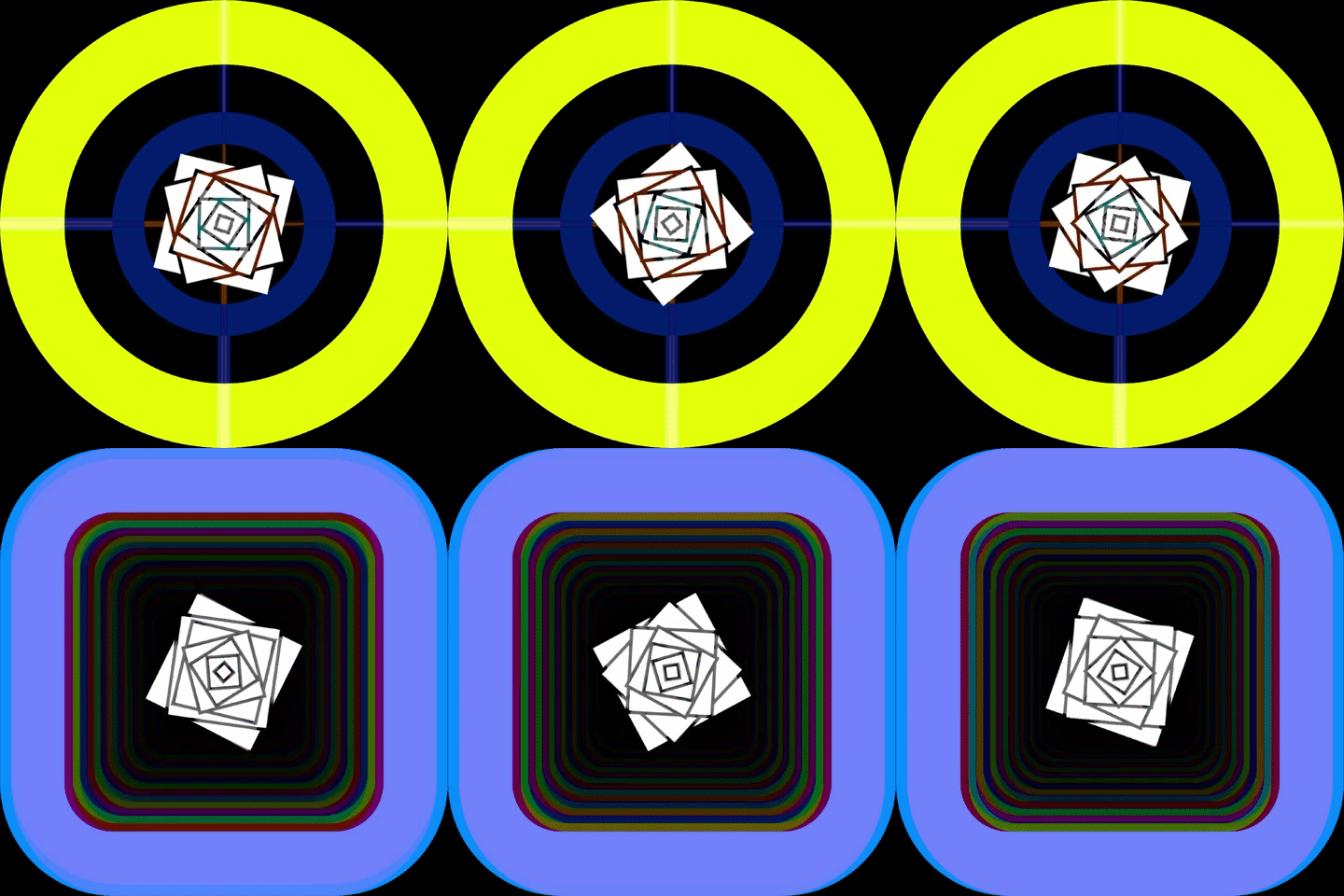
Psychological Healing: Psychological Mandala - Thoughts and Reflections 27
You always judge yourself by the standards of others, as if standing in the center of concentric circles of external gazes. Each gaze cuts through your heart, leaving tiny but lasting scars. Now, imagine those gazes retreating to the outermost circles, leaving only your own eyes in the center, slowly and earnestly looking at you once more.
Only by detaching yourself from the gaze of others can you truly see yourself. Please gaze at this image three times.
○ Chinese calligraphy – Running script
Running script lies somewhere between regular script and cursive script, boasting a fluid and dynamic structure, with continuous yet measured strokes. Its natural and unrestrained strokes, alternating between fast and slow, convey the writer's emotions and are well-suited for expressing inner thoughts. Practicing running script cultivates an inner sense of rhythm and emotional balance, helping the writer find peace of mind amidst the fluidity of the brushstrokes.
- Written words:
- Be observant and act calmly
- See Clearly into the Details, Respond with Composure
- Writing Tips:
- During diagnostic assessments, running script helps maintain a stable state of mind. When writing the phrase "clearly observing the smallest details and calmly handling affairs," the strokes should be clear and smooth, strengthening the ability to observe rationally and respond calmly.








○ Diagnosis and assessment of disruptive mood disorders: guidance and suggestions for painting therapy
This page uses the method of drawing therapy to externalize the diagnosis and assessment points of disruptive mood disorder (DMDD) into images. The core characteristics of DMDD areChronic irritability and frequent angry outbursts, it is necessary to combine the frequency, duration and functional impact of the attack to make an assessment. By drawing and recording, the pattern can be presented more clearly, providing assistance for self-observation and professional communication.
1. Outbreak Frequency Calendar
- Create a monthly calendar and color-code each angry outburst: mild = yellow, moderate = orange, severe = red.
- Count the number of times per week and visually see whether the frequency is ≥3 times/week.
- Write a reminder on your calendar: "Frequency Too High = Needs Attention."
2. Emotional Thermometer Curve
- Draw a curve on a scale of 0–10, with the vertical axis = anger intensity and the horizontal axis = time of day.
- Keep records for one week and see if it is often above 6.
- Write a reminder next to the curve: "High intensity = self-intervention required."
3. Functionality Affects Jigsaw Puzzles
- Draw a puzzle and divide it into four pieces: study/work, interpersonal relationships, family interactions, and self-perception.
- In each block, write the impact of the angry outburst (e.g., “classmates alienated,” “homework procrastination”).
- Draw a "patch" outside the puzzle and write down one step you'd like to improve (e.g., "Practice breathing every day").
Tip: While art therapy can help identify patterns in emotional outbursts, the diagnosis and assessment of DMDD still requires professional assistance. If anger is frequent and impacting academic performance, interpersonal relationships, or family life, please seek psychological or medical support promptly.
Please log in before submitting your drawings and feelings.
○ 1284. Diagnosis and Assessment of Disruptive Mood Disorders: Journal-Guided Suggestions
① Event Log: Record the frequency, intensity, recovery time, and consequences for four consecutive weeks to create a one-page "mood graph" for easy review.
② Functional impact: Write a specific example in each of the three areas of learning/peers/family. Avoid generalized terms to facilitate communication with professionals.
③ Past history: List pregnancy, development, major events, medication history and treatment history in timeline to complete key background information.
④ Effective strategy library: Record soothing actions and words that have been effective, mark applicable scenarios, and bring them for evaluation for optimization.
⑤ Three questions for the interview: Write down the three issues that you are most concerned about, such as "training focus", "family cooperation" and "school support".
⑥ Post-meeting plan: Confirm the next step and follow-up appointment time, and arrange a small reward for your child and yourself to help them persist.
⑦ Conclusion: Evaluation is about aligning rhythm, not labeling.
Please log in to use.
Through this course, you will be able to better understand the diagnosis and assessment of disruptive mood disorders, and learn how to regulate emotions through Eastern healing methods such as tea drinking, diet therapy, and calligraphy, helping yourself and others better manage emotional fluctuations.