

Lesson 1580: Prevention and Rebuilding Support Systems for Gambling Disorder
Duration:70 minutes
Topic Introduction:This course will summarize the recovery path for gambling disorder, helping participants develop effective prevention mechanisms, identify risks, and rebuild support systems. The course focuses on how to implement the comprehensive system of "relapse warning → support seeking → self-regulation → social connection" in daily life.
○ Relapse prevention core mechanism
- Early warning identification:Record high-risk situations and impulse triggers (such as loneliness, anxiety, and financial incentives).
- Default response:Create a five-minute interruption checklist + a contact priority list.
- Emotional care habits:Guide regular practices such as daily exercise, breathing, writing, and painting.
- Support system rebuild:Including AI companionship, interpersonal networks, family collaboration, mutual aid organizations, etc.
▲ AI interaction: Rebuilding your support system
Prevention and support are like guardrails that help you walk more steadily. They come from a regular life and real companionship.
Please write down three daily activities that help you stay away from gambling, such as exercise, art, or family time.
Make a list of someone who can support you and write down the kind words you want to say.
Think about how you would like to use these support resources when triggers arise.
Conclusion: When support is established, the road to recovery is no longer lonely.
Click the button below to draw your own "psychological support map" with AI to clarify the actions and help directions in each situation.
○ Gambling disorder prevention and reconstruction support system · Music therapy
Play a warm guitar song and remind yourself: prevention and support are like guardrails that can help you walk more steadily.
Write down three everyday things that help you stay away from gambling, such as exercise, art, or family time.
List one person who can support you and write down a sentence you would like to say to them. Let the melody support this connection.
Conclusion: When support is woven into a network, the road to recovery is no longer lonely.
○ Oriental healing tea
Recommended drinks:Tangerine Peel & Chrysanthemum Tea
Recommended reasons:It regulates Qi, relieves depression, clears the liver and improves eyesight. It is suitable for daily mood regulation during the prevention period and balances inner anxiety and distress.
usage:2g of dried tangerine peel and 2g of chrysanthemum, brew with hot water for 5 minutes, preferably drink it in the afternoon.
○ Japanese food therapy, stir-fried shrimp with miso (Ebi no Miso Itame)
After removing the fishy smell from the shrimp with ginger, stir-fry with miso and sake for a fresh and rich flavor that goes well with rice without being heavy. Shrimp's high-quality protein and trace elements can nourish the kidneys and strengthen yang, strengthening bones and muscles, making it ideal for recovery and protein supplementation on training days.
Healing Recipes
/home2/lzxwhemy/public_html/arttao_org/wp-content/uploads/cookbook/ebi-no-miso-itame.html(Please confirm that ebi-no-miso-itame.html has been uploaded)🎨 Freedom Mandala Healing
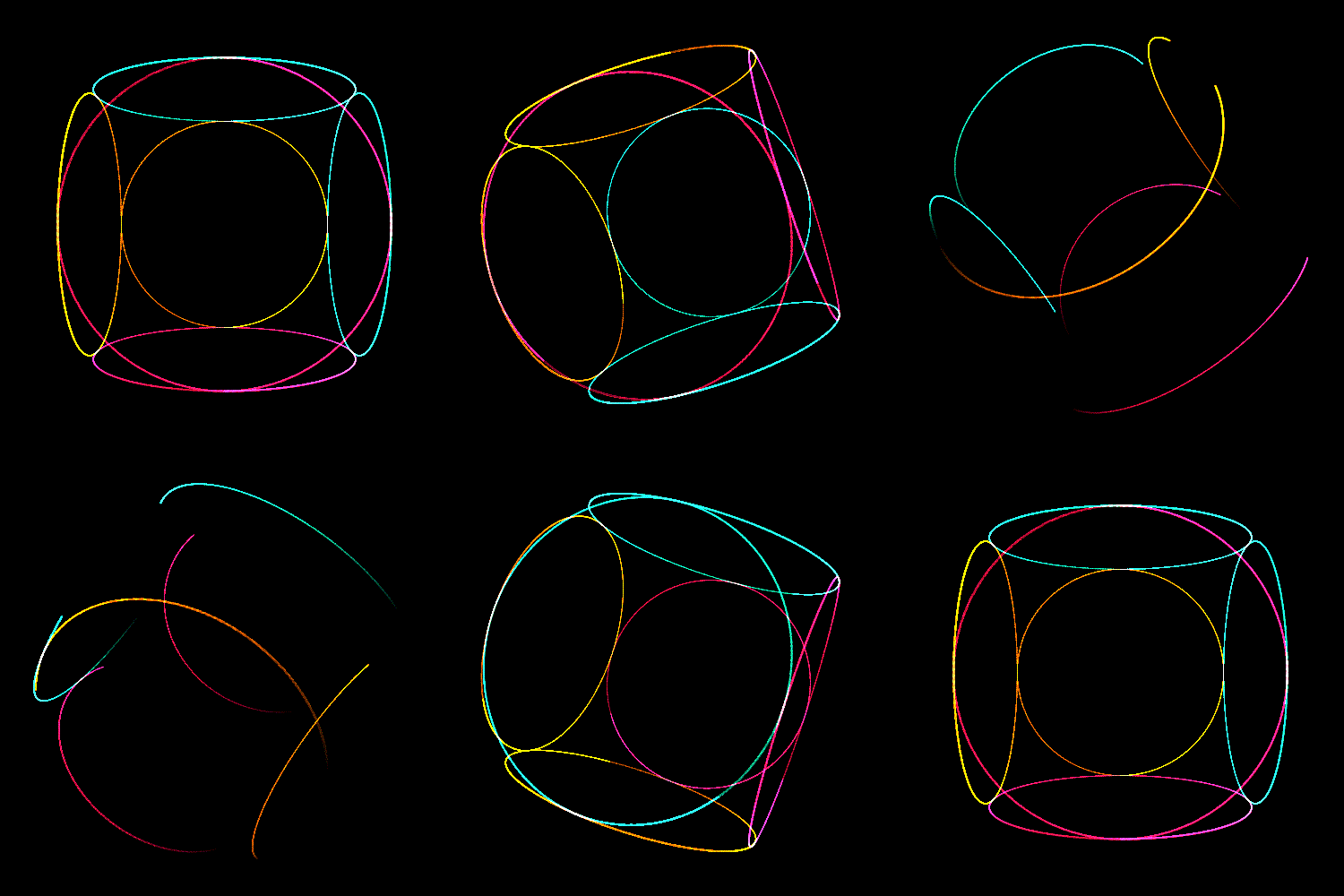
Free mandalas have no fixed form, allowing the artist to express themselves freely based on their emotions. There are no rules for drawing free mandalas, encouraging individuals to express their inner world, and they are often used to help with emotional release and self-awareness.
- Color mixing exercises: Break away from the black and white mindset and try mixing and matching colors and applying repeated layers.
- Random coloring: Practice "letting yourself go" by completing a mandala with your non-dominant hand without looking at the color code.
- Daily Color Mood Wheel: Use colors to indicate and record your daily mood swings.
○ Suggestions for seal carving calligraphy practice
The goal of this course is to help you, through focused, meticulous carving, enhance your sense of self-control and emotional regulation, assist in preventing gambling disorders and rebuilding your support system, and cultivate lasting self-discipline and inner stability. Depending on your needs, you can try the following:
- Introduction to the characteristics of seal carving:
Seal carving emphasizes steady knife skills and harmonious composition, emphasizing rhythm and patience during the carving process. In the development of prevention and support systems for gambling disorders, seal carving training can help strengthen endurance, cultivate a healthy rhythm of life, help individuals establish stable values and healthy living habits, and enhance confidence in long-term gambling abstinence. - Written words:
Longevity of Gold and Stone
Longevity like Gold and Stone - Psychological Intention:
The prevention and support of gambling disorder requires long-term commitment and patience. When writing "Longevity in Gold and Stone," the carving process reinforces the imagery of **perseverance and enduring self-discipline**, helping individuals maintain faith and patience as they rebuild their life support systems and reduce their reliance on short-term stimulation. - Knife skills:
During the carving process, maintain an even rhythm, steady blade movement, and focus on the harmony and thickness between lines. Through carving, you can train your willpower and ability to persist in your work, and enhance your ability to resist temptation and maintain a healthy lifestyle. - Emotional transformation:
Transform the anxiety and short-term gratification impulse in the risk of relapse into **calm and meticulous carving movements**, experience the inner rhythm and sense of control, strengthen the confidence in quitting gambling, and consolidate the psychological construction of a long-term support system.

○ Prevention and reconstruction support system for gambling disorder: guidance and suggestions for painting therapy
This page focuses onHow to prevent relapse, build a support system, and rebuild order in your lifeDrawing externalizes risk warnings, healthy alternatives, support networks, and future visions to help maintain recovery and growth. Drawing is intended only as a psychological aid and does not replace medical, legal, or professional intervention.
1. Warning signal ladder (green-yellow-red)
- Draw three steps: green = stable period (regular life, no gambling thoughts), yellow = alert period (increased craving, attention to gambling information), red = dangerous period (frequent fantasies, planned bets).
- Write the correspondingAction Script: Green = maintain daily habits, Yellow = immediately divert attention/contact friends, Red = activate emergency plan (seek professional help, cut off funding).
- Draw an “exit door” next to the stairs to symbolize the option of leaving the risky environment.
2. Support Network Diagram (Family - Peers - Professional - Community)
- Write "I" in the center of the paper and draw four circles outwards: ① Family (accompaniment, understanding, supervision), ② Peers (no gambling activities, mutual aid groups), ③ Professionals (doctors, psychologists, social workers), ④ Community resources (interest classes, sports groups, volunteer activities).
- Write down a “useful sentence” at each node, such as “Please take a walk with me,” “I need to listen,” and “Remind me to stick to the plan.”
- The outer circle is marked "Emergency Contact Card" with a phone number or address so it can be used at any time.
3. Life Reconstruction Grid (Economy - Emotion - Relationship - Value)
- Draw four boxes: ① Economy (financial planning, gradual repayment), ② Emotion (relaxation practice, journal writing), ③ Relationship (sincere communication, rebuilding trust), ④ Value (setting goals, engaging in meaningful activities).
- At the bottom of each box, write “1% Micro-Steps,” such as “Record expenses every day,” “Breathe for 5 minutes every night,” “Communicate with family every week,” and “Write down your vision for the future.”
- The squares can be colored to indicate progress towards completion: light = preliminary, dark = stable.
4. Review and Vision (Three Lines)
Please write in the margin of your work:
- The stage I most often appear in the "Warning Ladder" is: ______; the corresponding action script is: ______
- In the Support Network Diagram, the person/resource I would most like to proactively contact is: ______; My one-sentence request is: ______
- In the "Life Reconstruction Grid," the 1% micro-steps I need to complete today are: ______; my physical evaluation score after completion (0-10): ______
Tip: Prevention and recovery are long-term processes. Drawing and recording can help you stay sane and motivated. If you experience serious debt, impulsive behavior, or risk of self-harm, seek professional help or emergency resources immediately.
Please log in before submitting your drawings and feelings.
○ 1580. Prevention and Reconstruction Support System: Log-Guided Recommendations
① Support Map: Draw your circle of support (family/friends/professionals/groups), and write down the specific help they can provide and the contact information for each.
② Life rhythm: fix the four anchor points of getting up, eating, exercising, and leisure; stabilize the rhythm first, then talk about desire management.
③ Financial Repair: Set up automatic transfers, daily limits, and joint accounts. Write down one step you can take today.
④ Relapse plan: If you stumble, the 72-hour process is: seek help → rest and rehydrate → review trigger → restart the goal; stick it on a note.
⑤ Relationship repair: Spend non-issue-based time together once a week to rebuild connections instead of revolving around issues.
⑥ Rituals and Rewards: Create shared rituals for small progress so that hope can be seen and sustained.
⑦ Conclusion: The denser the web, the safer you are from falling; you don’t have to walk alone.
Please log in to use.
True recovery is not about being strong alone, but about continuous connection, care, and choices. You deserve a stable and gentle support system.