

Lesson 144: Methods to Interrupt Catastrophic Thinking
Duration:70 minutes
Topic Introduction:
Catastrophic thinking is the most common and persistent thought pattern of anxiety:
“"What if something goes wrong?"”
“"What if I can't control it?"”
“"It will definitely get worse."”
These thoughts are not facts, but rather "dangerous scenarios" pre-programmed by the brain to protect you.
This lesson will teach you how to effectively "interrupt" catastrophic imaginations and bring your mind back to reality.
Catastrophic thinking does not represent real danger.
- It is a "future projection," not a current fact:The brain anticipates the worst-case scenario to protect you.
- The more anxious you are, the more you amplify your imagination:When the body is tense, the brain may mistakenly perceive that danger is closer.
- This can be weakened by interrupting training:Mindset is not destiny; it can be reshaped.
Lesson 144: Methods to Interrupt Catastrophic Thinking (Click to listen to the reading, view the content)
Catastrophic thinking isn't rational analysis; it's an automatic chain of worst-case scenarios unfolding in a state of heightened arousal. An unpleasant signal is quickly extrapolated to an irreversible outcome, causing the brain to accelerate, constantly gathering evidence to try and avert danger. The key to interrupting catastrophic thinking isn't refuting the content, but rather disrupting the process. The first step is recognizing its rhythm: once you notice your thoughts jumping around, amplifying conclusions, and accelerating, you've found the interruption point. The second step is switching channels, shifting attention from verbal deductions back to sensory facts—what I see, what I touch, what I hear. The third step is narrowing the time unit, replacing the question "What will happen next?" with "What can I do this minute?" When the brain is forced back to the present, the catastrophic chain loses its fuel. Interruption isn't suppression, but a pause; you allow the thought to exist but no longer provide it with a continuous picture. As you repeatedly practice interrupting the process early, the brain gradually lowers the priority of this path. You'll find that catastrophic thinking is no longer like a flood but more like occasional noise, and you have the ability to press the pause button at any time.
▲ AI Interaction: In which scenario do you most often have catastrophic thinking?
Tell me your worst-case scenario prediction.
I will work with you to decipher this prophecy and see if it is truly inevitable.
We can find out together: feeling dangerous ≠ actually being dangerous.
You can learn to stop your thoughts halfway through, instead of letting them keep rolling down the road.
When your thoughts start to "head toward the worst version," music can be your metronome.
Slowing down your body gives your brain a chance to stop its accelerating predictive machine.
○ Eastern Healing Tea: Tangerine Peel Pu-erh
Recommended reasons:The aroma of dried tangerine peel can help stabilize breathing, while the mellowness of Pu-erh tea can reduce the feeling of "losing control."
practice:Brew with 90℃ hot water and let the aroma guide your attention back to the present moment.
○ Stable Dietary Therapy: Yam and Pumpkin Puree (ID144)
When catastrophic thoughts repeatedly raise alert levels, the body often experiences internal depletion and digestive tension, requiring gentle yet supportive nourishment. The delicate texture of yam and the natural sweetness of pumpkin provide stable, non-stimulating energy. This smooth puree is suitable for consumption after emotional turmoil; its authentic taste and temperature help the body return to a manageable rhythm, providing physiological support for the interruption of thought.
Back to the present
Lowering vigilance
Open Recipe
◉ Dietary therapy: Yam and pumpkin puree
Yam strengthens the spleen and stomach, nourishes the lungs and replenishes qi; its texture is delicate and easy to digest. Pumpkin is sweet and mild, rich in beta-carotene and dietary fiber, which helps replenish energy without being too greasy. Both can be steamed and mashed into a smooth puree, which can be served as a side dish for main meals, or as a small bowl of nutritional supplement for people who are recovering from physical exhaustion, have a weak appetite, or have a heavy chewing burden.
Strengthens the spleen and stomach Warming and nourishing Easily digested and absorbed
I. Recommended Dietary Therapy and Reasons
Recommended dishes:Yam and Pumpkin Puree (ID 41)
Recommended reasons:It has a soft and delicate texture, low fat content but a certain feeling of fullness, making it suitable for people with weak spleen and stomach, those recovering from surgery or illness, the elderly, and those whose digestive function has declined due to stress. It can be used as a mild alternative to staple food or side dish.
2. Recipe and Method
Recipe (1–2 servings):
- Yam (peeled) 120–150 g
- Pumpkin (peeled and seeded) 120–150 g
- 20–40 ml of warm water or milk/unsweetened soy milk (optional, to adjust consistency)
- Add a pinch of salt or a small amount of honey (choose one according to your taste, either salty or slightly sweet).
- A small amount of olive oil or 3–5 g of unsalted butter (optional, to improve smoothness)
practice:
- When peeling yams, wear gloves or work in a water bath to avoid skin irritation, and cut them into small pieces; peel and deseed the pumpkin, then cut it into pieces.
- Place the yam chunks and pumpkin chunks in a steamer or heat-resistant bowl, and steam for 15–20 minutes, or until they can be easily pierced with chopsticks.
- While still hot, put the steamed yam and pumpkin into a large bowl or a food processor, and mash them with the back of a spoon or blend them into a smooth puree.
- Add small amounts of warm water, milk, or unsweetened soy milk slowly as needed, adjusting to your preferred consistency.
- Seasoning: For a savory flavor, add a pinch of salt and a few drops of olive oil; for a sweeter flavor, add a small amount of honey after it has cooled slightly, stir well and it is ready to eat.
- Place it in a small bowl and use the back of a spoon to gently flatten the surface to create a smooth and soft texture.
3. Small rituals for body and mind
During the steaming or cooking process, adjust the heat to a stable medium-low temperature, allow yourself to briefly leave the highly stimulating environment, refrain from using your phone or working, and simply tidy up the countertop or look out the window.
When eating yam and pumpkin puree, you can deliberately slow down the speed of the spoon's movement, allowing each bite to linger in your mouth a little longer, to savor the delicate texture and subtle sweetness, reminding yourself that "you can eat slower and live slower."
After finishing your meal, give yourself a minute of quiet time to feel your stomach change from cold to warm, and treat this delicate mud as a gentle care for your spleen and stomach.
4. Dietary Therapy Experience Record
- Record the time of consumption (breakfast/dinner/snack) and the level of hunger at that time.
- Observe the feeling of fullness and stomach comfort 1–2 hours after consumption, as well as whether there is significant bloating or discomfort.
- If you replace some fried or heavily seasoned staple foods with yam and pumpkin puree for several consecutive days, you can record changes in physical recovery, bowel movements, and stomach sensations before bedtime.
V. Instructional Videos (approximately 4–7 minutes)
◉ Video Title:Yam and Pumpkin Puree: A Stomach-Friendly, Delicate Energy Bowl
6. Precautions
- Both yam and pumpkin contain a certain amount of carbohydrates. Those who need to strictly control their sugar intake should make overall arrangements according to their individual total amount of staple food.
- This recipe is not suitable for people who are allergic to yam or pumpkin. If you experience any discomfort such as itchy throat or rash, stop eating it immediately and consult a doctor.
- If you have weak digestive function or have recently experienced bloating, you can reduce the amount you eat at one time and observe your body's reaction before adjusting the frequency.
hint:This recipe is suitable as part of daily spleen and stomach health maintenance and cannot replace formal medical treatment. If you experience persistent and significant indigestion, sudden weight loss, or persistent fatigue, please seek medical attention promptly.
○ Humanist Script from the Italian Renaissance Period · Lesson 144 Writing Exercises
Today's healing phrase:
virtue nourishes life
In-depth analysis:
Catastrophic thinking often stems from a misunderstanding of the need to "take control of everything immediately."
The proportions and order in the Humanist Script help you shift your focus from accelerated deduction back to steady-state structures.
virtue nourishes life A reminder that sustained kindness and patience nourish life more than immediate conclusions.
When writing returns to order, the natural slowing of thought leads to interruptions.
Writing Skills (Advanced Version):
- Writing in lines:A sentence is broken into two lines to interrupt the chain of events.
- Balanced kerning:Avoiding visual clutter slows down thinking.
- Clear beginning and end of strokes:Establish a rhythm that can be paused.
- Medium speed writing:We prioritize stability over smoothness.
- Repeat the entire sentence:Reduce the priority of disaster paths.
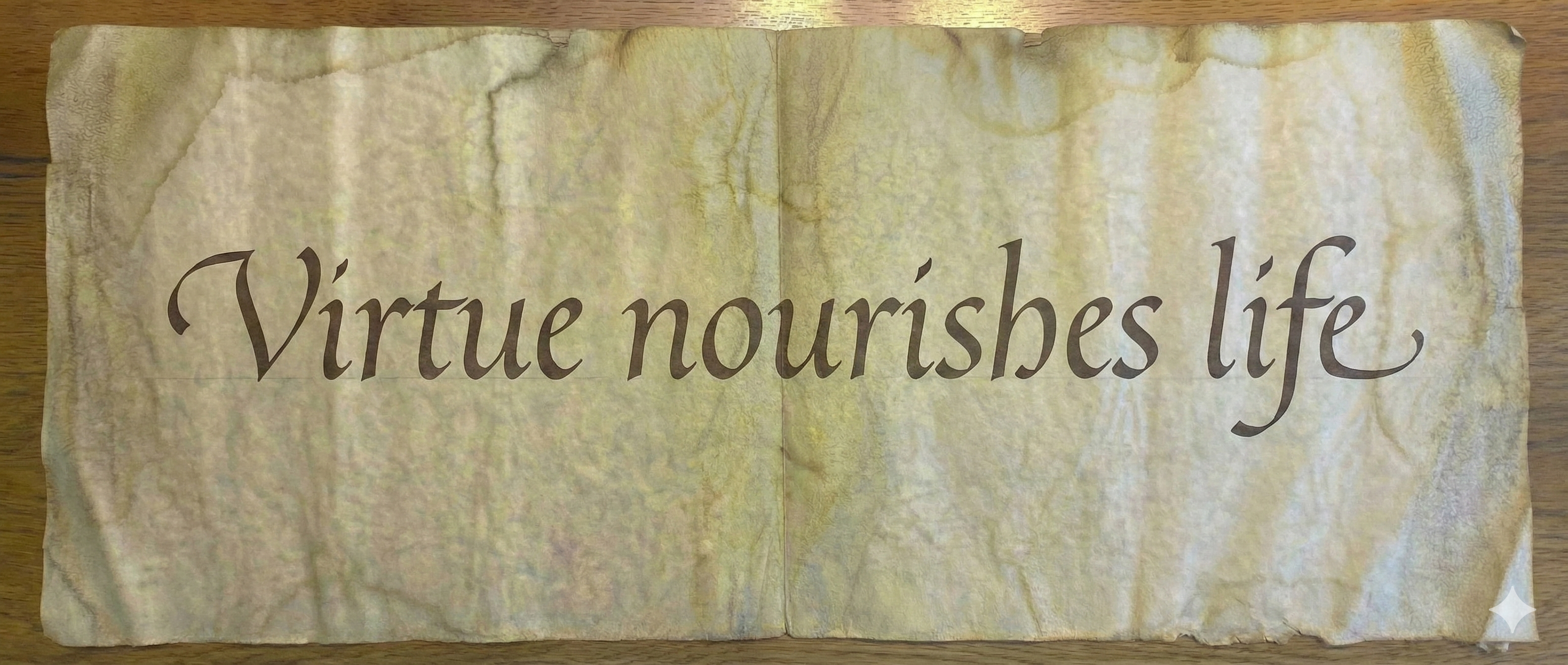
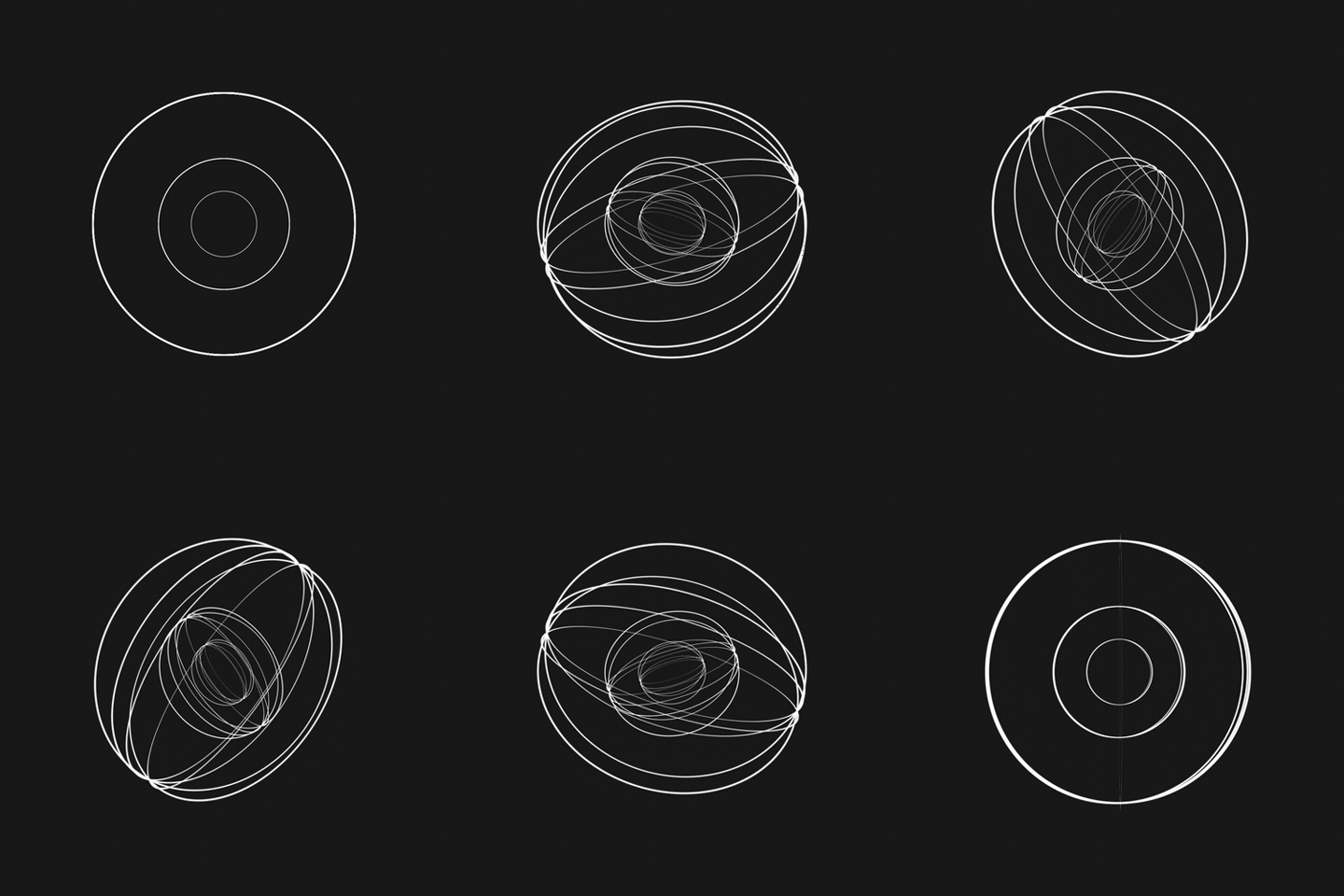
Image Healing: Guided Mandala Viewing - Lesson 144
Please observe a mandala with clearly segmented rhythms. The image is composed of multiple recognizable units rather than progressing as a single unit.
Let your gaze linger on one unit for a moment before moving on to the next, deliberately avoiding continuous scanning.
When you notice your thoughts starting to race, bring your gaze back to the nearest unit and take a "pause".
Mandalas are not about drawing something, but about observing. When vision is fragmented and disastrously continuous, it will naturally be interrupted.
The mandala in this lesson, with its "segmented structure and stable spacing," symbolizes a successful interruption of thought.
◉ One gaze is sufficient; no repetition is required.
Lesson 144: Guided Drawing - Disruption Disaster Scenario
① Draw a stable dot in the center of the paper to symbolize "the present moment".
② Draw radiating lines around the perimeter, symbolizing various future scenarios, but do not connect them to the center.
③ Encircle the center with a thick line to symbolize "I can avoid being pulled away by the future".
Please log in before submitting your drawings and feelings.
○ 144. Disrupting Catastrophic Thinking: Log-Guided Suggestions
① What is the worst-case scenario predicted today?
② What evidence supports this prediction? What are the speculative arguments?
③ If we don't consider the worst-case scenario, what other possibilities are there? List 2.
④ Write down a "stop phrase" that you can use immediately: such as "Stop for a moment, I'm here."“
Please log in to use.
Catastrophic thinking is an automatic reaction to anxiety, not a part of your personality. When you learn to stop it, you can pull your life back from the imagination to reality.
An interruption is an opportunity for self-salvation.