

Lesson 221: Practice when faced with "temporarily unreachable" situations
Duration:70 minutes
Topic Introduction:When the other person is temporarily unreachable, unable to respond promptly, or even shows no signal at all, the brain of an anxious attachment person often instantly enters "danger mode." You may start to associate, worry, speculate, and feel anxious. This lesson will use tiered exercises to teach you how to remain stable in a state of waiting and no response, shifting from "I've been abandoned" to "I'm still here and safe."
Why does being "unable to be contacted" cause such intense anxiety?
- The brain automatically associates worst-case scenarios:The idea that no contact equals a threatened relationship is a false alarm stemming from old attachment patterns.
- Attention was completely drawn to the other person:The more you care, the harder it is to bear the "blank".
- Triggered by past experiences:What was once ignored, disappeared, or neglected will be magnified in the present.
Lesson 221: Practice for when you can't contact someone temporarily; click to listen to the reading and view the content.
Many people's anxiety when faced with temporary loss of contact stems not from the reality itself, but from automatic imaginings of loss of control and abandonment. When messages go unanswered and calls fail to connect, the brain quickly fills in the worst possible interpretations, and the body goes into alert mode. The goal of this exercise is not to force yourself to calm down, but to allow the nervous system to relearn that temporary loss of contact does not equate to a broken relationship. The first step is to distinguish between reality and imagination. The reality is that there is no response at this moment; the imagination is inference about cause and effect. The second key is to recognize physical reactions, such as a rapid heartbeat, chest tightness, or the urge to constantly check devices—these are signals that the attachment system is being triggered, not evidence of danger. The third stage is to set a limited waiting framework, such as giving yourself a clear time window during which you don't repeatedly check, letting the system know that the waiting has boundaries. The fourth key point is to shift attention from monitoring others back to yourself, maintaining a continuous sense of self through standing breathing, writing, or completing a specific action. The fifth stage is post-event integration. When contact is restored, reflect on how you spent the wait instead of just focusing on why the other person didn't respond. The sixth key is to gradually extend the duration. Practice gradually, starting with a few minutes and progressing to longer periods, allowing the body to accumulate experience of what you can handle. It's important to understand that true security isn't about being always accessible, but about being able to stand firm even when you can't. Each time you complete this exercise, you weaken catastrophic associations and strengthen inner stability. When you stop viewing temporary absences as threats, trust in relationships naturally grows, and you regain your tolerance for time and uncertainty.
▲ AI Interaction: Are you waiting for a message, or a feeling of affirmation?
What truly causes you pain is the inability to contact someone.
It's often not that they "didn't reply to the message,"
Rather, it's that little voice inside your heart:
“Am I no longer important?”
This is not your fault, this is your wound.
When you can find peace in waiting
You will find that your value does not depend on anyone's immediate response.
Click the button below to practice "self-stabilization methods when unable to contact" with AI.
Play some music that slows down your breathing.
Shift your focus from "gripping your phone" to "holding your breath".
You'll find that as long as your body stays stable, the information gap isn't so terrible.
○ Eastern Healing Tea: Lily and Lotus Seed Tea
Recommended drinks:Lily and lotus seed tea
Recommended reasons:It calms the nerves, relieves anxiety, and soothes the mind, and is very effective for "anxiety and chest tightness while waiting".
practice:Take a small handful each of lotus seeds and lily bulbs, and steep them in hot water for 10 minutes.
○ Stable Dietary Therapy: Ancient Roman Puls Barley Porridge (ID221)
During periods of waiting and uncertainty, the body needs steady and gradual nourishment. Whole wheat porridge provides sustained and stable energy, symbolizing being firmly supported during these quiet moments. This nourishing dish is suitable to consume after completing a period of waiting to help the body return to a grounded rhythm.
Waiting for tolerance
Intrinsic stability
Open Recipe
◉ Roman Dietary Therapy: Roman-Style Barley Porridge (Puls – Barley Porridge) (ID 221)
In ancient Rome,Puls It is the staple food of soldiers, farmers, and philosophers. It doesn't seek to stimulate the taste buds, but rather emphasizes "stable energy supply" and "soothing the stomach." When prolonged anxiety and excessive thinking cause an upset appetite, bloating, and weakness, this bowl of slowly simmered barley porridge can help the body return to its rhythm. It symbolizes simplicity, continuity, and inner order; it is a calming food that doesn't create fluctuations.
Strengthens the spleen and stomach Stabilize blood sugar Restore physical strength
I. Recommended Dietary Therapy and Reasons
Recommended dishes:Roman-style barley porridge (Puls – Barley Porridge)
Recommended reasons:
1. The "buffer" of the digestive system:Barley is rich in beta-glucan, which can form a gentle protective layer in the intestines, reducing stomach irritation caused by stress, fasting, caffeine, or irregular eating.
2. The basic fuel for emotional stability:Whole wheat releases energy slowly, preventing large fluctuations in blood sugar, making it suitable for anxious people to avoid feeling even more anxious after eating.
3. Classical Philosophy of Simple Eating:The Romans believed that a simple, repetitive, and stable diet could keep the mind clear, which is highly consistent with the modern principle of "reducing stimulation and restoring the nervous system's sense of security."
2. Recipe and Method
Recipe (1–2 servings):
- 50g of hulled barley
- 1000ml of clean water
- 1 teaspoon olive oil (traditional Roman fat)
- A small amount of salt
- (Optional) A little chopped onion
- (Optional) Herbs: a small amount of bay leaf or thyme
practice:
- soak:Soaking barley in cold water for 6–8 hours beforehand can significantly shorten cooking time and reduce the burden on the stomach and intestines.
- Basic cooking:Add water to a pot, add the soaked barley, bring to a boil over high heat, then reduce to low heat and simmer for 40–50 minutes.
- Harmonize the flavor:Once the wheat grains have cracked and the broth has thickened slightly, add a small amount of salt and olive oil, and stir well.
- Ancient Roman style (optional):Add a small amount of chopped onion or herbs and cook for another 5 minutes.
3. Small rituals for body and mind
Slow eating practice:Don't rush to finish your food. Every bite is a reminder to your body: there's no need to speed things up or be on guard right now.
Rhythmic visualization:Imagine the whole wheat grains inside your body as a solid foundation, allowing your breathing to deepen, your heart rate to slow, and your thoughts to settle naturally.
4. Dietary Therapy Experience Record
- Record whether the stomach feels more comfortable and less bloated after eating.
- Observe whether your energy levels are more stable in the morning or afternoon.
- Pay attention to whether bowel movements become regular and smooth.
V. Instructional Videos (approximately 3–5 minutes)
◉ Video Title:A bowl of ancient Roman porridge teaches you what "stable energy" means.“
6. Precautions
- Gluten warning:Barley contains gluten, so people with celiac disease or gluten intolerance should avoid it.
- For those with weak digestive systems:Be sure to soak and cook thoroughly until soft, otherwise it may cause bloating.
- Not seeking intense flavors:This is a "restorative" food, and it is not recommended to add a lot of spices or meat.
hint:If you need a stronger feeling of fullness, add a small amount of olive oil before serving, instead of increasing the amount.
○ Seal Carving Practice Suggestions - Lesson 221: Practice When Faced with "Temporarily Unable to Contact"
The seal carving exercises in this lesson aim to help you distinguish between "feelings" and "facts." Through controlled, slow, and repetitive carving movements, you can reduce false alarms in your brain and rebuild your ability to judge the safety of reality.
- Introduction to the characteristics of seal carving:
Seal carving emphasizes clear judgment and stable execution. Every stroke must be made only after confirming the position. This process helps train the brain's ability to "observe first and then act". - Written words:
The meeting place is not far away - Psychological Intention:
Anxiety often leads people to mistake physical reactions for danger signals. Writing "feelings are not facts" is a repeated reminder to the brain that discomfort is not the same as a real threat. - Knife skills:
The brief pause before each strike to confirm the direction and force symbolizes observing rather than reacting immediately when anxiety arises. - Emotional transformation:
Transform the fear of bodily sensations into a judgment of the actual direction of the lines, thus weakening catastrophic associations.
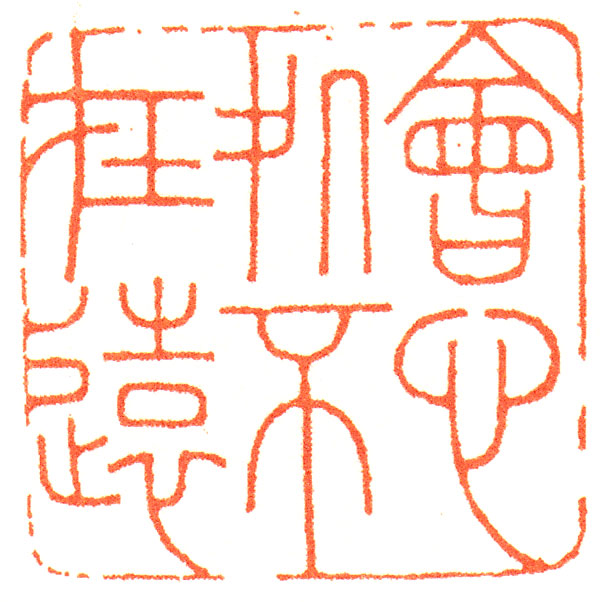
Image Healing: Guided Mandala Viewing - Lesson 221
Choose a mandala with clear segments and a stable center.
Let your gaze pass over each blank space in turn.
Feel the emptiness being supported rather than filled.
Mandala is not about drawing something, but about observing what you are doing and practicing being present while waiting.
The theme of this lesson's mandala is a ring of emptiness, symbolizing stability within a time gap.
◉ One gaze is sufficient; no repetition is required.

Lesson 221: My "Waiting for Stabilization Practice" Image
Objective: To visualize the "anxiety cycle when unable to contact" and establish a new, stable path.
Steps: Draw two circles: write "Reaction while waiting" on the left and "State when stable" on the right. Write down your typical behavior in the left circle (repeatedly checking your phone, making mental associations, feeling uneasy); write down your desired feelings in the right circle (relaxation, stability, breathing, peace of mind). Finally, draw a gentle bridge to symbolize your learning journey from the left circle to the right.
Please log in before submitting your drawings and feelings.
○ 221. Suggestions for stable log guidance when unable to contact the user
① At what moment today did you experience being "unable to contact"?
② What are your current physical reactions? (Chest tightness, heart racing, hands hot)
③ What comforting actions did you take? (Breathing, writing, drinking tea)
④ Are you able to pull your attention away from your phone and back to your body? How does it go?
⑤ Record a "stabilizing phrase" that resonates with you.
⑥ In which scenario will you practice "reducing the number of checks" tomorrow? What are the criteria for success?
Please log in to use.
Being unable to contact someone doesn't mean you've been abandoned. The more you can stay grounded in the silence, the less your relationships will be swayed by anxiety.