

Lesson 966: Advanced Exercises in Grounding Techniques
Duration:75 minutes
Topic Introduction (Overview):
During the peak of acute stress, you may have already learned some basic grounding techniques: counting the objects in front of you, feeling the contact between your feet and the ground, and using your breath to bring yourself back to the here and now. However, when the aftershocks of shock linger, triggers multiply, and emotions become more complex, simple grounding alone is often insufficient. This course will guide you into "advanced grounding" exercises: not only returning to the present moment, but also learning to adjust the intensity of fluctuations, choose anchor points, and establish your own stable rituals. We will start with the five senses, turning sight, hearing, touch, taste, and smell into pathways to "returning to the ground," allowing you to find an inner floor to stand on even in more complex situations.
The key to advanced grounding isn't pursuing "complete stillness," but rather maintaining a degree of awareness and autonomy amidst movement. You'll learn how to prepare different grounding solutions for different scenarios: indoors, in public spaces, at night, and when alone, what anchor points are available for each. Through repeated practice, you'll gradually experience that even if memories and triggers remain, you can repeatedly return to the here and now. Mandala drawing isn't about creating something, but about observation—observing the tangible details of the present moment, observing the weight under your feet, the support of the chair, the temperature of the air, allowing the feeling of being "washed away" to slowly develop boundaries and a foundation.
▲ AI Interaction: Design Your Own "Personalized Ground-Based Solution"“
Think back to the last time you felt like you were being swept away by emotions or memories: Where were you then? What was around you? Did you try to bring yourself back to the present moment?
Write down three readily available physical resources in your environment, such as a chair, a wall, a fixed object, or a calming self-talk.
AI will help you combine these resources into a simple and actionable "grounding process," so that you have something to use when an impact comes, instead of just passively enduring it.
Click the button below to help AI organize your advanced in-person practice worksheets.
○ Ground-based rhythmic therapy and music therapy
Choose a piece of music with a stable rhythm and clear but not overly intense drumbeats, and use it as a "grounded background sound".
While listening to the music, slowly do three things: feel the weight under your feet, touch a specific object around you (such as the edge of a table or the back of a chair), and softly read the time and place in your mind: "It is now..., I am...".
Let the rhythm of music become a bridge between you and reality: every beat reminds you, "I am here, I am not just a memory, I also have the present to rely on."
With repeated practice, you'll find it easier to return from emotional turmoil to the space and physical sensations around you.
🍵 Chinese Black Tea: Bring your attention back to your mouth and chest
Recommended drinks:Lapsang Souchong.
In grounded, advanced practice, Chinese black tea can serve as an "anchor point for taste and temperature." The woody aroma and slight smokiness of Lapsang Souchong naturally draw attention back to the mouth, throat, and chest, helping you return from out-of-control images or thoughts to the true sensations within your body. The warm tea glides down your throat like a clear path, slowly guiding you back from a detached state to your body.
usage:Take 3 grams of Lapsang Souchong, brew with hot water at 85–90℃, smell the aroma three times, observe the tea color for three seconds, and then sip it slowly. With each sip, silently say, "This is the taste of this time and place." Let black tea become one of your everyday rituals.
○ Chinese Food Therapy: Pumpkin, Millet, and Rehmannia Porridge
Pumpkin, with its soft texture and warm color, and millet, which strengthens the spleen and calms the nerves, make a perfect pumpkin and millet porridge for those experiencing a significant "sense of emptiness" after stress. The warm porridge, entering the stomach, creates an "inner support" within the body, helping you feel that "your body itself is the ground" rather than relying solely on external objects when practicing grounding exercises. This type of porridge is especially suitable as a calming meal in the evening or morning.
Healing Recipes
/home2/lzxwhemy/public_html/arttao_org/wp-content/uploads/cookbook/nangua-xiaomi-zhou(Alternatively, you could try relaxed="1" or use an existing filename.)
🎨 Mandala Stability Viewing · Mi Xiangwen 966 · Back to Earth
Please don't rush to understand the mandala; simply observe it slowly: starting from the outer circle, look inwards circle by circle. The outer circle is like distant noise and the world, the middle circle is like your immediate surroundings, and the innermost circle is the ground beneath your feet. You only need to focus your gaze on the innermost circle and feel that small, stable presence.
Mandala drawing isn't about drawing anything, but about observation—observing how the lines gradually converge from external complexity to a central stillness; observing how, through concentric circles of observation, you return from a chaotic image to a concrete point. You don't need to think about "what this represents," just observe and gradually convince yourself: I can stand here, I am on the ground right now.

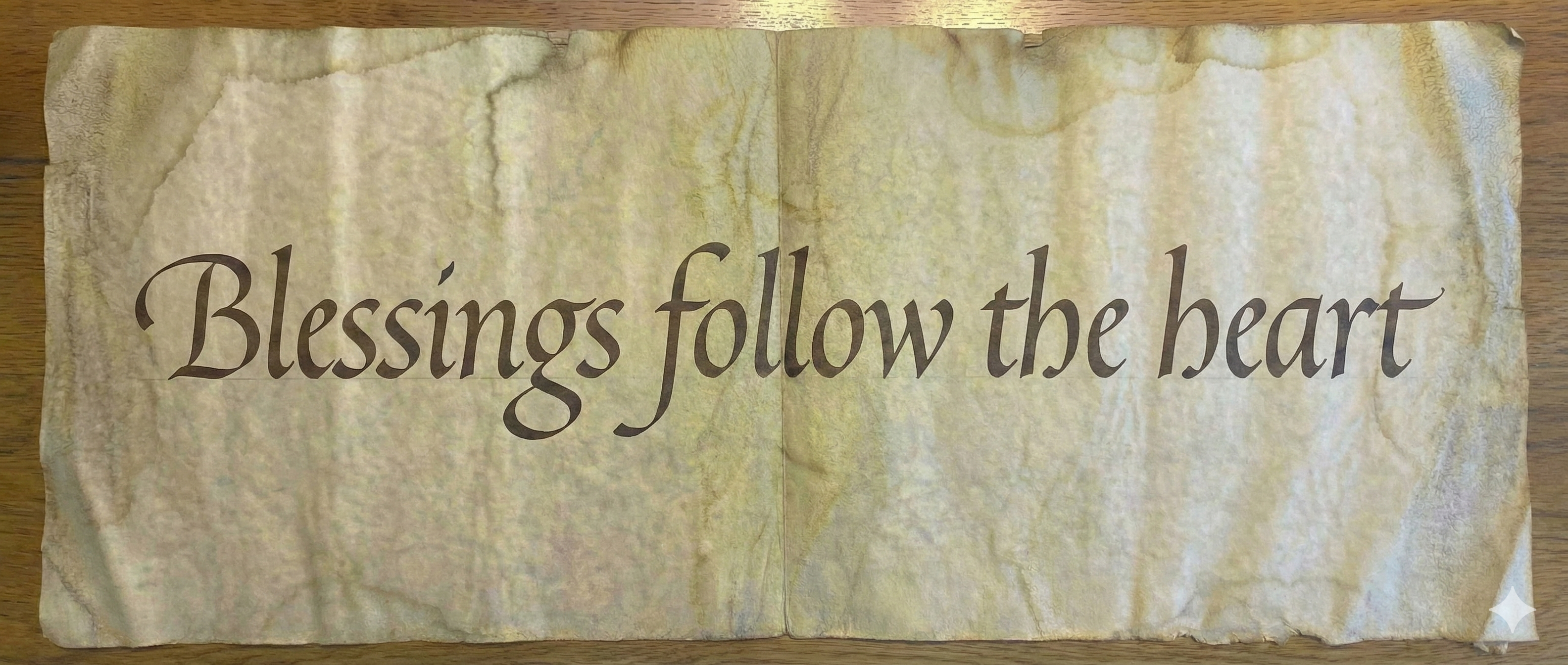
○ Italian Renaissance Humanist Script: A Practice in Writing about Gentle Communication
Write sentences:I let my feet feel the ground and my mind return to now.
When writing Humanist Script, slow down and let each letter feel like a steady footstep. Hold the pen neither too hard nor too loosely, but like the soles of your feet gently touching the ground. After writing each word, silently repeat in your mind, "ground," "now," making the English sentence itself a grounded verbal anchor. You're not practicing handwriting; you're practicing, stroke by stroke, "I can return to the present."
Lesson 966: Advanced Grounding Techniques - Drawing Guidance
Objective: To transform the experience of "returning to the ground" into a visualized path.
Steps: Draw a thick, slightly textured horizontal line at the bottom of the paper to represent the ground. Above the line, draw three small footprints, ranging from blurry to clear: the leftmost footprint has a faint edge and lighter color; the middle footprint is slightly clearer; and the rightmost footprint has a distinct outline and saturated color. Then, in a corner of the drawing, write down one ground-related action you'd like to try today, such as: feeling the chair surface when sitting, paying attention to the soles of your feet when standing, or counting to three while drinking tea. Let this drawing serve as a visual reminder for your progress towards ground-related actions.
Please log in before submitting your drawings and feelings.
○ 966. Advanced Practice of Grounding Techniques: Log Guidance Suggestions
① Write down the moment you most recently felt like you were about to be swept away, and record three specific objects that were visible around you at that time.
② Write down your most frequently used ground-level approach and in what situations it is usually most effective?
③ Design a "3-step progressive grounding process" that suits you, for example: see an object → feel the soles of your feet → state the time and place.
④ Record your feelings when using this process in a real-world situation today: Is there even the slightest difference?
⑤ Write a sentence you want to say to yourself: "When I need to, I can return to the ground instead of being dragged away by memories."“
⑥ Conclusion: Grounding is not a one-time skill, but an ability that can be practiced repeatedly and gradually become natural.
Please log in to use.
When grounding transforms from an "emergency skill" into a daily ability, you are no longer someone who is simply pulled away by stress responses, but someone who can repeatedly return to the here and now.