

Lesson 1003: The Interaction Between Mental Adjustment Disorders and Physical Health
Duration:75 minutes
Topic Introduction (Overview):
Psychological adjustment disorder is often misunderstood as "overthinking" or "emotional sensitivity," but its essence is a...A systemic response involving both psychological and physiological factorsThe greater the psychological stress, the more easily the body becomes unbalanced; the more unbalanced the body is, the more easily emotions are amplified. After an acute stressful event, the brain's alert system remains in an over-activated state. Stress hormones (especially cortisol and norepinephrine) can alter sleep structure, affect the immune system, and disrupt digestive rhythms, leading to symptoms such as bloating, stomach pain, headache, back pain, palpitations, fatigue, and decreased immunity.
This lesson will guide you through understanding this two-way cycle: psychological shock → physical defense activation → physical hypervigilance → further exacerbating psychological stress → triggering symptoms again. You will learn how to...Cut off circulation at the body end(such as breathing, muscle relaxation, and rhythm restoration), and fromReduce psychological burden(Such as lowering self-expectations, allowing emotions, and rebuilding a sense of security). We will practice methods to restore the body's "homeostasis" because only when the body is stable can the mind truly have room to recover. Mandala drawing is not about drawing anything, but about observation—observing the subtle connection between mind and body, observing how tension forms, spreads, and then subsides.
▲ AI Interaction: Observing Your "Psycho-Body Circuit"“
Please write down three of your most noticeable physical symptoms recently: stomach discomfort? stiff neck and shoulders? headache? rapid heartbeat? fatigue?
Then write down the mental state when they occurred: worry? recalling the event? fear? emotional fluctuation? blankness?
Finally, write: Is there a fixed order between these states? For example, "first chest tightness → then anxiety → then fatigue".
Click the button below to let AI help you understand your "mind-body interaction diagram".
○ Mind-Body Synchronization: Music Therapy Exercise
Choose music with a stable rhythm, as slow as breathing, and use it to help your body find its "rhythm again".
Exercise: Sit up straight with your feet flat on the ground, listen to music for 3 minutes, and focus only on the rise and fall of your chest.
For the next two minutes, shift your focus to your abdomen or neck and shoulders, letting the music's tempo guide your relaxation.
The goal is not complete relaxation, but rather to bring the body back from excessive tension to a manageable range.
🍵 Herbal Healing Tea - A Drink for Body and Mind Harmony
Recommended recipe:Chamomile + lemon verbena + mint.
Chamomile soothes the nervous system, lemon verbena relaxes the stomach, and peppermint helps with alertness and smooth breathing. The combination of these three can alleviate the symptoms of palpitations, stomach tightness, and shallow breathing.
It is especially suitable for drinking when physical symptoms are obvious and emotions begin to fluctuate, helping the brain to reduce alertness.
○ German-style whole grain therapy: Stabilizes blood sugar and mood
In psychological adjustment disorders, fluctuations in blood sugar can further destabilize emotions—hypoglycemia can exacerbate anxiety, palpitations, and fatigue. German whole grain therapy emphasizes maintaining bodily stability with warm, slowly releasing energy grains, such as warm oats, rye flakes, whole wheat porridge, and bran bowls, combined with small amounts of honey, almonds, or warm milk.
The fundamental logic that stabilizing blood sugar equals stabilizing emotions is often overlooked. This lesson suggests that when under significant psychological stress, one should include at least one meal of whole grains daily to promote "physical stability" and thus "psychological stability."
Healing Recipes
/home2/lzxwhemy/public_html/arttao_org/wp-content/uploads/cookbook/kao-hong-shu-pei-hei-dou.html(Please confirm that the file has been uploaded: kao-hong-shu-pei-hei-dou.html)
🎨 Dream Mandala Healing · Mi Xiangwen 1003 · The Bridge of Breathing
You dream of a long, narrow bridge spanning two worlds: one of chaos, the other of tranquility. You stand in the middle of the bridge, the planks beneath your feet rising and falling gently with your breath: as you inhale, the bridge rises slightly, as you exhale, it slowly descends. Suddenly, you realize—you are the bridge.
Imagine the bridge surface transforming into a mandala: the center represents the "rhythm of breathing," while the two sides represent the "mind" and the "body." When the body is tense or the mind is agitated, simply refocus your attention on the central fluctuations. A mandala is not about drawing anything, but about observation—observing how breathing reconnects the mind and body to the same rhythm.

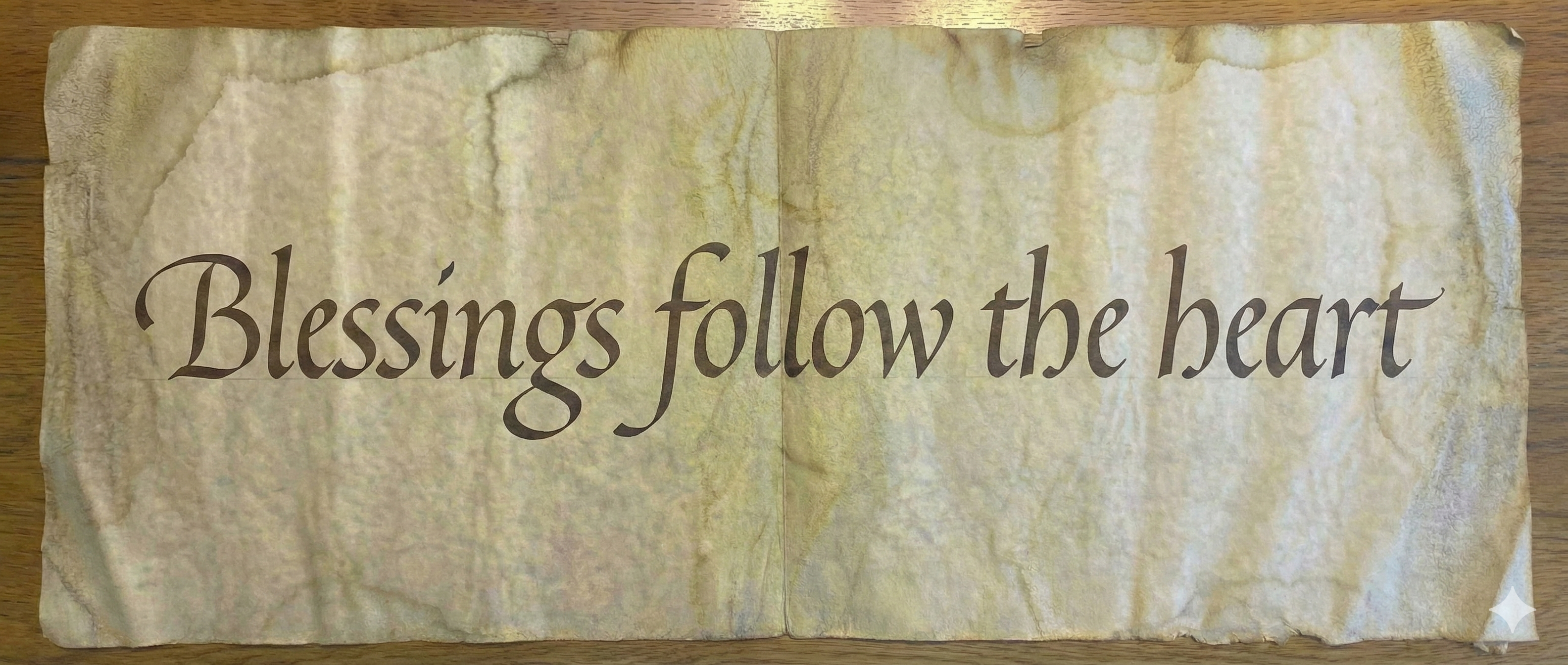
○ Running script - Writing sentences in sync with mind and body
The fluidity of running script symbolizes harmony between mind and body.
- Sentence writing:Body and mind are both stable.
- English equivalent:Body steady, mind steady.
- hint:When writing the character "稳" (steady), slow down your brushstrokes and keep your wrist and breathing in sync.
Lesson 1003: Mind-Body Interaction - Guided Drawing
Objective: To observe the trajectory of the interaction between the mind and the body.
Steps: Draw two lines on the paper—one representing "psychological fluctuations" and the other representing "physical reactions." The psychological line can be jagged, wavy, or discontinuous; the physical line can be tight, thick, or slowly spreading. Next, let the two lines meet at a certain point, symbolizing "mind-body synchronization." Finally, draw a soft halo around the meeting point, symbolizing "restorative stability." Observing the lines is more important than adjusting them.
Please log in before submitting your drawings and feelings.
○ 1003. Psychological Adjustment Disorders and Physical Health: Journaling Guidance Suggestions
① What is the most obvious physical signal today? (Panics/Stomach tightness/Neck and shoulder pain/Fatigue...)
② When you experience physical discomfort, what are your immediate psychological feelings? Write down the most honest words.
③ Can you trace a cycle of "psychology → body → psychology"? Write down its order.
④ What small action can you take today to make your body more stable? Drink water, take a walk, stretch, eat a stable meal, etc.
⑤ Say something to your body, such as, "Thank you for reminding me, I will slow down."“
⑥ Give yourself a mental message, such as: "I am learning to take better care of you."“
Please log in to use.
When you understand the interaction between mind and body, you will no longer be frightened by symptoms, but will gradually regain a stable and controlled rhythm.