

Lesson 1007: How to Cope with Persistent Stressors
Duration:75 minutes
Topic Introduction (Overview):
For many, stress isn't a "one-off event," but rather a persistent source of stress that lingers in their lives: caring for the sick, complex interpersonal conflicts, long hours at work, financial pressure, family disputes, chronic illnesses… After an acute stressful event, this stress often doesn't disappear immediately; instead, it feels even greater and harder to cope with because the person is already "exhausted." If we continue to simply try to "get through it" or "tough it out," it's easy to push both our bodies and minds into a state of exhaustion, leading to adjustment disorders: insomnia, irritability, stomach discomfort, palpitations, sudden emotional breakdowns, or extreme numbness.
This course doesn't require you to solve all your problems immediately, but rather helps you build a mental and physical framework for "long-term coping with persistent stress": distinguishing between controllable and uncontrollable factors, practicing adjusting standards instead of self-punishment, scheduling "micro-recovery windows" instead of waiting for complete collapse, and learning to maintain a minimum sense of order and self-care in unstable environments. You will gradually see that while stressors may not disappear immediately, your response can gradually change. A mandala isn't about drawing something, but about observation—observing the trajectory of stress in your life, observing how you learn to breathe, adjust, and stand firm amidst the cyclical fluctuations.
▲ AI Interaction: Mapping Your "Continuous Stress"“
Write down your three main sources of stress right now, such as: work, family, health, finances, and interpersonal conflicts.
For each source of stress, add a description: How long did it last? What was the most unbearable part?
Please write again: Which part is completely unchangeable? Which part can be fine-tuned? Which part requires your help?
Click the button below to explore with AI where I can make small but real adjustments.
○ Rhythmic music therapy for sustained stress
Choose music with a steady beat that is neither too loud nor too sad, and make it your daily ritual to "take a step back from stress".
Exercise: Put on headphones and listen for only 5 minutes. Do not process information or look at your phone. Allow yourself a brief respite from the source of stress.
Observation: When you set aside 5 minutes for your brain each day, you will gradually find yourself having more energy to return to real-world problems.
🍵 Herbal Healing Tea: A Mind and Body Buffer During Periods of Sustained Stress
Recommended tea recipe:Chamomile + Rose + Lemon Verbena.
Chamomile helps soothe a tense nervous system, rose relieves chest tightness, and lemon verbena helps regulate a digestive system that has become sensitive due to stress.
It is recommended to have a cup of herbal tea during the most stressful time of day (such as afternoon or evening) as a "pause button"—not to escape, but to give the body a chance to readjust its load.
○ German Whole Grain Therapy: The Foundation for Supporting Long-Term Stress Tolerance
Under constant stress, many people either forget to eat or rely on high-sugar, high-caffeine diets to "get through it," resulting in drastic fluctuations in blood sugar and a greater likelihood of emotional breakdown. German whole grain therapy emphasizes stabilizing the body's energy curve through warm, slowly releasing grains (such as oats, rye, whole wheat, wheat germ, and buckwheat porridge), preventing complete depletion during prolonged stress.
You don't need to drastically change your diet; simply add one "stable meal" to your daily diet: a bowl of warm whole-grain porridge, a hearty slice of whole-wheat rye bread, or a small bowl of mixed whole-grain rice. When your body has a stable energy supply, you won't always be on the verge of collapse when facing stress.
Healing Recipes
/home2/lzxwhemy/public_html/arttao_org/wp-content/uploads/cookbook/kao-hong-shu-pei-hei-dou.html(Please confirm that the file has been uploaded: kao-hong-shu-pei-hei-dou.html)
🎨 Dream Mandala Healing · Mi Xiangwen 1007 · Mountain and Wind
You dreamt you were sitting at the foot of a mountain, the wind blowing in gusts, sometimes gentle, sometimes biting. The mountain didn't stop the wind; it simply stood there quietly, sometimes shrouded in mist, sometimes revealing its clear outline. You realized that what truly brought you peace wasn't whether the wind stopped, but that the mountain was always there.
Imagine this mountain as a mandala: the center is the stable mountain body, and the outer circle is a constantly flowing wind—some dense, some sparse, some rapid, some gentle. You no longer try to control the wind, but practice being that mountain. A mandala is not about drawing something, but about observing—observing how pressure comes and goes, observing how you gradually become more stable through repeated impacts.

○ Running script: A self-declaration under continuous pressure
The continuous flow of running script resembles an uninterrupted vitality.
- Sentence writing:The wind rises, but I am still here.
- English equivalent:The wind rises, but I remain.
- hint:When writing the word "still", I deliberately slowed down, letting my wrist and breath sink down together, as if I were drawing a solid line for myself.
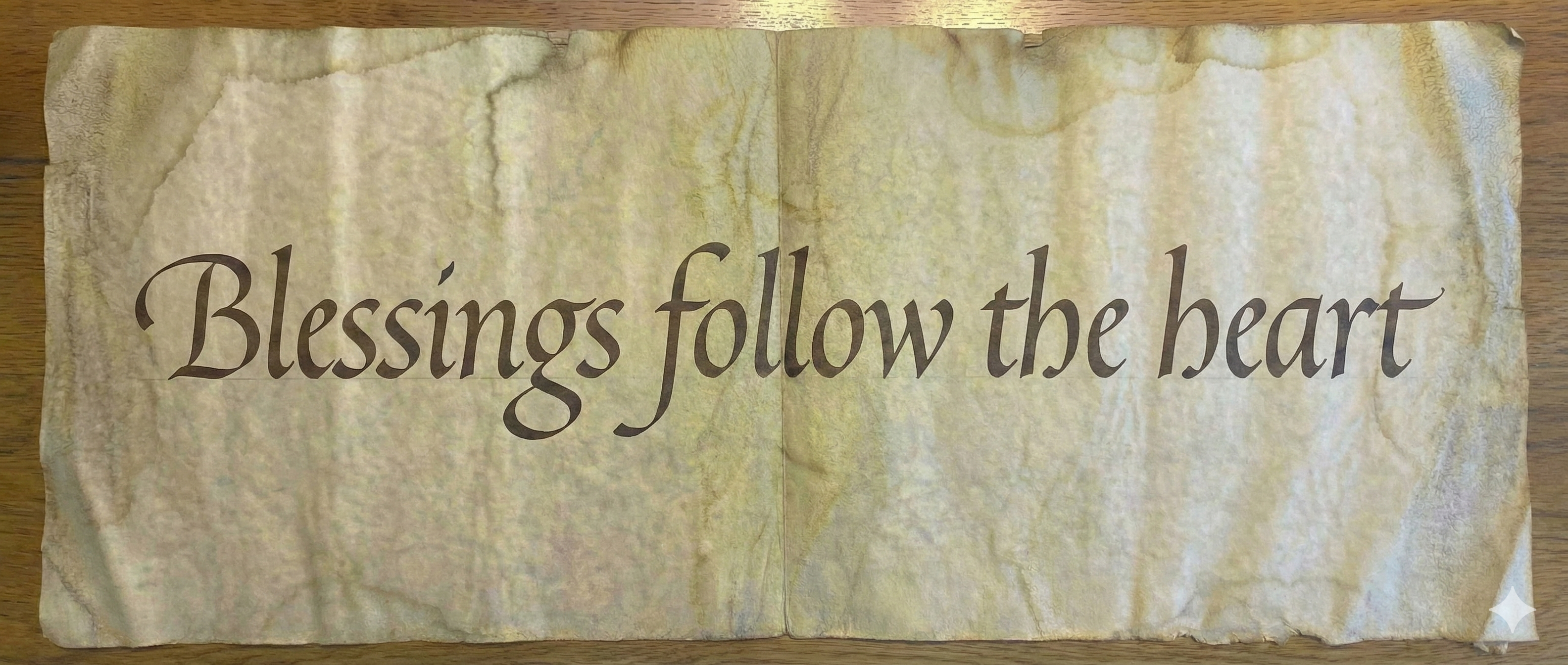
Lesson 1007: Continuous Stress - Guided Drawing
Objective: To see the "distance" and "boundary" between you and your stressors.
Steps: On one side of the paper, draw an image representing the source of stress (it could be a tall building, waves, rocks, a clock, etc.). On the other side, draw a symbol representing yourself (a mountain, tree, cottage, or point of light are all acceptable). Connect yourself to the source of stress with lines: some lines can be thick, some thin, and some can be broken. Then, draw a soft outer circle around you, representing your boundaries and personal space. You don't need to erase the stress, just prevent it from intruding into your inner world indefinitely.
Please log in before submitting your drawings and feelings.
○ 1007. Log-based guidance suggestions for dealing with persistent stressors.
① Write down your three main sources of stress and give each one a simple name (e.g., "Work Mountain", "Relationship Fog", "Money Sea").
② Of these three sources of stress, which one drains your energy the most? Why?
③ Write down one "minor adjustment" you can make today: shorten a communication session, postpone an unnecessary task, or give yourself a 10-minute break, etc.
④ Write down one small habit you hope to maintain in the coming week (related to sleep, diet, exercise, herbal tea, whole grain breakfast, etc.).
⑤ Tell yourself: "Even if the pressure is still there, I can learn to coexist with it step by step."“
⑥ Conclusion: Constant pressure doesn't define you; how you respond is what truly defines you.
Please log in to use.
It's not about waiting for all the pressure to disappear before you can recover; it's about learning to reserve a space where you can breathe while the pressure is still there.