

Lesson 1019: Deepening Psychological Growth and Self-Acceptance
Duration:75 minutes
Topic Introduction (Overview):
In the recovery process from acute stress and adjustment disorders, many people go through an important and subtle phase: transitioning from "I must get better quickly" to "I am willing to understand who I truly am now." Psychological growth is not linear; it is a continuous journey through fear, hope, repetition, understanding, frustration, and small steps forward. This course will show you that true growth is not about banishing vulnerability, but about being willing to refocus your attention on your own pace, needs, and boundaries after experiencing chaos.
We will explore the core mechanisms of self-acceptance: how to shift from "Why am I like this?" to "I can move forward with my current state"; how to stop seeing yourself as a "problem to be fixed" and instead see the strength that allows you to persevere through the storm. A mandala is not about drawing something, but about observation—and so is psychological growth: not about creating an idealized self, but about learning to observe "me in this moment," observing our true emotions, vulnerabilities, resilience, and desires, and gently accepting them, allowing growth to happen naturally.
▲ AI Interaction: The First Step to Self-Acceptance
Please answer: What were the most frequent self-evaluation phrases you used during this period? Criticism? Negation? Urging? Shame?
Then write down its reverse form, such as "I'm not good enough" → "I've tried my best." You don't have to accept it immediately; you just need to let your brain hear another possibility.
Then ask yourself: If this were a friend, not yourself, how would you say it to him?
You will find that your heart is actually softer than you thought.
Click the button below to let AI help you practice "gentle self-talk".
○ Deep Self-Acceptance · Music Therapy
Choose a gentle, slow piece of music with a touch of brightness, such as piano or light strings.
Close your eyes and feel the vibrations of the music starting from your chest. No need to analyze; just let the melody linger.
When self-criticism arises, let it flow away with the music.
Practice goal: To make "acceptance" not just a word, but a physical experience.
🍵 Herbal Healing Tea: Gentle Self-Companionship
Recommended tea recipe:Rose + Chamomile + Calendula.
Roses soothe the mind, chamomile calms the body, and calendula symbolizes "repair and renewal".
How to drink: While drinking, take three slow breaths and silently say a gentle response that you are willing to give yourself, such as "I am here".
○ German Whole Grain Therapy: The Daily Foundation for Stable Mood
Deepening self-acceptance requires a stable energy base. German whole grain therapy emphasizes supporting the mind and body with warm, slow-release grains, such as rye flakes, whole oats, buckwheat porridge, and warm grain bowls with pumpkin seeds and raisins.
They not only maintain stable blood sugar levels, but also reduce mood swings, preventing self-understanding from being interrupted by "physical exhaustion."
A bowl of whole grains every day is a gentle shift in focus from "what I'm not good enough" to "I deserve to be nourished".
Healing Recipes
/home2/lzxwhemy/public_html/arttao_org/wp-content/uploads/cookbook/kao-hong-shu-pei-hei-dou.html(Please confirm that the file has been uploaded: kao-hong-shu-pei-hei-dou.html)
🎨 Dream Mandala Healing · Mi Xiangwen 1019 · Returning to One's Own Center
You dream that you walk into a huge mandala. The outermost layer is dark blue, symbolizing your past chaos and fear; the middle layer is light gold, like the parts that are gradually being understood; and the innermost circle is a small patch of soft light.
As you stand on the outer circle and slowly walk inward, with each step you take, the self-critical voices become lighter, like the wind.
As you approach the center, you find that it is not dazzling, but quiet and warm. You place your hand on that light, as if touching your own reality.
Mandala is not about drawing something, but about observing—you are not just observing the pattern, but how you move from the edge to the center, from blame to understanding, from defense to softness.

○ Running script - Writing sentences of self-acceptance
The flow, pressure, and weight variations in running script resemble the loosening and opening of one's own self-relationship.
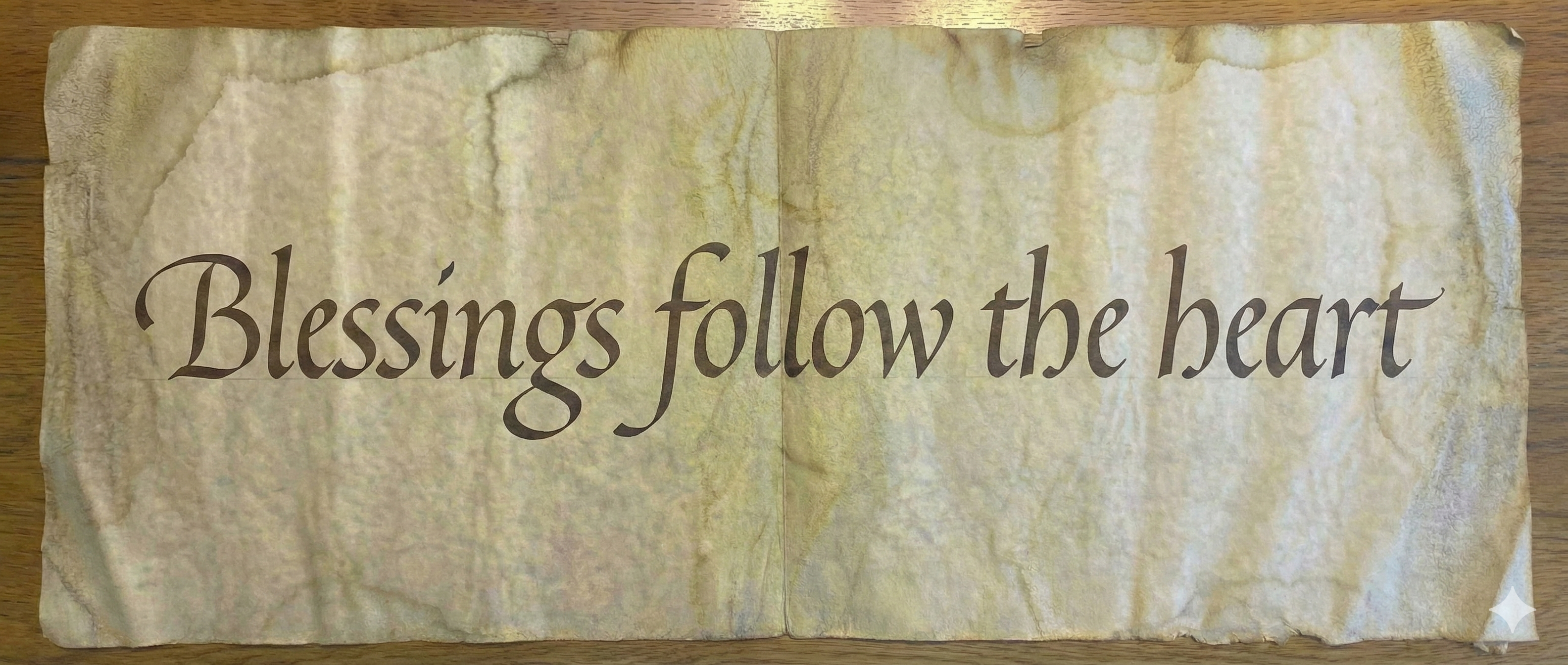
- Written words:So it is, so it is.
- English equivalent:I accept who I am, as I am.
- hint:When writing the character “如”, slow down and let the brushstrokes sink naturally, symbolizing “allowing real weight”.
Lesson 1019: Psychological Growth - Art Guidance
Objective: To transform growth from an abstract concept into a visible image.
step:
● Draw a small dot of light in the center of the paper to symbolize "your true self".
● Draw a three-layered gradient circle on the outer edge: the dark color represents old wounds, the middle color represents the part that is being understood, and the light color represents the part that is beginning to soften.
● Add a touch of light or small lines between the circles to symbolize each small step forward.
● Finally, write a sentence you would like to say to yourself outside the center of the circle, such as "I am changing, and I don't have to be perfect."“
Please log in before submitting your drawings and feelings.
○ 1019. Psychological Growth and Self-Acceptance: Suggestions for Journal Guidance
① In which three areas have you shown subtle but real growth during this period?
② Which evaluations, labels, or old beliefs are slowly becoming less important?
③ Write down a moment when you were "not so harsh on yourself". How did it happen?
④ What are your reasons for allowing yourself to “go slower” now?
⑤ End today's record with a new self-commitment.
Please log in to use.
Psychological growth isn't about becoming a stronger person, but about becoming someone who can gently accept you. Every step you take deserves to be seen.