

Lesson 1098: Frustration and Motivation During Recovery
Duration:75 minutes
Topic Introduction (Overview):
In the process of recovering from complex psychological trauma, the experience of "getting a little better and then falling back down" and "persevering for a few days and then returning to square one" is almost inevitable.
Many people repeatedly ask themselves during the recovery period: "Am I not trying hard enough?" "Am I beyond saving?" - Every emotional downturn and trigger is interpreted as "failure", which further erodes motivation.
In fact, the repair of complex trauma is never a straight line, but more like a spiral path that sometimes moves forward and sometimes spirals back.
This lesson will focus on "Frustration and Motivation Maintenance During Recovery": helping you understand that setbacks are not proof of your incompetence, but rather a natural shock to your mind and body when learning new methods;
Learn to distinguish between "symptom fluctuations" and "overall trends"; establish a sustainable, gradual pace rather than relying on short bursts of energy.
We will combine Eastern healing tea drinking, Chinese medicinal soups, calligraphy practice, and mandala viewing to learn how to gently preserve the embers of life amidst the ebb and flow of life.
A mandala is not about drawing something, but about observing—observing how you slowly accumulate real change on a seemingly repetitive path.
▲ AI Interaction: Seeing "I didn't actually go back to zero"“
The biggest blow during recovery is often not the symptoms themselves, but the self-blame and despair of "Why am I like this again?" You can use this lesson to do a small exercise with the AI:
① Write down the most recent situation in which you felt "you failed again" (e.g., losing control of your partner again, avoiding important tasks again, or becoming numb again).
② Please describe in detail: How did your reaction differ this time compared to a year ago or a few months ago in a similar situation? Even if it's just "I recovered a little bit faster after the breakdown".
③ Send these subtle differences to the AI and ask it to compile a "list of evidence that has actually changed".
④ Next, ask the AI to help you write the "pre-prepared self-comforting statements" into a short passage that you can read when you encounter setbacks again.
Click the button below to rewrite your understanding of "setbacks" with AI.
○ Rhythm Restoration Exercises with Music Accompaniment
Choose a piece of music with a moderate tempo and a gentle rhythm, neither a completely flat background nor an overly intense battle song.
On those days when you feel like you've "regressed again," play this song at the same time every day and treat it as a "signal to keep going."
Practice method: In the first half of the music, focus only on your breathing and heartbeat; in the second half, gently write down a sentence to encourage yourself (even if it's just "Just live tonight for now").
Instead of forcing yourself to cheer up immediately, allow yourself to be supported by the music while you're feeling down.
Over time, you'll find that even if your mood still fluctuates, your relationship with setbacks is no longer one of "being knocked down," but rather one of "being caught after falling down."
Eastern Healing Tea: A cup of tea brewed to "keep going, just a little bit more".
Recommended drinks:Longan and cinnamon calming tea.
Longan has the effect of warming and nourishing the heart and spleen, nourishing blood and calming the mind, while cinnamon provides a warm base, suitable for those who often feel "very tired and lack energy" during the recovery period.
This cup of tea isn't meant to instantly motivate you, but rather to remind you when you're really tempted to give up: I can give myself some comfort first before deciding on the next step.
usage:Steep 5-8 dried longan fruits and a small amount of cinnamon fragments in hot water for 5 minutes.
It is recommended to drink it during the time of day when you are most likely to fall into "procrastination and self-blame", such as in the afternoon or at night.
While drinking, you can silently repeat to yourself: "All I can do now is to make myself a little bit better than before."“
○ Chinese Food Therapy · Soups · Yam and Carrot Vitality Soup
Yam invigorates the spleen and replenishes qi, carrots nourish the liver and improve eyesight, and when combined with a small amount of mushrooms or tofu, it creates a bowl of warm-colored, mild-tasting, and invigorating soup.
For common symptoms during the recovery period such as "mental fatigue, difficulty concentrating, and easy giving up," this type of soup not only replenishes basic energy but also gives a visual and gustatory suggestion that "I can keep going a little longer."
Healing Recipes
/home2/lzxwhemy/public_html/arttao_org/wp-content/uploads/cookbook/yang-rou-gou-qi-tang.html(Please confirm that you have uploaded: yang-rou-gou-qi-tang.html)
Mandala Healing · Mi Xiangwen 1098 · "The Road Upward Spiral"“
Imagine a mandala that doesn't expand outwards in neat concentric circles from the center, but rather as a slowly ascending spiral.
You've gone around in circles and find yourself back in a similar situation: the same emotions, the same triggers, the same helplessness.
But if you look up even a little bit, you'll find that the height of this circle is different from the previous one.
You may still break down, but the recovery time will be shorter; you may still avoid things, but you will take a second look at yourself before you do; you may still want to give up, but the moment you actually give up will be postponed.
A mandala is not about drawing something, but about observing—observing the spiral that seems to be spinning in place but is actually slowly rising.
When you're willing to stop and look for a few more seconds, you'll find that what seems like "useless persistence" is actually paving the way for the next step forward.

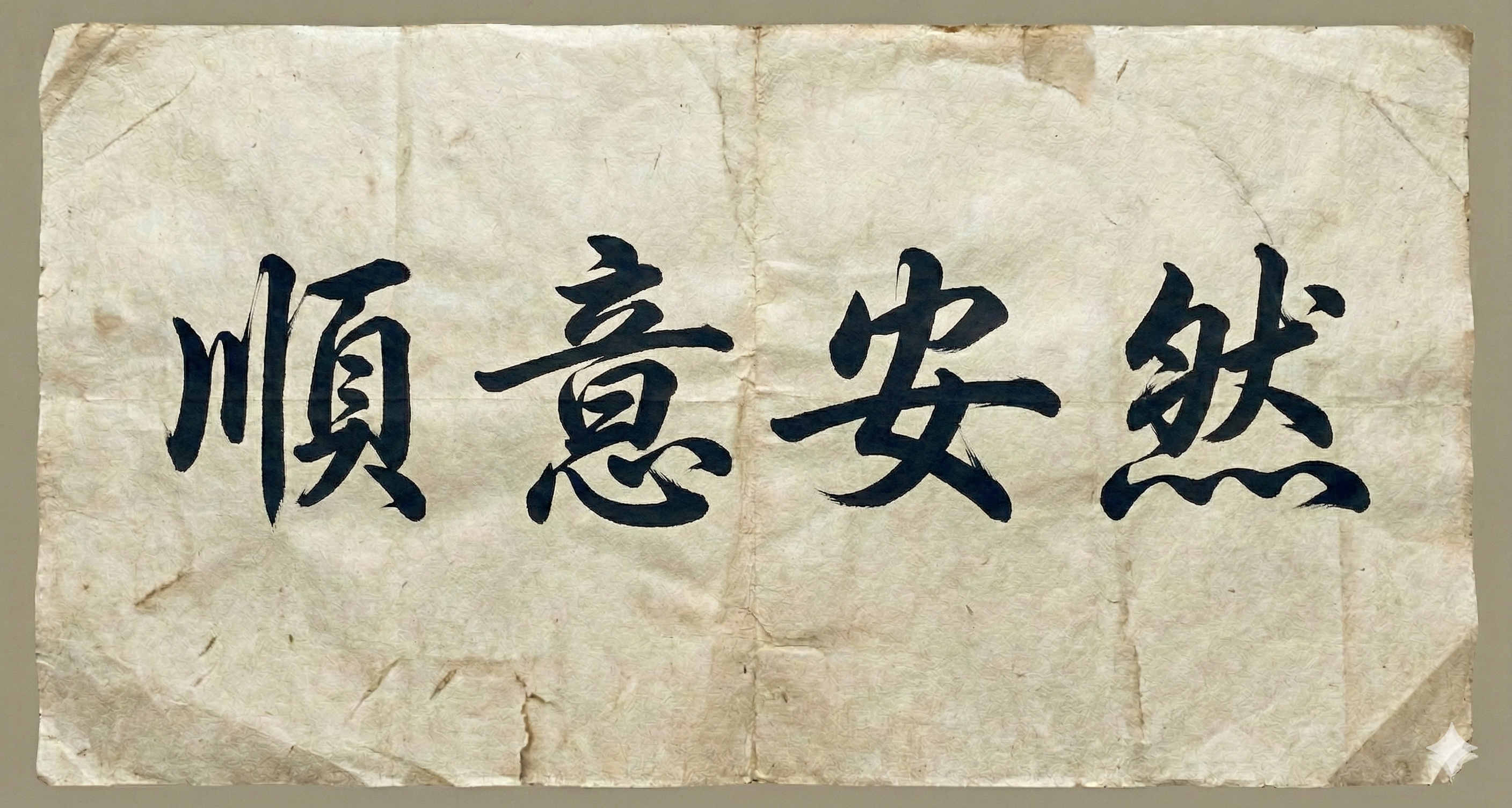
○ Running script - Writing sentences that maintain momentum
Use the rise and fall of cursive script to practice writing "continue a little bit" into muscle memory.
- Written words:Slowly, continue on.
- English equivalent:I move slowly, but I keep going.
-
hint:When writing the character “缓”, deliberately enlarge the horizontal stroke and the left-falling stroke, allowing the character shape to be slightly loose; when writing “续行”, make the two characters have a sense of connection, as if the footsteps are pulling each other.
After writing each set, gently look up and glance at it, allowing yourself to "observe" the set of characters, rather than just treating it as a practice task.
Lesson 1098: Restoring the Rhythmic View - Drawing Guide
Objective: To transform the "advancement amidst repeated rises and falls" from an abstract concept into a visible image.
Draw a large circle on the paper as the boundary, and then draw a spiral line slowly outward from the center of the circle.
Whenever you recall a setback (e.g., relapse, self-blame, avoidance), draw a small mark at a point on the spiral and write down the keyword from that time next to it.
Then, outside the same mark, draw a small circle of a slightly lighter color and write down "one small thing I still managed to do that time" (e.g., asking for help from others, not hurting myself like before, or writing down my feelings).
Once finished, stop and look at the whole picture: Can you count how many times the spiral went around? How many times did you think it was a complete failure, only to find a tiny point of light still following beside you?
A mandala is not about drawing something, but about observing—observing how this path, through repeated turns and loops, slowly expands outward to create new spaces.
Please log in before submitting your drawings and feelings.
○ 1098. Recovery Period Setbacks and Motivation Maintenance: Journaling Guidance Suggestions
① Write down the most recent experience that made you feel like "I'm back to square one," and describe in detail what happened at that time.
② Compare this situation with similar situations in the past: Is there even one small difference? For example: Did you stop to breathe, did you send a message for help, or did you postpone self-attack for a few minutes?
③ Write down three harsh words you usually say to yourself after a setback, and write a substitute sentence below each sentence (the sentence should be gentle and not deny reality).
④ Design a "minimum action level" recovery plan: When you are completely exhausted, what small thing do you need to do to recover even if you are still on the road to recovery today?
⑤ Record your energy level today on a scale of 0 to 10. What is your current score? At this score, what is one act of self-care that you can do for yourself?
⑥ Conclusion suggestion: Rewrite it in your own words: "I don't need to perfectly maintain my motivation, I just need to be willing to push myself forward a little bit after each fall."“
Please log in to use.
The setbacks on the road to recovery do not define who you are; they only define that you are walking a real and difficult path.
When you are willing to reserve even a little bit of space for yourself to continue moving forward, you are already drawing a new line with the complexities of trauma.