

Lesson 1113: Sleep Disorders and Coping After Sudden Events
Duration:75 minutes
Topic Introduction (Overview):
In the wake of a sudden event, sleep is one of the most vulnerable yet crucial recovery mechanisms. Many people experience typical reactions such as "insomnia," "sudden awakenings," "recurring light sleep," "overly vivid dreams," "recurring dreams about the event," "heart palpitations in the middle of the night," and "waking up too early in the morning." These are not "insomnia," but rather the nervous system's attempt to regain a sense of security from a hyperarousal state after trauma. The body uses alertness to stay awake, dreams to process unresolved emotions, and awakenings to remind you that "danger may still be present." This survival mode is instinctive and stubborn, therefore requiring gentle and continuous intervention, rather than forced sleep.
This course will help you understand and deal with post-traumatic sleep disturbances from four perspectives: ① The body remains in a false alarm state of "the event is not over"; ② The brain processes fragmented emotions and memories through dreams; ③ The autonomic nervous system struggles to switch from tension to recovery; ④ The silence of night amplifies the fears suppressed during the day. This course will provide you with specific sleep soothing strategies, including grounding the body, regulating breathing rhythms, bedtime safety rituals, stabilizing light and sound, and dealing with nighttime awakenings. A mandala is not about drawing something, but about observation—observing the tension, nightmares, and emptiness that surface at night, and also observing how the body gradually regains stability in the darkness.
▲ AI Interaction: What is your sleep telling you?
Sleep disorders are a language of the body, not a sign of weak willpower. Please write down the answers to the following three questions:
- ① When was the last time you woke up in the middle of the night? Please describe the most obvious physical sensation at that time.
- ② Is there a recurring dream? Please give it a name, rather than describing the details.
- ③ What scares you most at night not dreams, but what? Darkness? Silence? Loneliness? A racing heart?
Sleep is an echo of trauma, not failure. Let AI help you decipher the meaning behind these echoes.
○ Sleep Regulation & Voice Stabilization Exercises
Many people have trouble sleeping after trauma because too much quiet makes their bodies more alert. Stable, low-frequency, and non-alarming sounds can help the nervous system slowly lower its guard.
Practice method:
- Play a steady stream of white noise, light rain, low-frequency piano, or wind sounds.
- Turn the volume down to a level that makes you feel just at ease.
- Once you lie down, you don't need to try to fall asleep; just let your body relax a little to the rhythm of the sound.
- If your thoughts start to wander, bring your attention back with a phrase like "Listen to the sound now."
A mandala is not about drawing something, but about watching—watching how your body slowly relaxes in the sound, rather than being pressed tighter by the silence of the night.
Aromatherapy Drinks - Warm Nighttime Drinks for Peace of Mind
Recommended drinks:A gentle sleep-inducing aromatherapy drink made with chamomile and valerian.
Chamomile can relax the stomach and diaphragm, relieving the persistent tension caused by shock; valerian root is used in naturopathy to help with deep sleep, soothe anxiety, and reduce nighttime awakenings. This combination is particularly suitable for those experiencing light sleep, rapid heartbeat, and difficulty falling asleep after trauma.
Suggested use: Steep 2 grams of chamomile and 1 gram of valerian root for 7 minutes. Before drinking, cup the cup with both hands to allow the warmth to enter your palms, then take a deep breath of the aroma and feel a slight relaxation in your chest. A mandala is not about drawing anything, but about observing—observing how warmth enters the body from the palms, like a small lamp illuminating the unease of the night.
○ American Natural Therapy Diet: Restorative Bedtime Comfort Bowl
Post-traumatic sleep disorder is often accompanied by blood sugar fluctuations, nighttime hunger, stomach upset, or energy depletion. The American naturopathic diet recommends consuming small, warm, easily absorbed, and blood sugar-stabilizing comfort foods one hour before bedtime. This lesson recommends a "bedtime comfort bowl": warm oatmeal with mashed banana, a few chopped walnuts, date paste, or honey for flavor.
The tryptophan in bananas helps form melatonin; the slow-release carbohydrates in oats can stabilize blood sugar and reduce nighttime awakenings; walnuts provide healthy fats that soothe the brain; and date paste provides a subtly sweet comfort, making it easier for the body to enter "rest mode." This is a gentle way to help the body fall asleep first.
Healing Recipes
/home2/lzxwhemy/public_html/arttao_org/wp-content/uploads/cookbook/hu-jiao-feng-mi-ning-meng-shui.html(Please confirm that the following has been uploaded: hu-jiao-feng-mi-ning-meng-shui.html)
Dream Mandala Healing · Mi Xiangwen 1113 · The Texture of Night
In your dream, you walk into a deep blue night. There are no boundaries, only darkness and silence. You think you'll be surrounded by fear, but suddenly a faint circle of light appears beneath your feet, as if someone is drawing the first ring of a mandala for you in the darkness. You step onto that circle of light, and the tension in your chest begins to ease a little.
You continue walking forward, and with each step, new halos of light slowly illuminate. They are not intense lights, but rather steady like breathing in the night. You realize that these halos are not "taking you out of the darkness," but helping you find direction in the darkness, making the night no longer a vast expanse of chaos, but a night sky with patterns, rhythm, and order.
A mandala is not about drawing something, but about observing—observing how darkness takes shape, observing how your steps become firm again on the ring of light, and observing how you allow your body to slowly rest in the night.

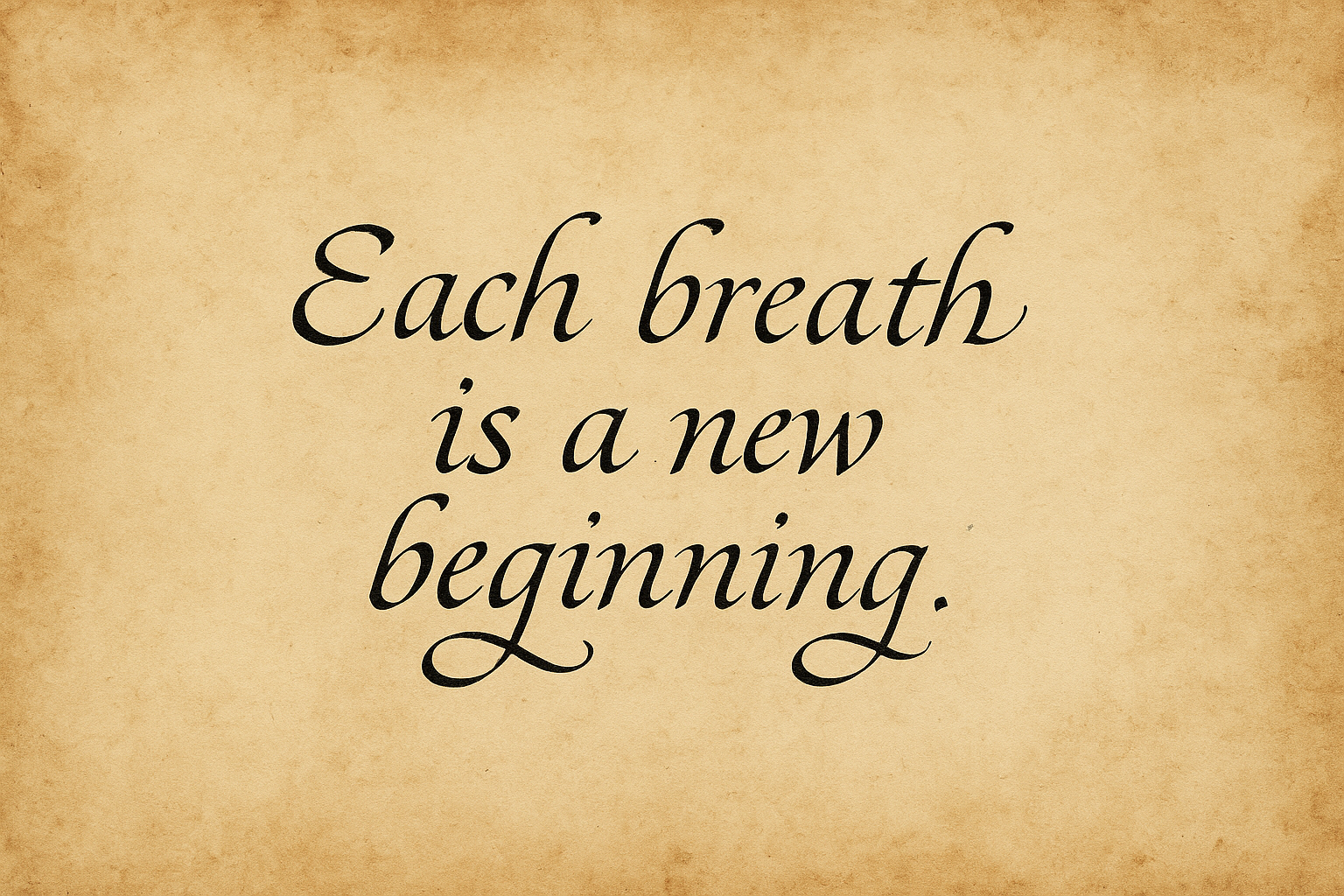
○ Medieval Gothic calligraphy: “Night will not swallow me.”
The solid structure of Gothic calligraphy is like establishing clear support in the dark, allowing you to rediscover boundaries and a sense of security through writing.
- English sentences:Night will not swallow me.
- Chinese equivalent:The night will not swallow me.
- Writing Tips:Each vertical line is like a pillar erected in the darkness, each horizontal line like a redefined space for you. The process of writing itself paves the way for sleep.
Lesson 1113: Coping with Sleep Disorders - Guided Mandala Viewing
Purpose:Soothe your nervous system that is constantly tense in the darkness by watching "The Order of the Night".
Find a mandala image with deep tones and even patterns. First, focus on the center, making it the "deepest place in the night." Observe if your body is tense. Then, look outwards along the symmetrical lines, moving your gaze layer by layer, imagining each circle as a soothing gesture: the first circle is breathing, the second is a steady heartbeat, the third is relaxed muscles, and the fourth is a slowed brainwave.
A mandala is not about drawing something, but about observing—observing how the night is illuminated by layers of order, and also observing how you gradually return to the rhythm of sleep, no longer fighting against the darkness.
Please log in before submitting your drawings and feelings.
○ 1113. Sleep Disorders and Coping: Journal-Based Guidance Suggestions
① Write down the circumstances of your most recent nighttime awakening, including the time and the most obvious physical sensations.
② Write down the image, sound, or worry that makes it hard for you to fall asleep (you can name it with a code).
③ Write down which night in the past seven days you slept slightly better than usual? What was it related to?
④ Write a self-comforting sentence that says, "If I wake up tonight, I will..."
⑤ Write down one bedtime comforting behavior you would be willing to try: warm drink, reading, adjusting the lighting, playing slow music, or applying a warm compress.
⑥ Finally, write: "The night is becoming a place I can enter."“
Please log in to use.
Sleep is the most vulnerable, yet also the most honest, signal of recovery. May you see your own rhythm slowly returning as you watch the night unfold.