

Lesson 1114: Strategies for Managing Anxiety and Hypervigilance
Duration:75 minutes
Topic Introduction (Overview):
After a sudden event, many people don't just experience fear, but rather remain in a state of hypervigilance—constantly scanning their surroundings, highly sensitive to soft noises, easily startled, finding it difficult to trust in their own safety, and feeling like their body is always ready to flee. Hypervigilance isn't just "tension," but rather the body's survival system getting stuck in "defense mode" after a crisis, unable to automatically shut down. It makes it difficult to relax, concentrate, and fall asleep, and turns everyday tasks into incredibly energy-consuming and difficult work. This course will help you understand the neural mechanisms behind this reaction and learn gradual adjustment strategies to help your body gradually return from fight/flight mode to balance and recovery.
The core of hypervigilance isn't "overthinking," but rather the nervous system remaining stuck in the assumption that "the danger hasn't passed." This lesson will analyze this from four angles: ① The body's threat detection system is overactivated; ② Certain triggers continuously remind you of events; ③ Emotions and memories are not yet integrated; ④ A lack of "internal stability." We will learn how to reduce the sensitivity of the nervous system, identify triggers, restore a sense of physical security, and rebuild internal and external "predictability" through breathing rhythms, grounding sound, tactile soothing, and stress reduction through movement. Mandalas aren't about drawing anything, but about observation—observing the source of anxiety, the body's reactions, and the patterns of alertness, allowing you to rediscover rhythm instead of being led by vigilance.
▲ AI Interaction: What is your body warning you?
Hypervigilance often kicks in faster than emotions. Please write down three of the following to help AI help you "see your body's alarm logic":
- ① What has recently triggered your sudden nervousness and racing heart?
- ② In that instant, what was the first physical reaction you noticed? Chest? Shoulders? Back? Stomach? Hands?
- ③ What is the "what if..." thing that you are most worried about?
Anxiety isn't your fault; it's your body telling you, "There's more to come." Click the button below to help AI interpret your body's alert patterns.
○ Grounding your voice: The first step to reducing alertness
Over-vigilance causes the brain to constantly "scan for danger," and sound can help stop the scanning and establish a sense of the present moment.
Practice steps:
- Choose a slow, steady, and non-abrupt sound (such as the sound of light rain, wind, or a gentle piano).
- Close your eyes and focus your attention on the lowest frequency of the sound.
- If other thoughts arise, there's no need to fight them; simply say softly, "Return to the sound."“
- Continue for three minutes, allowing the alert system to gradually slow down amidst the sound.
Mandala is not about drawing something, but about observing—observing how awareness slowly flattens like a wave, rather than demanding that it disappear immediately.
Aromatherapy Drinks: Herbal Combinations for Calming Anxiety
Recommended drinks:A soothing aromatherapy drink made with lemon balm and lavender.
Melissa can soothe a racing heart and a tense diaphragm, helping the body return from a state of hypervigilance to a more moderate level of alertness; lavender can reduce sympathetic nerve excitation, slowing down the body's "danger scan." This is a classic, gentle combination for post-traumatic anxiety.
Suggested usage: Steep 2 grams of lemon balm and 1 gram of lavender for 5 minutes. Before drinking, smell the aroma, then slowly drink, allowing the fragrance to extend downwards through the body like a warm thread, soothing areas that are always "tense in advance." A mandala is not about drawing something, but about observing—observing how the aroma spreads out in a small, resting space within the body.
○ American Natural Diet: Anti-Tightness Energy Stabilizing Bowl
Anxiety and hypervigilance are often accompanied by blood sugar fluctuations, stomach cramps, and insufficient energy. The American naturopathic diet emphasizes foods that stabilize blood sugar, warm the body, and provide a slow release of energy. This lesson recommends the "Steady Energy Bowl": a base of brown rice or quinoa, topped with steamed carrots, shredded chicken breast or tofu, soft leafy greens, and drizzled with a small amount of olive oil or pumpkin seed oil.
This food combination not only maintains stable energy levels but also reduces the body's basal sensitivity to "emergency responses." The warm, soft, and predictable taste itself is calming. After the first bite, you can observe if your body feels even slightly loosened; this is the beginning of recovery.
Healing Recipes
/home2/lzxwhemy/public_html/arttao_org/wp-content/uploads/cookbook/wen-he-xiang-liao-niu-rou-dun-cai.html(Please confirm that the following has been uploaded: wen-he-xiang-liao-niu-rou-dun-cai.html)
Dream Mandala Healing · Mi Xiangwen 1114 · A Glimmer of Awareness
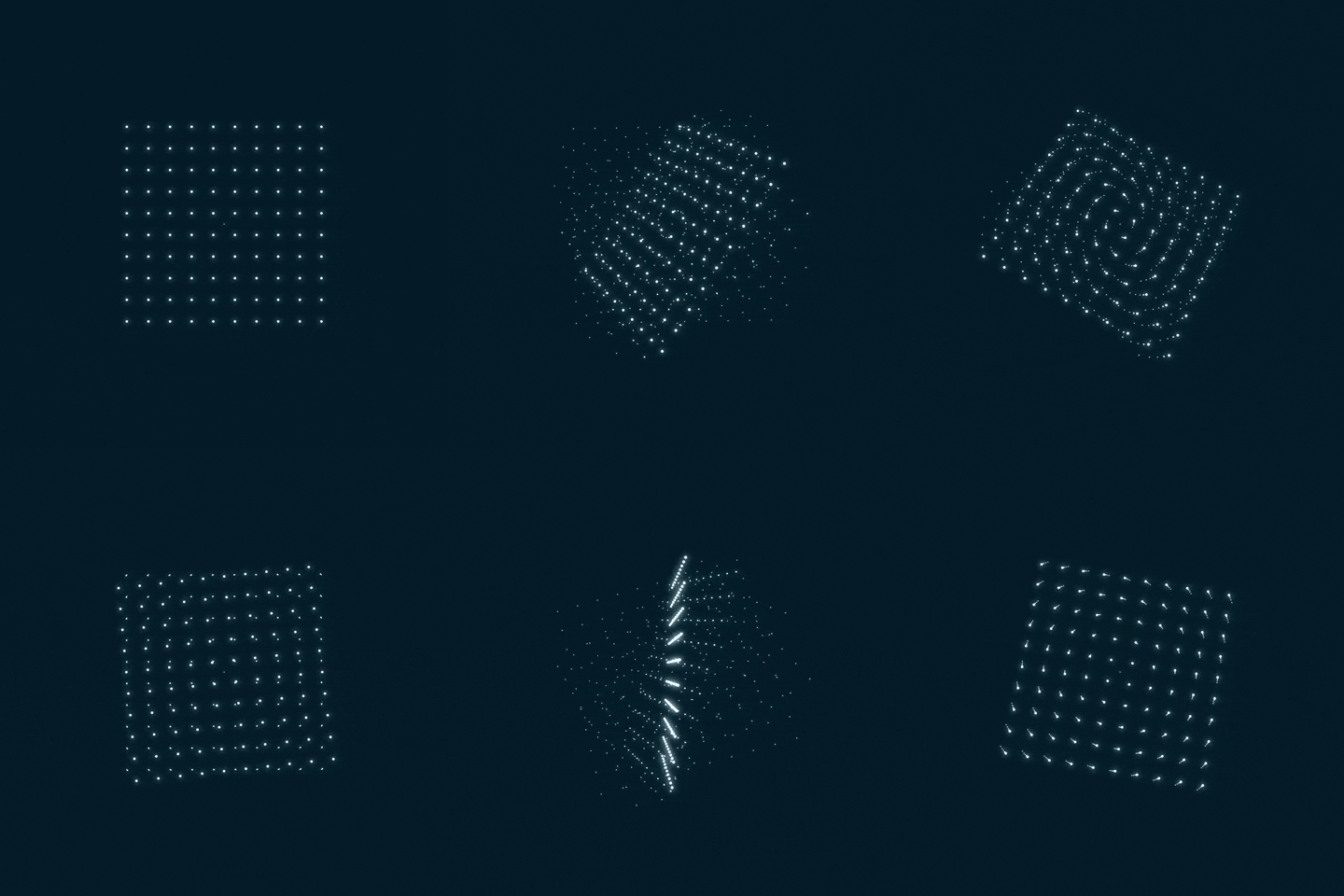
In your dream, you stand in the center of a dark room, surrounded by many faint points of light. You initially perceive these lights as dangerous, but as you approach, you discover they are "fragments of your heightened awareness." Each light flickers incessantly, causing your heartbeat to rise and fall with it.
Instead of trying to turn them off, you picked one up and saw a small, unprocessed fear inside. You placed the light at your feet, took a deep breath, and it slowly became more stable. So you picked up the second, then the third, and with each breath, the light softened slightly.
When all the points of light begin to flash in the same rhythm, they suddenly arrange themselves into a giant mandala: the center still trembles slightly, but the outer rings are already slowly rotating. A mandala is not about drawing something, but about watching—watching how awareness transforms from "disorderly flashing" to "rhythmic light," watching how you stop being led by the points of light and become the observer.
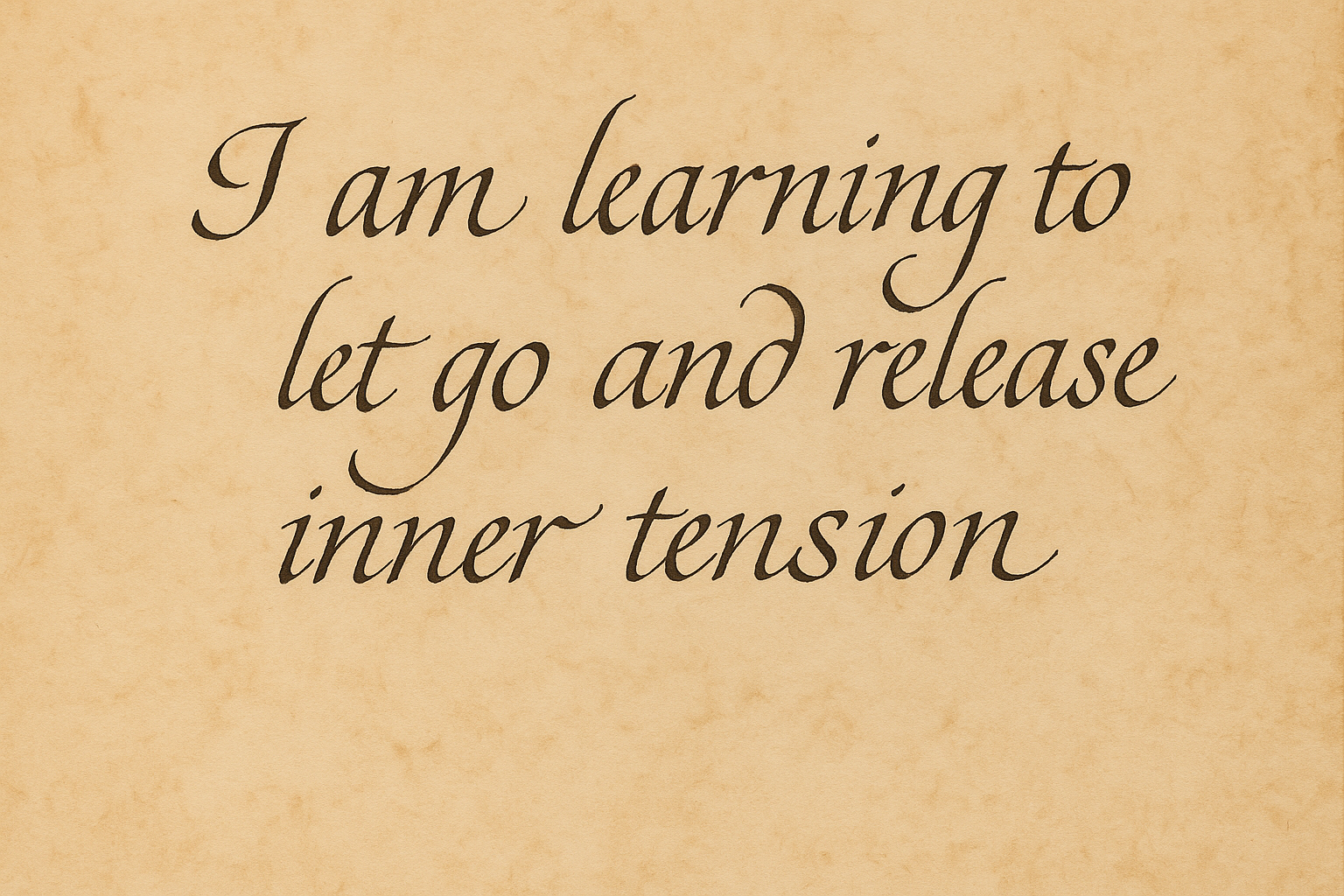
○ Medieval Gothic calligraphy: “I slow down to see clearly.”
The sense of boundary and structure in Gothic architecture is very suitable for regulating the "sense of internal order" when one is overly alert.
- English sentences:I slowed down to see clearly.
- Chinese equivalent:I slowed down so I could see clearly.
- Writing Tips:Inhale when writing vertical lines, allowing the lines to land steadily downwards; exhale when writing horizontal lines, slowing down your strokes. Writing itself is a way to reduce nervous excitement.
Lesson 1114: Anxiety and Hypervigilance - Guided Mandala Viewing
Purpose:Soothe internal chaos and overscanning by observing "order".
Find a mandala image with regular lines and a slow rhythm. Fix your gaze on the center for 10 seconds, then move your gaze along the outer circle of the first layer, observing whether the shapes have a repeating rhythm. Then move to the second layer, the third layer—let your eyes guide your brain to "see order," rather than constantly searching for threats.
Mandalas are not about drawing anything, but about observing—observing how the patterns repeat smoothly, allowing the alert system to learn to "follow the rhythm" instead of jumping around on its own. The process of observing itself is a form of regulation.
Please log in before submitting your drawings and feelings.
○ 1114. Anxiety and Hypervigilance: Journaling Guidance Suggestions
① Write down the situation in which you last experienced a noticeable "sudden tension".
② Write down the position where your body first "jumped" at that moment.
③ Write a true statement about your anxiety, starting with "I get nervous when I am anxious because...".
④ Write down a sentence you would like to use to comfort yourself, starting with "I'm willing to go slower..."
⑤ Write down one "anti-alertness action" you would like to try today: take three deep breaths, drink warm water, walk slowly for two minutes, and close your eyes and listen to sounds.
⑥ Finally, write: "My alertness is slowing down, and I am watching it."“
Please log in to use.
Being overly vigilant is not your fault; it's your body trying its best to protect you. May you gradually return to your own pace as you observe the light and rhythm.