

Lesson 1432: The Difference Between Health Anxiety and Somatic Symptom Disorders
Duration:60 minutes
Topic Introduction:
This lesson focuses on the core differences between "health anxiety" and "somatic symptom disorder," helping you understand why seemingly similar worries stem from different psychological mechanisms. Many people, when experiencing physical discomfort such as palpitations, chest tightness, dizziness, tingling, bloating, or fatigue, immediately associate it with illness, leading to high levels of anxiety, repeated medical visits, constant information searches, or various medical examinations. However, the two focus on different aspects—
**Health anxiety focuses more on the "possibility of getting sick": fearing that serious illness will occur in the future, even if the physical symptoms are mild, they will be magnified in the imagination.
**Somatic symptom disorder focuses more on "the physical discomfort itself": the symptoms are real, obvious, and accompanied by persistent distress, but the interpretation is often reinforced by anxiety, misunderstanding, and catastrophizing.
This lesson will help you distinguish between the two in terms of "thinking logic, focus of attention, behavioral patterns and physical experience", so that you will no longer attribute all discomfort to "early signs of serious illness" and rebuild a healthy physical and mental framework.
○ Health Anxiety vs. Somatic Symptom Disorder: Four Major Differences
- Different focuses:Health anxiety stems from worrying about "getting sick in the future"; somatic symptoms disorder is a source of "current discomfort".
- Symptoms vary in intensity:Symptoms of health anxiety can range from mild to severe; symptoms of somatic symptom disorder are more real and obvious.
- Different behavioral patterns:The former repeatedly seeks verification; the latter tends to avoid, be tense, and become overly sensitive.
- Different emotional experiences:Health anxiety focuses on the "unknown," while somatic symptom disorder focuses on the "discomfort."
[arttao_Healing_Course_tts_group1426_1431]
▲ AI Interaction: Which type are you?
Question 1: Are you more afraid of "current discomfort" or "future illness"?
Question 2: What do you most often ask others to confirm?
Question 3: When discomfort occurs, are you more inclined to avoid it, become anxious, or constantly seek confirmation?
○ Music-guided approach to loosen the circuit of over-focus.
In the cycle of anxiety and amplified symptoms, music can be the first force to "break the chain".
Choose a stable, gentle, and reassuring melody to allow your breath and mind to relax first.
Once the body is relaxed, thoughts and fears will no longer hold on tightly.
○ Eastern Healing Tea - Shengmai Sanwei Ningxin Tea
effect:Composed of Ophiopogon japonicus, ginseng, and Schisandra chinensis, this formula invigorates qi and calms the mind, making it suitable for symptoms such as palpitations, fatigue, decreased concentration, and chest tightness caused by anxiety.
○ Healing Soup: White Hyacinth Bean and Poria Cocos Spleen-Strengthening Soup
When one is in a state of prolonged anxiety and constant monitoring of their body, the function of the spleen and stomach is prone to decline, making symptoms more pronounced.
Soups that strengthen the spleen and replenish qi can enhance digestion and basic physical fitness, reducing the likelihood of aggravated discomfort.
To make the body more stable, thereby reducing the fear of disease.
Improve fatigue
Reduce sensitivity
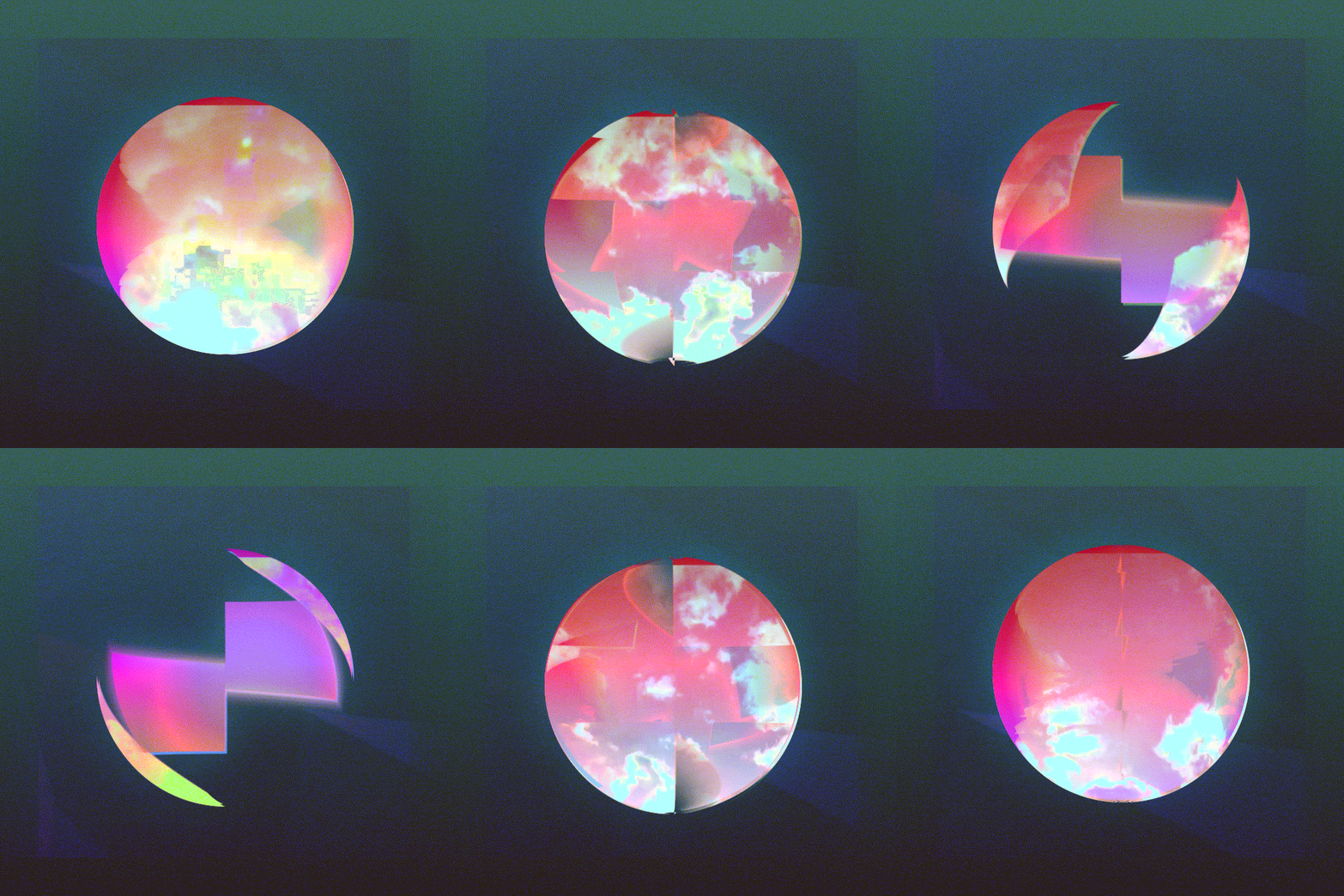
○ Mandala Viewing: The Dividing Line Between Observation, Feeling, and Imagination
A mandala is not about drawing something, but about observing it.
The inner circle symbolizes "the true physical sensations of this moment";
The outer ring symbolizes "imagination of future diseases".
During the viewing process, you will discover:
There is only one kind of feeling, but imagination can expand infinitely.
Viewing a mandala helps you refocus your attention on "reality".
Let your imagination no longer overwhelm you.
○ Chinese Calligraphy - Regular Script Practice: The Return of Stability
Regular script, with its stable structure and distinct rhythm, is the best exercise for slowing down both the mind and body.
When you write sentences stroke by stroke, the brain's stress circuits are reorganized.
You will rediscover a sense of control.
Practice sentences:“"The truth is more important than imagination."”
○ A Dual-Track Chart of Feeling and Imagination: Art Therapy
Through visual means, you can see that the "true intensity of symptoms" and the "imagined disaster" are actually two different tracks.
1. Draw two parallel tracks.
- Write "My real feelings" for the first item; write "Imagine a disaster" for the second item.
- Mark your recent symptoms and thoughts, and observe whether they are moving in different directions.
II. Mark "The method that allows me to return to the real world"“
- For example: tactile exercises, breathing, ground sense, body scan.
- Let the image become a map that "returns from imagination to feeling".
The better you can distinguish between reality and imagination, the more your body will regain stability.
Please log in before submitting your drawings and feelings.
○ 1432. The Difference Between Health Anxiety and Somatic Symptom Disorders · Journal Guidance
① Write down the symptoms that you are most worried about recently.
② Determine whether it belongs to "real feelings" or "future imagination".
③ Write a calming sentence: "I am returning to reality."“
Please log in to use.
When you can distinguish between "reality" and "imagination," the tension in your body will gradually ease, and life will become lighter again.