

Lesson 1578: Exercises on Emotion Regulation and Stress Management
Duration:70 minutes
Topic Introduction: This course focuses on "Emotion Regulation and Stress Management," helping you understand that gambling is often not simply a matter of greed, but rather an outlet for long-term stress, feelings of powerlessness, shame, and emptiness. When your heart is filled with tension, anxiety, loneliness, and a sense of failure, yet these feelings remain unseen and unaddressed, gambling acts like an immediate painkiller, allowing you to temporarily forget your predicament, only to bring deeper self-blame and loss afterward. This course will guide you through identifying your common sources of stress, recognizing bodily signals and emotional patterns under high pressure, and practicing simple yet structured regulation tools such as breathing exercises, muscle relaxation, emotion naming, and self-soothing phrases. We won't ask you to "become instantly calm," but rather train you to be more aware and selective when emotional fluctuations are just beginning, allowing stress to be digested in stages rather than erupting all at once through gambling. The goal is to establish your own "emotional cooling and stress diversion system," so that even when reality is still imperfect, you can stop harming yourself through gambling.
○ The key role of emotion regulation and stress management in gambling recovery
- Identifying the Emotion-Behavior Chain:Work backwards from "I went gambling" to find the source of the emotions and stress that preceded it.
- Body signals as early warning:A rapid heartbeat, stiff neck and shoulders, a tight stomach, and shallow breathing are all signs that you need to cool down.
- Emotion Naming and Permission:Change "annoyed", "bored", and "chaotic" into more specific words, such as "disappointed", "ashamed", and "ignored".
- Pressure segmentation processing:Break down the idea that "all problems are bad" into smaller pieces and decide which ones you can do a little bit of today.
- Alternative adjustment toolbox:Prepare a set of stable, non-gambling tools, such as breathing, walking, writing, hot baths, music, and tea.
▲ AI Interaction: Designing an "Alternative Outlet" for Emotions and Stress“
Many people relapse not because they "want to win big money," but because they "can't stand how they feel now." Without a new outlet, old habits will automatically reactivate in the brain.
Please first write down the three most distressing emotions you have experienced recently (such as shame, loneliness, and helplessness) and the three main sources of stress (such as debt, strained relationships, and job instability). Just use keywords.
Then, send this content to the AI and ask it to help you find three non-gambling alternative outlets for each emotion and stress, such as: calling someone, doing ten minutes of breathing and stretching, writing an honest page in a journal, drinking a calming cup of healing tea, or watching a mandala.
Finally, choose two or three exercises that you are truly willing to try, write them down on a "Mood and Stress Management Card," and stick it in your phone's notes or wallet.
Click the button below to work with AI to find a gentle outlet for your emotions and stress, instead of being repeatedly pushed back down the path of gambling.
○ Emotional Regulation and Stress Management: Music Therapy
Choose a slow, steady instrumental piece, such as piano or strings. There's no need for a climax; just breathe in and out like a gentle breath. One minute before the music starts, take three deep, slow breaths: inhale, count to four, hold for two beats, and exhale, count to six.
Next, shift your attention to your body, scanning from your scalp to your toes segment by segment, gently noticing where you feel tightness, soreness, heat, or discomfort. Don't rush to change it; just acknowledge, "I am indeed very tired and tense."
In the middle of the music, write down a sentence about your strongest emotion today, such as "I'm actually very afraid of failing again." Then, on the next line, add a comforting sentence: "Even now, I still deserve to be treated well."“
When the music ends, fold the paper and put it away. Let this short exercise become a small "cooling-off station" in the day, reminding yourself: I can cope with stress in other ways, instead of just gambling.
○ Oriental healing tea
Recommended drinks:Chrysanthemum & Goji Relax Tea
Recommended reasons:Chrysanthemum clears the liver and improves eyesight, relieving head tension, while goji berries nourish the liver and kidneys and alleviate fatigue. For those experiencing irritability, dry eyes, and headaches due to long-term stress and staying up late, this gentle herbal tea provides a cooling effect on both the body and emotions.
usage:Take 3 dried chrysanthemums and 5-8 goji berries, gently rinse them with warm water, then steep them in 80-90℃ hot water for 5 minutes before drinking. You can link this daily tea-drinking time with a short breathing or writing exercise to create a stable mood-regulating ritual.
○ Greek-Mediterranean Diet: Olive Oil and Herb Roasted Vegetables with Chickpeas Platter
Featuring bell peppers, zucchini, eggplant, and onions, this dish is drizzled with cold-pressed olive oil, lemon juice, and rosemary and thyme, and topped with cooked chickpeas lightly seasoned with salt. The high fiber, healthy fats, and plant-based protein help stabilize blood sugar and promote satiety, reducing irritability and impulsivity caused by hunger and blood sugar fluctuations. Incorporating this simple, refreshing Mediterranean-style meal into your routine during times of stress provides your body with a stable source of energy, indirectly supporting mood regulation.
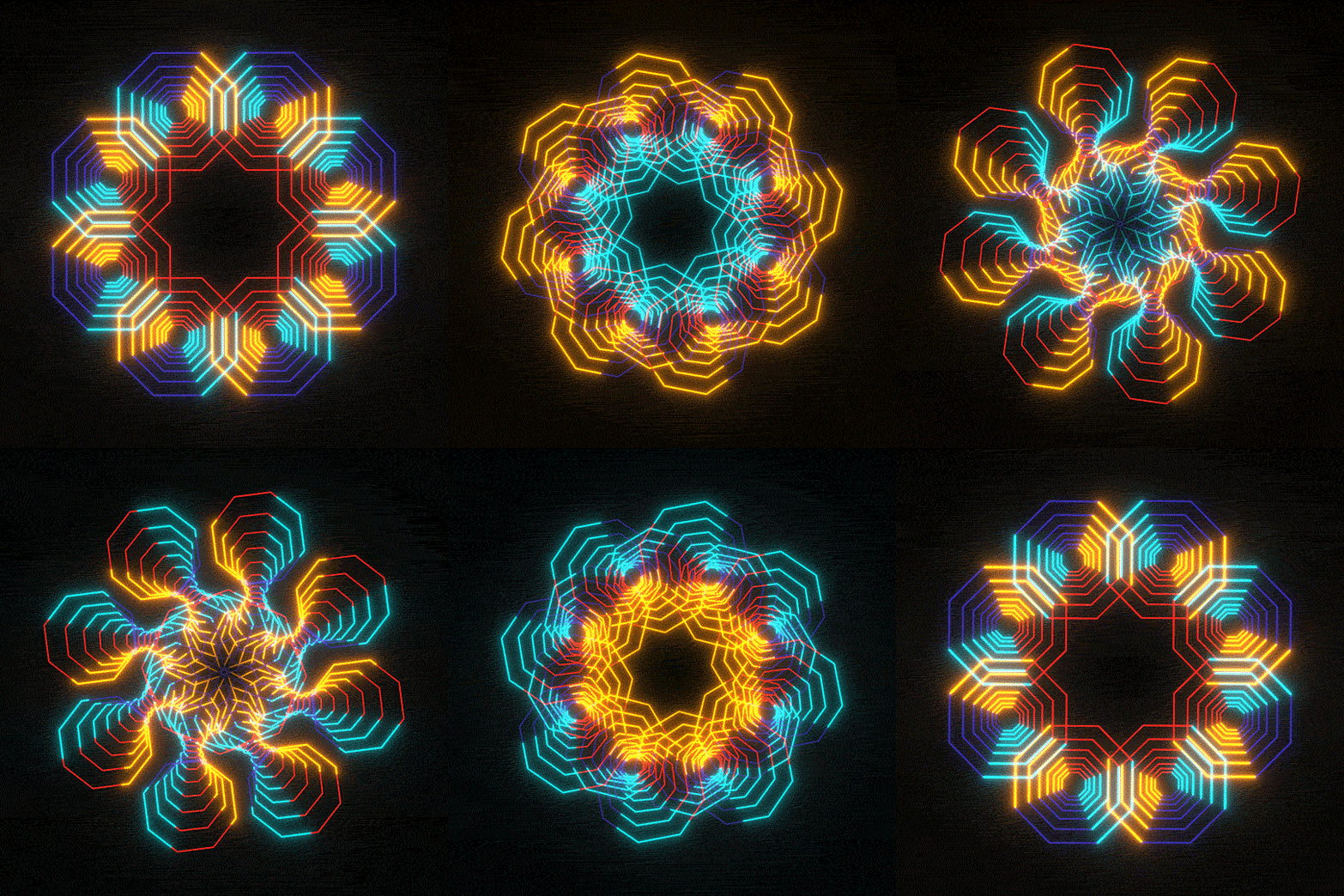
○ Free Mandala Healing: Allow emotions to settle gradually through observation.
Image Healing: Free Mandala Stability Guidance
Please choose a mandala with clear layers and rhythmic repetition of lines. Simply observe it quietly; there is no need to interpret its meaning.
Mandala drawing isn't about what you draw, but about what you observe. When you feel stressed or agitated, temporarily step away from the screen and gambling-related information, focus your gaze on the center of the mandala, and slowly expand your gaze outwards along the lines, then return to the center from the outer edge. Notice how your breathing gradually stabilizes as you observe. You don't need to force yourself to "calm down quickly," just allow your emotions a chance to slow down while observing.
If you wish, you can silently repeat to yourself before watching: "I am under a lot of pressure right now, but I am willing to take a break." Over time, the mandala will become a small transition space for you during high-pressure moments, helping you to restrain your impulses and give your rationality some time to catch up.
○ Suggestions for practicing Roman script
In this lesson, ancient Roman script symbolizes an ability to "carry emotions within structure": the lines are dignified and the proportions are stable, yet it allows inner emotions to flow slowly between the lines.
- Writing words:
Latin:Tranquillitas(Tranquility, peace)
Meaning in Chinese: A heart that can still find peace amidst turmoil. - Psychological Intention:
The thrill of gambling often masks inner anxiety and emptiness. When writing "Tranquillitas," remind yourself: what I truly desire is not how much I win, but inner peace. Writing practice is a small step towards this peace. - Writing method:
Draw the baseline and top edge on the paper, and slowly write each letter, paying attention to making the vertical strokes slightly thicker and the horizontal strokes slightly thinner, maintaining a neat structure. After writing each letter, pause twice to feel the changes in your hand muscles and breathing. - Emotional transformation:
When you feel overwhelmed by stress and want to "escape" for a while by gambling, tell yourself, "Write Tranquillitas three times before deciding on the next step." Let the act of writing be a small buffer, leaving your emotions on paper instead of bringing them into the casino or betting software.
○ Emotion Regulation and Stress Management Exercises: Guiding Suggestions for Art Therapy
This page uses drawing to remove the "suffocating emotions and pressure" from my body and rearrange them on paper. Drawing is for self-awareness and organization only and does not replace medical, legal, or financial professional services.
1. "Emotional Storm Radar Chart"“
- Draw a small circle in the center of the paper and write "Me today".
- Draw several rays outwards, each representing an emotion (such as anger, sadness, shame, anxiety, emptiness), and draw a small circle at the end of each ray and write its name on it.
- Use different thicknesses or lengths to represent intensity: the thicker and longer, the stronger. You can draw while telling yourself, "No wonder I wanted to run away so much, it's like a lot of forces are pressing down on me at once."“
II. "Pressure Piping and Outlet Diagram"“
- Draw several entrances on one side of the paper and write down the main sources of stress for each: money, relationships, work, health, family, etc.
- Let these entry points converge into a thick pipe, and label the middle of the pipe "Body and Emotions," writing down the physical symptoms and thoughts you often experience.
- Draw two exits at the end of the pipe: one leading to "gambling," and the other to an "alternative exit" (such as rest, exercise, writing, seeking help, healing tea, or mandalas). Emphasize with color that you are practicing directing stress towards the latter.
Note: Emotions and stress won't disappear just because you "understand the reasons"; they need to be recognized, transformed, and settled. If you feel you can no longer bear it, or have suicidal thoughts, please contact your local professional addiction treatment center or emergency resources as soon as possible.
Please log in before submitting your drawings and feelings.
○ 1578. Emotion Regulation and Stress Management Exercises: Journaling Guidance Suggestions
① At what moment today did you most want to escape your current life? Please write down what happened at that moment and how your body felt.
② Name the dominant emotion of that moment (such as shame, loss, anger, loneliness), and write a sentence about your understanding of yourself, rather than blaming yourself.
③ Record any gentle conditioning exercise you did for yourself today: breathing, walking, listening to music, writing, drinking tea, viewing mandalas, etc.
④ At the end of the diary, write a supportive reminder: "When I am willing to learn to adjust instead of numbing myself with gambling, I am already moving towards a different life."“
Please log in to use.
Emotions and stress won't disappear overnight, but you can gradually learn to live with them and stop pushing yourself into the abyss of gambling. May this set of exercises help you slowly accumulate a true sense of security.